Abstract
Redundant Array of Inexpensive Disks (RAID) combines multiple physical storage drives into a single logical storage unit managed by the operating system or dedicated hardware controllers. RAID architectures leverage data striping, mirroring, or bitwise parity to achieve higher I/O throughput, increased storage capacity, and fault tolerance against drive failure.
- Category: Distributed Storage & Reliability
- Core Objectives: High throughput, increased capacity, and fault recovery.
- Mathematical Foundation: Bitwise XOR () parity calculations.
RAID Level 0: Striping (Performance)
RAID 0 splits data sequentially into blocks and stripes them round-robin across physical drives:
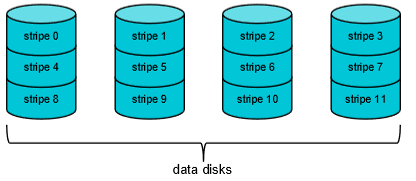
- Read / Write Throughput: Multiplied by up to times through parallel drive access.
- Storage Efficiency: ( disks provide ).
- Fault Tolerance: Zero (). If a single drive fails, the entire array’s data is lost.
RAID Level 1: Mirroring (Redundancy)
RAID 1 maintains identical copies of all data on secondary mirror drives:
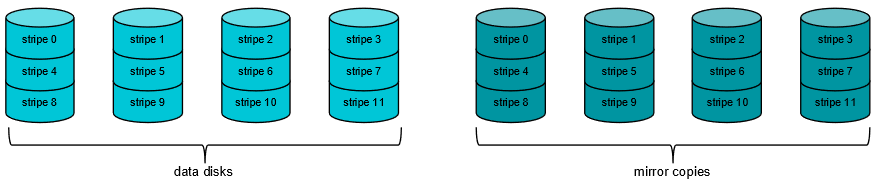
- Read Throughput: Enhanced; reads can be serviced in parallel from either drive.
- Write Throughput: Slightly constrained; writes must update both physical disks simultaneously.
- Storage Efficiency: ( disks yield ).
- Fault Tolerance: High; survives the complete failure of any single drive in a mirrored pair.
RAID Level 4: Dedicated Parity Disk (XOR Reconstruction)
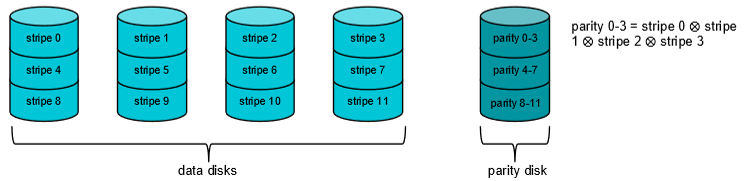
RAID 4 stores data blocks striped across data drives while dedicating a single disk exclusively to store bitwise Parity ():
Bitwise Parity Mathematics
Parity is calculated by evaluating the bitwise XOR () across matching blocks on all data disks:
By definition of XOR arithmetic, combining all data blocks and the parity block yields zero:
Fault Recovery Walkthrough
If Disk fails physically, its data is reconstructed by XORing the surviving data disks together with the parity disk:
graph TD
    D0["Disk A (Alive)"] --> XOR["Bitwise XOR Engine"]
    D1["Disk B (Alive)"] --> XOR
    D3["Disk D (Alive)"] --> XOR
    DP["Disk P (Parity Alive)"] --> XOR
    XOR --> Rec["Reconstructed Disk C"]
Performance Bottleneck: The Parity Write Penalty
Because every write operation to any data disk requires updating the dedicated parity disk, the parity drive becomes a severe bottleneck under concurrent write workloads. Modern systems use RAID 5 (Distributed Parity) to rotate parity blocks evenly across all drives.
RAID Level Trade-Off Summary
| RAID Level | Structural Pattern | Minimal Disks | Capacity Utilization | Fault Tolerance | Primary Use Case |
|---|---|---|---|---|---|
| RAID 0 | Striping | 2 | () | None (0 drive failures) | High-performance scratch storage |
| RAID 1 | Mirroring | 2 | () | 1 drive per mirrored pair | Mission-critical OS boot drives |
| RAID 4 | Dedicated Parity | 3 | 1 drive failure | Read-heavy redundant arrays |