Abstract
The File System Layout dictates how logical files and directories are mapped onto physical storage blocks via the hardware Block Interface. Because real-world workloads feature extreme size non-uniformity (most files are small, but most storage capacity is consumed by a few large files), file systems employ distinct Block Allocation Strategies—Contiguous, Linked, Indexed, and Multi-Level Indexed—to balance sequential throughput, random access speed, and dynamic growth.
File System Abstraction Boundaries & Workload Motivations
File systems operate between two primary interfaces:
graph TD
    App["Application Layer"] -->|"Files & Directories API<br/>(Named bytes)"| OS["Operating System Kernel"]
    OS -->|"Block Interface API<br/>(Logical Block Addressing)"| Hardware["Physical Storage Hardware"]
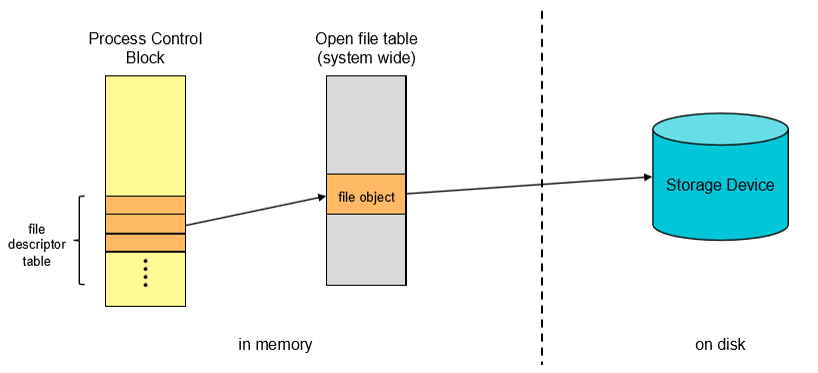
Typical File System Data Structures
Design Challenges
- Dynamic File Sizing: File sizes span 6 to 8 orders of magnitude.
- Hardware Non-Uniformity: Physical disk latency varies significantly based on seek and rotational delays.
- System Reliability: Preserving metadata integrity and file contents across sudden system crashes.
Workload Characteristics (UNIX / Windows NT Measurements)
- File Size Non-Uniformity: Most files are small (), but of total disk space is occupied by the top of large files.
- Spatial Locality: Files located within the same directory are frequently accessed together.
- Metadata Locality: File metadata (permissions, size, block pointers) must be accessed simultaneously with file data.
File System Block Partitioning
The operating system divides physical disk space into fixed-size File System Blocks (typically ):
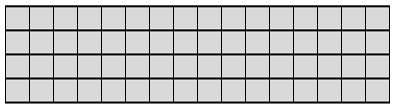
- Block Formatting: Block size is configured when formatting the file system and operates independently of physical disk sector sizes (e.g., a sector yields 8 sectors per block).
- Allocation Rules: Large files span multiple contiguous or scattered blocks (e.g., a file occupies 10 blocks). Small files smaller than still consume an entire physical block.
Block Allocation Strategies
1. Contiguous Allocation Layout
Allocates a continuous range of adjacent physical blocks to each file.
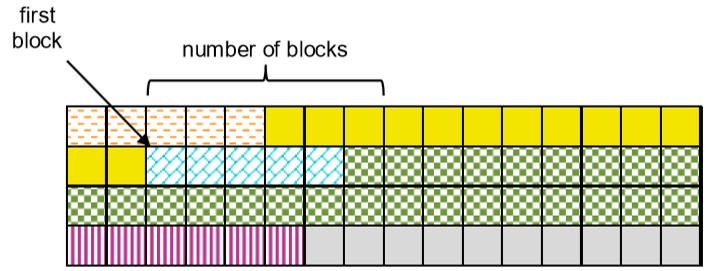
- Metadata: Location of the first block on disk + total block count.
- Pros: High sequential bandwidth; fast random access; minimal physical actuator seeks.
- Cons: Inflexible file growth; severe external fragmentation requiring disk compaction.
2. Linked Allocation Layout
Stores blocks as a linked list on disk, where each block holds data and a pointer to the next block.
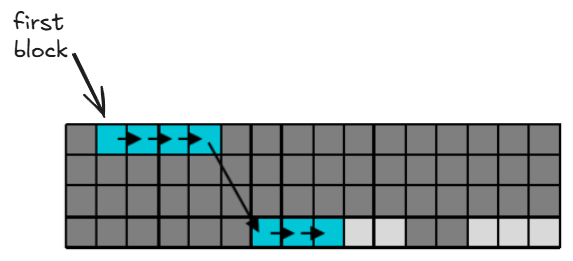
- Metadata: Pointer to the first physical block.
- Pros: Dynamic file growth; zero external fragmentation.
- Cons: Extremely slow random access ( block traversal); poor sequential bandwidth; high vulnerability (a single corrupted block loses the entire remaining file chain).
3. Indexed Allocation Layout
Uses a dedicated Index Block containing an array of direct pointers to physical data blocks.
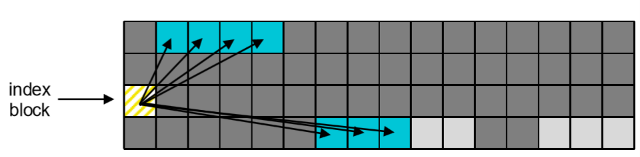
- Metadata: Disk address of the Index Block.
- Pros: Fast random access; dynamic file growth; zero external fragmentation.
- Cons: Fixed index block capacity limits maximum file size; potential seek overhead if data blocks are scattered.
4. Multi-Level Indexed Layout
Extends indexed allocation by storing direct pointers alongside single, double, or triple Indirect Blocks pointing to additional index structures.
This layout format is the implementation of the file system today, more information here
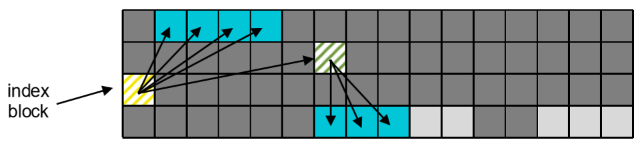
- Metadata: Disk address of the root Index Block containing direct and indirect block pointers.
- Pros: Accommodates massive files dynamically while maintaining fast access for small files.
- Cons: Upper ceiling on maximum file size still exists; multi-level pointer traversals add read indirection overhead.
Allocation Strategy Trade-Off Summary
| Allocation Strategy | Sequential Access Speed | Random Access Speed | Dynamic File Growth | Fragmentation Profile |
|---|---|---|---|---|
| Contiguous | Fast | Fast | Inflexible | External Fragmentation |
| Linked | Slow | Very Slow () | Dynamic | Zero External Fragmentation |
| Indexed | Moderate | Fast | Dynamic | Wasted Space on Small Files |
| Multi-Level Indexed | Moderate / Fast | Fast | Dynamic (Massive Files) | Minimal Overhead for Small Files |