Abstract
Because page tables are too large to fit inside MMU registers, they are stored in physical RAM. The hardware points to the root table using a dedicated register (e.g.,
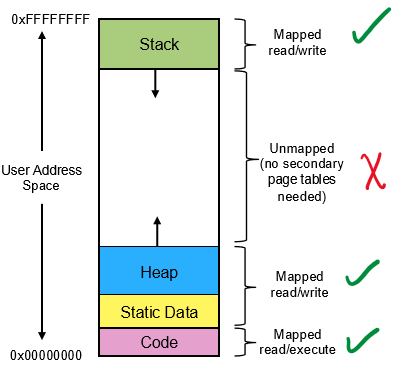
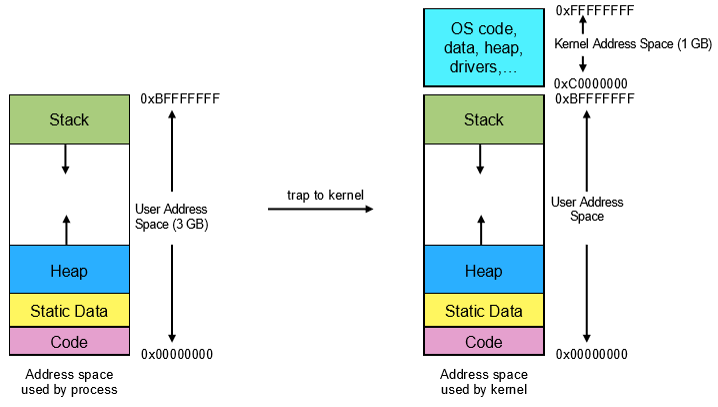
CR3on x86). To ensure fast, safe execution during system calls, the operating system kernel maps its own Kernel Address Space into the upper region of every process’s Virtual Address Space.
- Category: Kernel Memory Architecture
- Key Control Hardware: Top-level Page Table Base Register (
CR3in x86).- Security Mechanism: Kernel Page Table Isolation (KPTI).
Storing & Addressing Page Tables
Page tables reside in main memory (RAM). Schedulers configure page tables using two primary architectural approaches:
graph TD
    Root["<b>Page Table Memory Storage</b>"]

    Root --> Phys["<b>Stored in Physical Memory</b><br/>• Directly accessed via physical RAM pointers<br/>• No recursive address translation required"]
    Root --> Virt["<b>Stored in Virtual Memory</b><br/>• Allows page table pages to be swapped to disk<br/>• Requires non-paged root page table"]
- Physical Memory Storage: The MMU dereferences physical pointers directly. No translation is needed to look up page tables.
- Virtual Memory Storage: Page tables reside within kernel virtual memory. Unused secondary page tables can be swapped to disk when physical RAM is low. To prevent infinite translation loops, the outermost root page directory is pinned permanently in physical RAM.
Page Table Base Registers
The CPU maintains a specialized control register that holds the physical address of the active process’s top-level page table (e.g., CR3 on x86 architectures):
When performing a context switch, the OS kernel updates CR3 to point to the incoming process’s page directory. A single write to CR3 instantly alters the active virtual memory mapping.
The Kernel Address Space Split
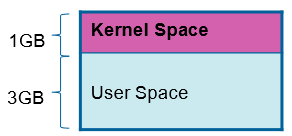
To handle interrupts, hardware exceptions, and system calls efficiently, the operating system kernel maps itself into the upper address range of every process’s virtual address space:
flowchart TD
    TITLE["<b>PROCESS VIRTUAL ADDRESS SPACE</b>"]
    KERNEL["<b>TOP PORTION: Kernel / OS Memory Space</b><br/>• Mapped identically across ALL processes<br/>• Protected by Supervisor / Kernel privilege bits (User Access = No)"]
    USER["<b>BOTTOM PORTION: User-Level Application Space</b><br/>• Code, Static Data, Heap, and Stack<br/>• Unique to each individual process"]

    TITLE --- KERNEL --- USER
Privileged Enforcement
- User Mode Execution: The process can access only the bottom user-level portion. Attempts to access upper kernel addresses trigger a hardware protection fault.
- Kernel Mode Execution: When a system call or interrupt traps into Kernel Mode, the CPU gains permission to access the upper kernel addresses directly without performing an expensive context switch or swapping page tables.
Context Switches & Kernel Page Table Isolation (KPTI)
During a standard context switch between Process A and Process B, only the lower (user-level) page table mappings change. The upper (kernel-level) mappings remain identical.
Kernel Page Table Isolation (KPTI)
To mitigate speculative execution side-channel attacks (such as Meltdown), modern operating systems utilize Kernel Page Table Isolation (KPTI). KPTI maintains two sets of page tables for each process:
- User-Space Page Table: Maps user memory and a minimal set of kernel entry trampolines.
- Kernel-Space Page Table: Maps the complete address space (User + Kernel).
Trapping into the kernel switches
CR3to the kernel-space page table, preventing speculative user-mode reads of kernel memory.