Abstract
A Deadlock is an execution state where a set of threads is permanently stalled because every thread is waiting for a resource held by another thread in the set. Deadlocks can exist if and only if four necessary and sufficient hardware/software conditions (the Coffman Conditions) hold simultaneously: Mutual Exclusion, Hold and Wait, No Preemption, and Circular Wait.
- Category: Concurrency Failures & Formal Modeling
- Classic Analogy: The Dining Philosophers Problem (Dijkstra, 1971).
- Modeling Primitive: Resource Allocation Graph (RAG).
The Dining Philosophers Problem
Introduced by Edsger Dijkstra in 1971, the Dining Philosophers Problem illustrates how competing for limited, shared resources leads to deadlock.
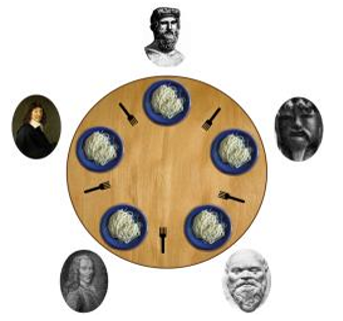
- Five philosophers sit around a table with 5 forks.
- Each philosopher alternates between Thinking and Eating.
- To eat, a philosopher must acquire two adjacent forks (one at a time).
The Deadlock Scenario
If all 5 philosophers become hungry simultaneously and every philosopher picks up their right fork at the exact same instant, all 5 forks are held. When each philosopher attempts to pick up their left fork, they wait forever Deadlock.
Formal Deadlock Definition
Deadlock Definition: Deadlock exists among a set of threads if every thread in the set is waiting for an event that can be caused only by another thread in that set.
Deadlock causes permanent execution starvation, requiring external intervention (such as process termination or system reboot) to resolve.
The Four Coffman Conditions
Deadlock can arise if and only if the following four conditions hold simultaneously within the system:
- Mutual Exclusion: At least one resource must be held in a non-sharable mode (only one thread can use the resource at a time).
- Hold and Wait: A thread holding at least one resource can request additional resources currently being held by other threads without releasing its existing resources.
- No Preemption: Resources cannot be forcibly taken away from a thread; they can only be released voluntarily by the thread after it has completed its task.
- Circular Wait: A closed chain of threads exists () such that waits for a resource held by , waits for , and waits for .
Breaking Deadlock
Eliminating at least one of these four conditions guarantees that deadlock cannot occur.
Resource Allocation Graphs (RAG)
Deadlocks can be represented visually using a directed graph called a Resource Allocation Graph (RAG):
- Nodes:
- Threads (): Represented as circles.
- Resources (): Represented as squares (dots inside represent resource unit counts).
- Edges:
- Assignment Edge (): Resource is currently held by Thread .
- Request Edge (): Thread is currently blocked waiting for Resource .
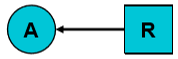 (Thread A holds Resource R)
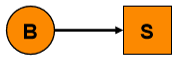 (Thread B requests Resource S)
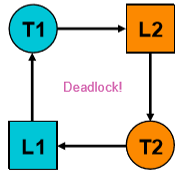 (Thread 1 and Thread 2 request each other’s locks)
Cycle Analysis Rules
| Resource Instances per Type | Graph Cycle Status | Deadlock Status |
|---|---|---|
| Single-Unit Resources (1 instance per type) | Cycle Detected | DEADLOCK EXISTS |
| Single-Unit Resources | No Cycle | No Deadlock |
| Multi-Unit Resources ( instances) | Cycle Detected | DEADLOCK MAY EXIST (Requires matrix reduction) |