Abstract
Multipliers and Dividers execute multi-cycle or high-density combinational arithmetic in modern ALUs. Binary multiplication computes the sum of shifted partial products generated by bitwise AND operations, implemented in hardware via dense Array Multipliers using arrays of AND gates, Half Adders, and Full Adders. Binary division operates as the inverse process through iterative repeated subtraction, requiring dedicated subtractors, adders, and comparators to compute the Quotient and Remainder.
Binary Multiplication Principles
Multiplying an -bit multiplicand by an -bit multiplier yields a product up to bits wide:
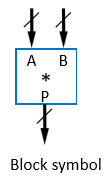
N-Bit x M-Bit Multiplier Block Symbol
Long Multiplication by Hand
In binary, generating a partial product bit is equivalent to a logical AND operation:
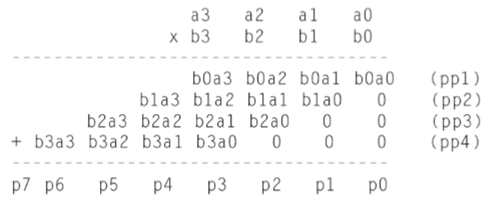
Generalized Partial Product Generation for 4-Bit Multiplication
Array Multiplier Hardware Architecture
An Array Multiplier computes all partial products in parallel using an array of AND gates, then sums the shifted partial product columns using a grid matrix of Half Adders (HA) and Full Adders (FA).
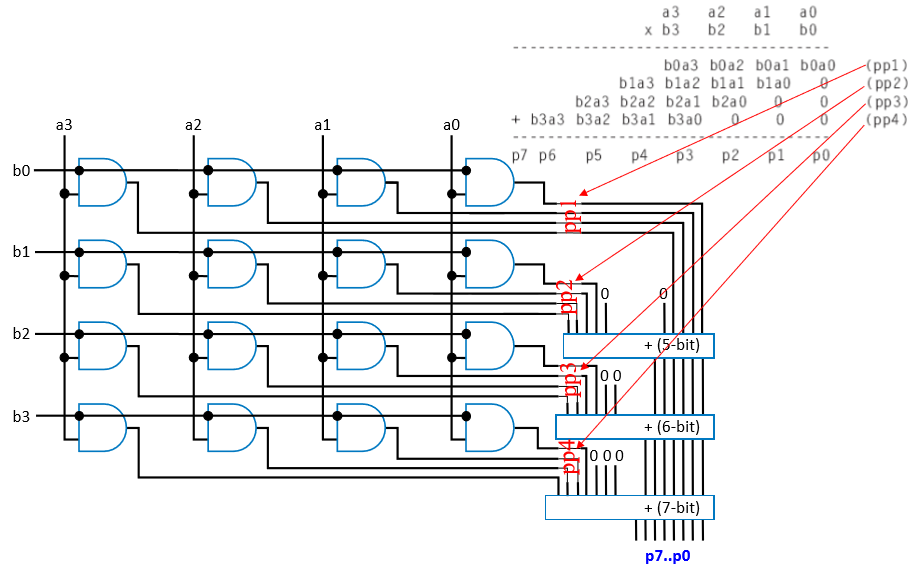
4x4 Combinational Array Multiplier Architecture
Structural Components
- Partial Product Generator: An array of AND gates generating every single-bit term .
- Adder Reduction Matrix:
- Half Adders: Used at column boundaries where only two bits are added.
- Full Adders: Used in intermediate array cells to sum three bits (partial product bit, sum bit from upper row, carry bit from adjacent cell).
- Final Vector Adder: A bottom-row Ripple-Carry or Carry-Lookahead Adder to compute the final high-order product bits.
Array Performance Characteristics
While combinational array multipliers offer fast execution, hardware area grows quadratically as gates, and propagation delay scales as along the worst-case diagonal carry-propagation path.
Binary Division & Repeated Subtraction
Division of unsigned positive binary numbers divides a Dividend by a Divisor to calculate a Quotient and a Remainder:
Iterative Repeated Subtraction Algorithm
The basic hardware approach iteratively subtracts the divisor from the dividend while incrementing a quotient counter until the remaining dividend is strictly less than the divisor.
flowchart TD
    Start(["Start: Dividend, Divisor"]) --> Init["Set Quotient = 0<br>Remainder = Dividend"]
    Init --> Check{"Remainder ≥ Divisor?"}
    Check -- Yes --> Sub["Remainder = Remainder - Divisor<br>Quotient = Quotient + 1"]
    Sub --> Check
    Check -- No --> End(["Final Quotient & Remainder Found"])
Hardware Resource Requirements
Executing binary division via repeated subtraction requires three core hardware blocks:
- Subtractors (2 Units / Operations): One adder/subtractor to subtract the divisor from the dividend (), and one adder to increment the quotient register ().
- Magnitude Comparator (1 Unit): A less-than / greater-than comparator block to evaluate the termination condition ().