Abstract
While single-threaded programs execute deterministically, multi-threaded programs running on shared state are subject to arbitrary instruction interleavings driven by the OS scheduler. A Race Condition occurs when the final outcome of execution depends on the exact order or timing of thread instruction execution, leading to silent data corruption and non-deterministic bugs.
- Category: Concurrency Pitfalls & Memory Architecture
- Primary Trigger: Unsynchronized concurrent reads/writes to shared memory.
- Key Invariant: Local thread stacks are private, but global variables, static objects, and heap allocations are shared across all threads.
The Problem with Concurrency
In a single-threaded program, execution is strictly deterministic: given the same input, instructions execute sequentially, producing identical results every time.
In a multithreaded program, thread execution is interleaved arbitrarily at runtime based on timer interrupts and CPU scheduling decisions.
Case Study: Unsynchronized Bank Withdrawals
Consider two concurrent threads attempting to withdraw $100 simultaneously from a shared bank account holding $500:
void withdraw(Account* account, int amount) {
    int balance = get_balance(account);
    balance = balance - amount;
    put_balance(account, balance);
    return balance;
}
If the CPU context switches between Thread 1 and Thread 2 midway through the function:
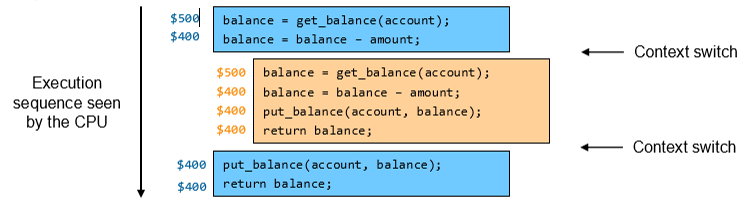
- Expected Result: \300$500 - $100 - $100$).
- Actual Result: $400 remaining. Thread 1 overwrote Thread 2’s update because its execution was interleaved on an stale read.
Race Conditions Defined
A Race Condition is a flaw in a concurrent system where the output is wildly sensitive to the relative timing or execution order of threads.
- Non-Determinism: The exact same program with identical inputs can produce correct results on one run and corrupt memory on the next, depending on microsecond timing variations.
- Arbitrary Interleaving: Programmers do not control when the kernel timer interrupt fires to trigger a context switch. Interleaving can occur at the individual machine instruction level.
Which Memory Resources Are Shared?
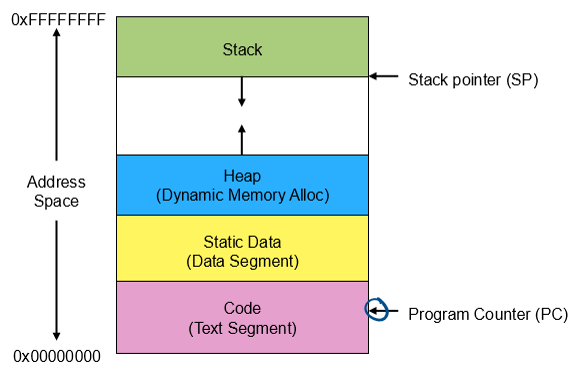
To identify race conditions, engineers must distinguish thread-private memory from thread-shared memory:
| Memory Region | Shared Across Threads? | Safety Profile |
|---|---|---|
| Local Stack Variables | No (Thread-Private) | Safe. Each thread has its own SP and stack frame. Never pass/store pointers to stack variables across threads! |
| Global & Static Variables | Yes (Thread-Shared) | Unsafe. Reside in the shared Data/BSS segment; accessible by any thread. |
Heap Memory (malloc / new) | Yes (Thread-Shared) | Unsafe. Dynamic objects are reachable by any thread holding a pointer. |
| OS Resources (Files, Sockets) | Yes (Thread-Shared) | Unsafe. Open descriptors and buffers are shared across all process threads. |
Hardware Atomicity & Interleaving Assumptions
When reasoning about concurrency problems, system developers make three fundamental assumptions:
- Instruction Granularity: High-level code statements (e.g.,
x++orbalance = balance - amount) are not atomic. They break down into multiple assembly instructions (LOAD,SUB,STORE). Context switches can happen between these assembly instructions. - Arbitrary Context Switches: A context switch can occur at any instruction boundary, driven by hardware timer interrupts or preemption.
- Arbitrary Execution Delays: A thread can be delayed indefinitely (due to scheduling priorities or page faults), provided it is not stalled forever.
Atomic Operation Definition
An operation is Atomic if it executes completely as an indivisible unit or not at all—it cannot be paused, read, or modified by another thread mid-execution.