Abstract
Virtual memory performance relies on Program Locality. When the collective memory footprint of active processes exceeds physical RAM capacity, the system spends more time reading and writing pages to disk than executing instructions—a catastrophic state known as Thrashing. Managing frame allocation across competing processes requires tracking their dynamic Working Sets.
- Category: System Memory Scheduling & Performance
- Core Problem: I/O thrashing destroying CPU utilization.
- Key Mitigation: Working Set Model and Out-of-Memory (OOM) Process Termination.
Program Locality
Operating systems rely on application access patterns to optimize page replacement:
flowchart TD
    TITLE["Program Locality Types"]

    TL["<b>Temporal Locality</b><br/>Recently accessed memory locations are likely to be accessed again soon.<br/><i>(e.g., Execution loops, local stack variables)</i>"]

    SL["<b>Spatial Locality</b><br/>Memory locations near recently accessed addresses are likely to be accessed soon.<br/><i>(e.g., Sequential array traversal, instruction streams)</i>"]

    TITLE --> TL
    TITLE --> SL
Synchronous vs. Asynchronous Page Eviction
Evicting pages can occur inline during execution or in the background:
| Eviction Paradigm | Execution Flow | Performance Characteristics |
|---|---|---|
| Synchronous Eviction | Executed directly inside the page fault handler when a fault occurs on full RAM. | High latency; the faulting thread blocks while the OS selects a victim page and flushes dirty frames to disk. |
| Asynchronous Eviction | A dedicated kernel daemon (e.g., kswapd in Linux) wakes periodically to maintain a pool of clean, free page frames. | Low latency; faulting threads immediately claim pre-cleaned free frames, batching disk flushes in the background. |
Multi-Process Frame Allocation: Global vs. Local
When multiple processes compete for memory, the kernel allocates physical frames using one of two strategies:
flowchart TD
    TITLE["Frame Allocation Policies"]

    GLOBAL["<b>Global Replacement</b><br/>• Single unified pool of physical frames for all processes.<br/>• Process memory footprint grows and shrinks dynamically.<br/>• <i>Drawback:</i> High-memory processes steal frames from other workloads."]

    LOCAL["<b>Local Replacement</b><br/>• Each process is assigned a strict fixed-size pool of page frames.<br/>• Page faults in Process A can only evict pages belonging to Process A.<br/>• <i>Drawback:</i> Underutilizes memory if one process is idle while another needs memory."]

    TITLE --> GLOBAL
    TITLE --> LOCAL
Thrashing & The Working Set Model
The Working Set Model
Defined by Peter Denning, a process’s Working Set () models its dynamic memory requirements over time:
- Working Set Size (): Total number of physical pages needed to execute without frequent page faults.
- System Demand: Total memory demand across all active processes is .
Thrashing Mechanics
When the sum of working sets exceeds total physical RAM (), processes starve for frames, causing an avalanche of page faults:
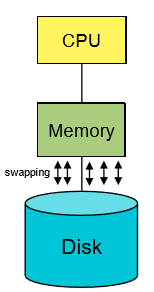
graph TD
    A["Processes Request Pages"] --> B["Physical Memory Exhausted"]
    B --> C["Continuous Disk Swapping (Page Fault Avalanche)"]
    C --> D["Processes Block Waiting for Disk I/O"]
    D --> E["CPU Utilization Drops to Near Zero"]
    E --> F["OS Spawns More Processes (Worsens Thrashing)"]
Thrashing Mitigations
- Process Suspension / Swapping: De-schedule entire processes and swap their allocated memory to disk to allow remaining processes’ working sets to fit in RAM.
- Out-Of-Memory (OOM) Killer: The kernel evaluates process scores and terminates high-memory processes when physical RAM and swap space are exhausted.
- Hardware Expansion: Adding physical RAM capacity.