Abstract
Combinational Logic Design translates functional behavioral descriptions into physical gate-level circuits. Logic problems are specified using Truth Tables that define output behavior for every combination of input signals. Standard arithmetic building blocks such as Half Adders and Full Adders illustrate how multi-output truth tables synthesize into optimized Boolean expressions. Formal circuit analysis relies on fundamental canonical terms: literals, implicants, implicates, minterms, and maxterms.
Converting Boolean Equations to Gate Circuits
To construct a circuit diagram from a Boolean expression:
- Identify the primary output function.
- Work backwards from the output gate toward the input variables.
- Sub-expressions inside parentheses or under complement bars represent intermediate logic gate outputs.
Example Construction
Given the Boolean expression:
- Output Gate: An AND gate combining with the intermediate signal .
- Intermediate Logic: A NOR gate operating on input and the inverted input (NOT gate on ).
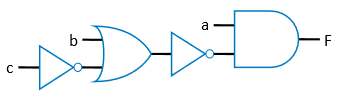
Gate-level Circuit Diagram for
Specifying Logic Functions with Truth Tables
Truth tables provide a complete, non-ambiguous specification of a combinational circuit by listing all possible input state combinations and their corresponding outputs.
1. Half Adder
A Half Adder adds two 1-bit binary inputs () and produces a 1-bit Sum () and a Carry-out ().
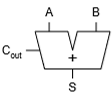
Half Adder Logic Gate Implementation
Half Adder Truth Table
| Carry () | Sum () | ||
|---|---|---|---|
Half Adder Boolean Equations
2. Full Adder
A Full Adder adds three 1-bit binary inputs: two primary operands () and an incoming Carry-in () from a less significant bit position. It produces a Sum () and a Carry-out ().
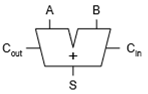
Full Adder Circuit Schematic
Full Adder Truth Table
| Carry-out () | Sum () | |||
|---|---|---|---|---|
Full Adder Boolean Equations
Canonical Definitions & Terminology
Understanding algebraic structure requires precise terminology for variables and expressions:
| Term | Definition | Examples |
|---|---|---|
| Complement | A variable negated with a bar or prime. | , , |
| Literal | A single variable or its complement. | |
| Implicant | A product (AND term) of one or more literals. | |
| Implicate | A sum (OR term) of one or more literals. | |
| Minterm () | A product (AND term) containing every input variable in true or complemented form. Evaluates to for exactly one input combination. | |
| Maxterm () | A sum (OR term) containing every input variable in true or complemented form. Evaluates to for exactly one input combination. |