Abstract
Non-Volatile Memory (NVM) retains binary data indefinitely when system power is removed. Traditional NVMs (EPROM, EEPROM, Flash) rely on floating-gate charge trapping. Emerging NVM technologies (FeRAM, STT-RAM/MRAM, PCM, FeFET, and ReRAM) represent a maturing class of solid-state storage that bridges the boundary between fast, volatile working memory (SRAM/DRAM) and slow, non-volatile mass storage (Flash/SSD). Offering near-SRAM access speeds, DRAM-like density, and high energy efficiency, emerging NVMs target big data analytics and persistent in-memory computing architectures.
Traditional Non-Volatile Memory Evolution
Traditional Read-Only Memory (ROM) devices evolved from factory-programmed circuits into in-system programmable non-volatile storage.
Floating-Gate Transistor Mechanics
Traditional floating-gate transistors embed an electrically isolated gate inside an oxide layer. High programming voltages force electrons to tunnel into the floating gate, trapping them to shift the transistor’s threshold voltage () to store logic '0'.
flowchart LR
    subgraph Layer["Device Layer"]
        direction TB
        CG["Control Gate"]
        FG["Floating Gate"]
        SUB["Substrate"]
    end

    subgraph Function["State / Operation"]
        direction TB
        V["Applied Programming Voltage"]
        E["Trapped Electrons (Logic '0')"]
        CH["Source/Drain Channel"]
    end

    CG -->|Drives| V
    FG -->|Stores| E
    SUB -->|Conducts| CH
Evolutionary ROM Spectrum
Erasable Programmable ROM (EPROM):
Programmed using higher voltages to trap electrons in floating gates. Erased by exposing the chip to ultraviolet (UV) light through a quartz package window to energize trapped electrons.
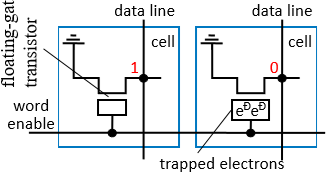
Electrically-Erasable Programmable ROM (EEPROM):
Injects and erases electrons electronically at byte/word granularity without requiring UV exposure.
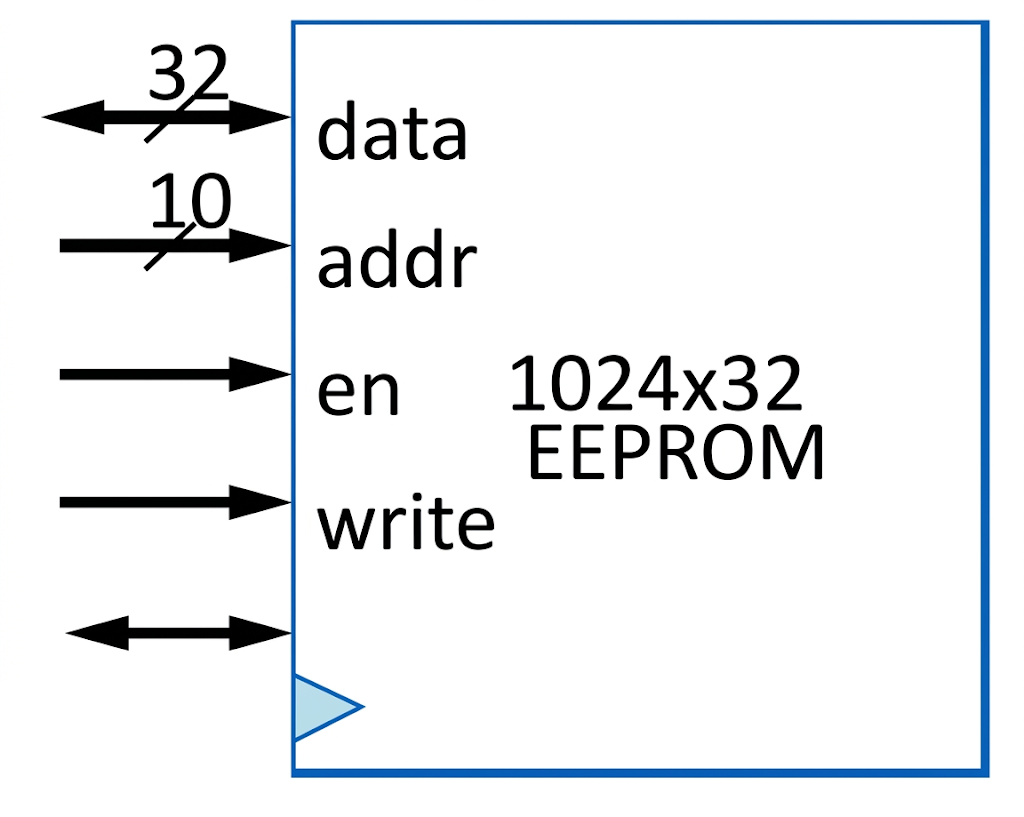
Flash Memory: Operates on principles similar to EEPROM, but optimizes erasure density by erasing large blocks of words simultaneously. Both EEPROM and Flash are In-System Programmable (ISP).
Emerging NVM Paradigm
Emerging NVM technologies blur the historical distinction between Memory (fast, expensive, volatile) and Storage (slow, cheap, non-volatile).
flowchart TD
    subgraph Traditional["Traditional Memory Limitations"]
        SRAM["<b>SRAM</b><br/>Fast Read/Write<br/>Low Density (6T Cell)<br/>Volatile"]
        DRAM["<b>DRAM</b><br/>High Density (1T1C)<br/> Requires Power Refresh<br/> Volatile"]
        Flash["<b>NAND Flash</b><br/>Non-Volatile (~10 Yrs)<br/> High Write Latency<br/> Limited Endurance"]
    end

    subgraph SweetSpot["<b>Emerging NVM Sweet Spot</b><br/>(Storage-Class / Universal Memory)"]
        direction TB
        NV["<b>Non-Volatile</b><br/>10+ Year Retention"]
        SP["<b>SRAM Speed</b><br/>Nanosecond Read/Write"]
        DN["<b>DRAM Density</b><br/>1T1R / 3D Cross-Point"]
    end

    SRAM -->|Provides Speed| SP
    DRAM -->|Provides Density| DN
    Flash -->|Provides Retention| NV
Key Technical Features & Challenges
- Target Applications: Excellent fit for Big Data analytics (in-memory databases) and energy-efficient edge AI processing by eliminating static leakage and refresh power.
- Maturing Challenges:
- Slow Writes: Write operations require higher current or longer pulse durations than reads.
- Write Endurance: Cell degradation under repeated switching cycles ( cycles for PCM/ReRAM).
- Manufacturing Complexity: Requires integrating novel ferroelectric, phase-change, or magnetic materials onto standard CMOS back-end processes.
Emerging NVM Technology Breakdown
1. Ferroelectric RAM (1T-1C FeRAM)
- Mechanics: Similar to DRAM (1 Transistor, 1 Capacitor), but replaces the dielectric with a ferroelectric layer (typically Lead Zirconate Titanate - PZT). Electric fields shift central atoms into up/down polarization states representing
'1'or'0'. - Advantages: lower power than DRAM; no refresh cycles required; fast read/write performance.
- Disadvantages: Destructive reads require rewriting data after every read cycle; physical scaling limits below as materials lose ferroelectricity.
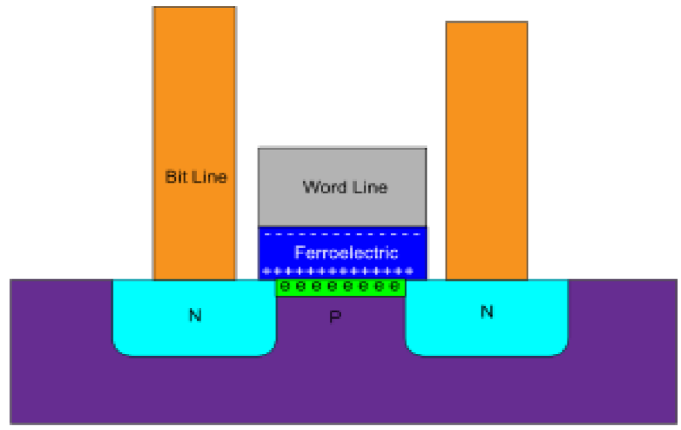
1T-1C FeRAM Cell Structure
2. Spin-Transfer Torque RAM (STT-RAM / MRAM)
- Mechanics: Stores data using a Magnetic Tunneling Junction (MTJ) with a Fixed Magnetic Layer and a Free Magnetic Layer. Spin-polarized electron currents align free-layer magnetization parallel (P =
'1', low resistance) or anti-parallel (AP ='0', high resistance) to the fixed layer. - Advantages: High endurance ( cycles); ultra-fast read latency (); high retention ().
- Disadvantages: Asymmetric write energy: Writing a
'1'requires significantly higher current and duration than writing a'0'.
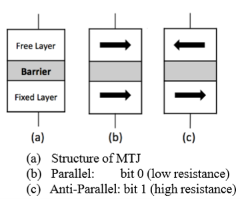
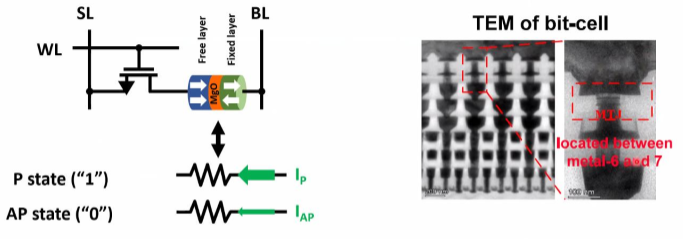
STT-RAM Magnetic Tunneling Junction (MTJ) Structure
3. Phase Change Memory (PCM / PCRAM)
- Mechanics: Thermally shifts a chalcogenide material between an amorphous phase (RESET, high resistance) and a crystalline phase (SET, low resistance) via electrical current pulses.
- Advantages: Excellent physical cell scalability beyond other emerging NVMs.
- Disadvantages: Slow write times; limited write endurance ( cycles); high write power.
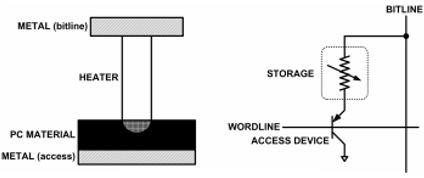
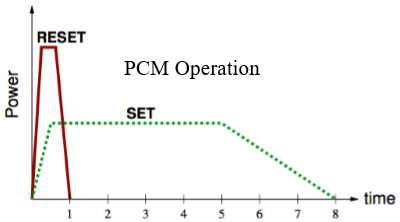
PCM Crystalline (SET) vs. Amorphous (RESET) States
4. Ferroelectric Field-Effect Transistor (1T FeFET)
- Mechanics: Integrates ferroelectric material directly into the gate stack of a single FET transistor. Reversible threshold voltage () shifts are driven by sub- nanosecond field pulses.
- Advantages: Non-destructive read detection; co-located directly with CMOS logic gates (requiring only additional mask layers).
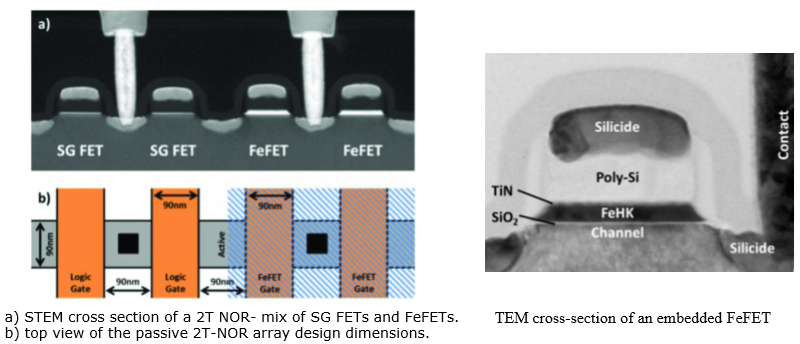
1T FeFET Co-Located Logic Transistor Cell
5. Resistive RAM (ReRAM)
Stores data by forming (low resistance) or breaking (high resistance) conductive atomic filaments across a dielectric oxide layer using applied voltage pulses.
- Access-Based ReRAM (1T-1R): Pairs 1 Transistor with 1 Resistor. Offers ultra-fast reads/writes (), low latency (), but lower capacity. Serves as an alternative to embedded NOR flash.
- Crossbar ReRAM (1T-nR): Organizes cells at perpendicular wire intersections in dense 3D arrays. Highly scalable and cheap, providing an alternative to NAND flash and SSD disk caches.
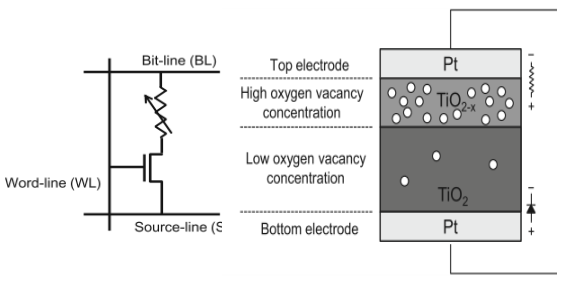
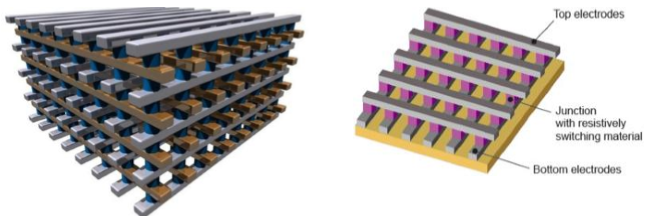
1T-1R Access ReRAM vs. 1T-nR 3D Crossbar Architecture
Quantitative Technology Comparison Matrix
Emerging NVM Technology Comparison
| Metric | MRAM | ReRAM | eFlash | FeRAM |
|---|---|---|---|---|
| Non-Volatility | Yes () | Yes () | Yes () | Yes () |
| Read Latency | ||||
| Write Latency | ||||
| Write Voltage | ||||
| Endurance (Cycles) | ||||
| Multi-Level Cell | Limited () | Good | Good | Limited () |
| Scalability | Good () | Good | Limited | Limited |
| Reliability | High | Limited | High (Low endurance) | High |
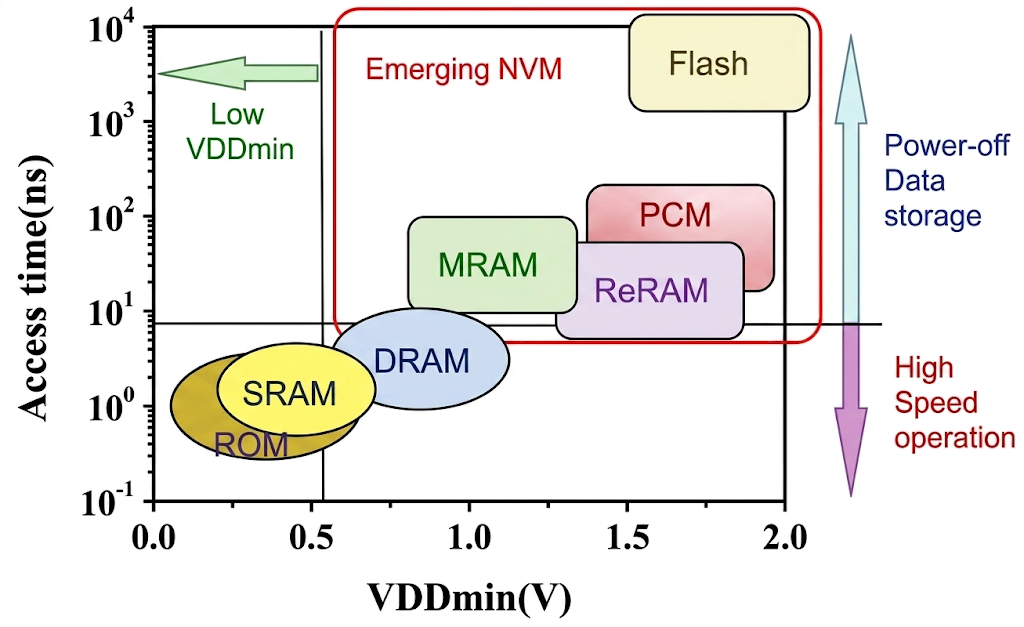
NVM Quantitative Metric Comparison Chart
Full Memory Spectrum Feature Comparison
| Feature | SRAM | eDRAM | STT-RAM | PCRAM | ReRAM |
|---|---|---|---|---|---|
| Density | Low | High | High | Very High | Very High |
| Speed | Very Fast | Fast | Fast Read / Slow Write | Slow Read / Very Slow Write | Slow Read/Write |
| Dynamic Power | Low | Medium | Low | Low | Low |
| Leakage Power | High | Medium | Low | Low | Low |
| Non-Volatility | No | No | Yes | Yes | Yes |
System Architecture Replacement Mappings
Emerging NVM technologies target specific replacements across the memory hierarchy:
flowchart LR
    subgraph Traditional["<b>Traditional Volatile / Flash Memory</b>"]
        direction TB
        T1["L1/L2/L3 Caches<br/>(SRAM)"]
        T2["Main Memory<br/>(DRAM)"]
        T3["Flash / Storage<br/>(NAND)"]
    end

    subgraph Emerging["<b>Emerging Non-Volatile Replacement</b>"]
        direction TB
        E1["STT-RAM<br/>(Eliminates Static Leakage Power)"]
        E2["PCRAM<br/>(High Density Non-Volatile RAM)"]
        E3["ReRAM<br/>(3D Crossbar / High Throughput)"]
    end

    T1 -->|Replace with| E1
    T2 -->|Replace with| E2
    T3 -->|Replace with| E3
- STT-RAM SRAM Cache Replacement: Eliminates static leakage power in dense multi-core CPU caches.
- PCRAM DRAM Main Memory Replacement: Provides high-density, non-volatile main memory arrays for persistent in-memory database systems.
- ReRAM NAND / NOR Flash Replacement: 1T-1R access ReRAM targets embedded NOR replacement for Execute-in-Place (XiP) code, while 3D Crossbar ReRAM replaces NAND flash in data center block storage.