Abstract
Most applications utilize only a tiny, sparse fraction of their total Virtual Address Space. Multi-Level Page Tables exploit this sparsity by introducing a tree-like hierarchy of page directories. By allocating secondary page tables only for virtual address regions currently in use, hierarchical page tables eliminate the massive memory overhead of flat linear tables.
- Category: Hierarchical Address Translation Architectures
- Core Principle: Indirection via a Page Directory tree.
- Primary Advantage: Memory overhead scales with actual memory usage, not total address space capacity.
The Need for Hierarchical Paging
A flat linear table allocates Page Table Entries (PTEs) for every possible virtual page, even if those pages are unmapped.
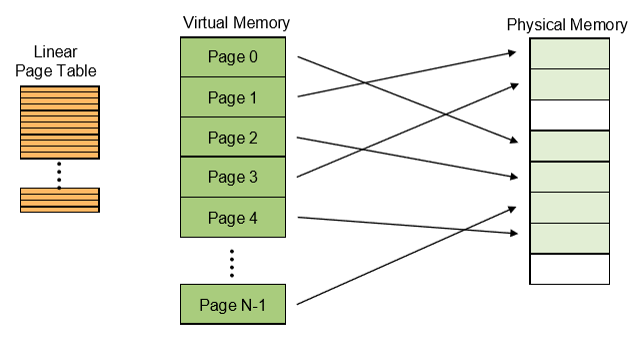
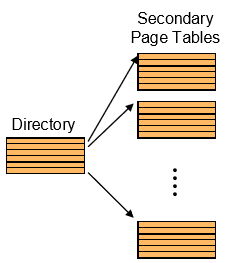
By adding a level of indirection, Multi-Level Page Tables dynamically allocate secondary page tables only when a process actually uses that region of memory:
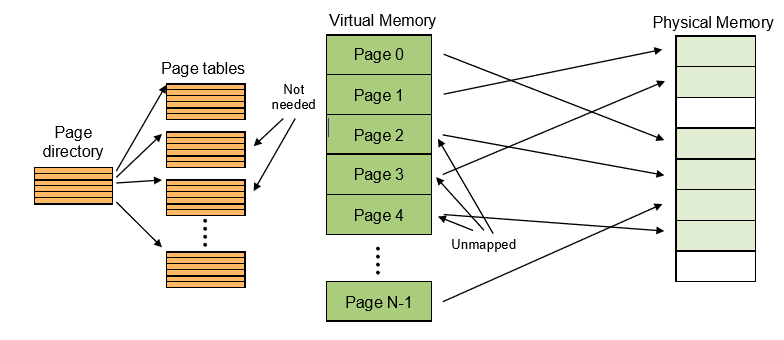
Two-Level Page Table Architecture
In a two-level scheme, the virtual address is divided into three distinct bitfields:
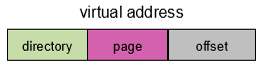
- Directory Page Table (Root / Page Directory): Maps the upper virtual address bits to a secondary page table. If an entire range of memory is unused, its directory entry is marked invalid (
0), and no secondary page table is allocated. - Secondary Page Table: Maps the middle virtual address bits to physical Page Frame Numbers (PFN).
- Offset: Indexes directly into the physical page frame.
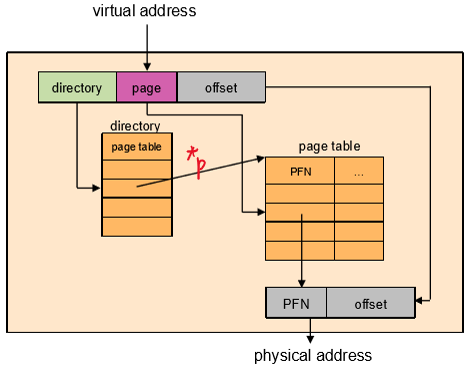
Bit-Splitting Calculation Example
Assume a 32-bit address space, page size, and PTEs:
- Offset Bits:
- Page Directory Sizing:
To ensure every page table fits cleanly inside a single page frame: - Secondary Page Table Sizing:
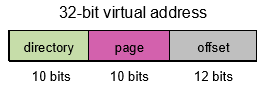
This bit split allows each secondary table to fit inside one page (). If a process uses only its code and stack segments, it requires only the Page Directory plus two secondary page tables ( total instead of ).
Generalizing to Multi-Level Paging & x86-64
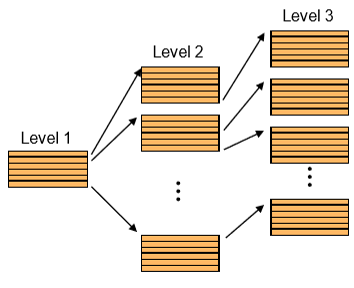
Hierarchical paging extends to levels to accommodate 64-bit architectures. Unmapped subtrees in the page map hierarchy are omitted entirely:
x86-64 4-Level Paging Scheme
Standard x86-64 hardware utilizes a 4-level page table handling a canonical address space ():
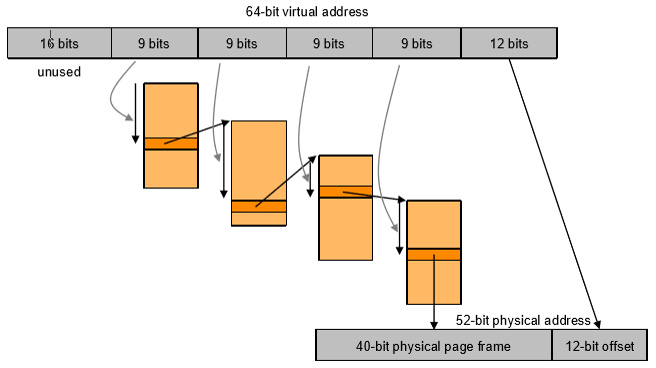
- Page Size: .
- PTE Size: .
- Entries per Page: .
- Highest : Unused / Sign-extended.
Multi-level Paging with TLB Caching
graph TD
    VA["Virtual Address<br/>(Directory Indices | Offset)"] --> TLB{"Query TLB Cache"}
    TLB -->|"TLB Hit (~1 cycle)"| Concat["Concatenate PFN + Offset"]
    TLB -->|"TLB Miss"| Walk["Walk Page Directory Tree in RAM"]
    Walk --> Update["Update TLB with New PTE"]
    Update --> Concat
    Concat --> PA["Physical RAM Address"]