Abstract
Sharing finite physical memory among multiple running applications presents severe safety and efficiency challenges. Operating systems resolve these challenges using Virtual Memory, providing each process with an isolated, contiguous Virtual Address Space. Addresses used by user applications are dynamically translated to physical RAM addresses at runtime by the hardware Memory Management Unit (MMU).
- Category: OS Virtualization Fundamentals
- Core Invariant: User programs execute strictly with Virtual Addresses; the CPU hardware translates them to Physical Addresses on every memory access.
- Hardware Enforcer: Memory Management Unit (MMU).
1. Memory Management Challenges & Goals
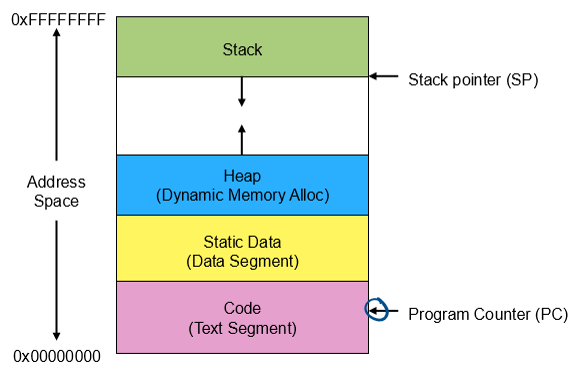
Managing physical RAM across multi-threaded and multi-process workloads creates four fundamental challenges:
- Finite Capacity: Physical RAM is limited; processes in aggregate may demand more memory than physically exists.
- Data Location: Dynamically tracking where each process’s data resides in RAM as processes are launched, expanded, and terminated.
- Protection & Isolation: Preventing buggy or malicious applications from reading/writing memory assigned to other processes or the OS kernel.
- Efficiency: Maximizing RAM utilization while minimizing CPU execution overhead during memory access operations.
The Four Architectural Goals
- Multitasking: Allow multiple distinct process address spaces to reside in RAM simultaneously.
- Transparency: Provide a convenient abstraction so applications operate without knowing memory is shared or where in physical RAM they reside.
- Isolation & Protection: Enforce strict access boundaries; a process cannot corrupt other applications or kernel space.
- Efficiency: Maintain high CPU speed and memory utilization without incurring severe latency penalties during address lookup.
2. Early Approaches & Their Limitations
1. Single-Tasking Systems
In early computers, only one process executed at a time. The OS kernel occupied the highest physical memory addresses, while the active user application occupied physical memory starting at address .
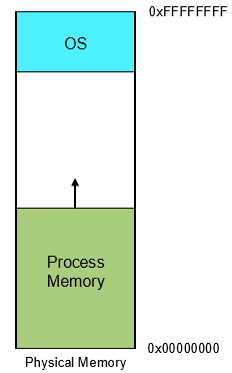
- Limitations: Supports only one process at a time; user programs execute directly against physical addresses and can overwrite kernel memory.
2. Multitasking with Static Relocation
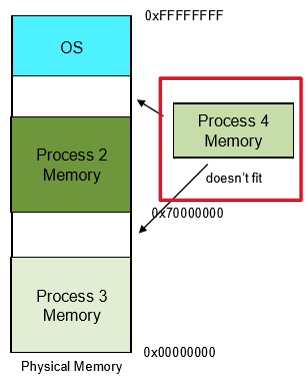
To support multiple processes without hardware translation, operating systems used Load-Time Static Relocation. When a program was loaded into a free contiguous block of physical RAM, a loader rewritten all memory addresses inside the binary code to match its new physical offset.
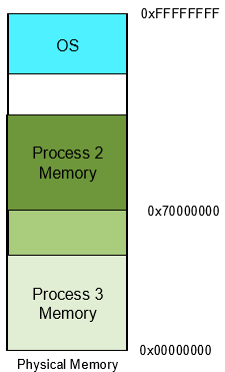
- Limitations:
- No Protection: A process can still forge pointers to read or write to other processes or kernel RAM.
- Inflexible / Low Utilization: Addresses are fixed after loading. Processes cannot be moved in RAM at runtime to consolidate empty memory holes.
- No Sharing: Processes cannot share portions of their address space (e.g., shared code libraries).
graph TD
    A["Program Machine Code"] -->|"Load Time"| B["OS Loader"]
    B -->|"Rewrite Raw Pointers"| C["Physical Memory"]
    C --> D["Direct Execution<br/>(No Hardware Protection)"]
3. The Virtual Memory Abstraction
Virtual Memory decouples the program’s logical view of memory from physical RAM by establishing two distinct address spaces:
flowchart LR
    subgraph VAS ["<b>VIRTUAL ADDRESS SPACE (Seen by Program)</b><br/><br/>• Contiguous address range (0 to 2<sup>64</sup> - 1 on 64-bit systems)<br/>• Independent of physical RAM placement"]
    end

    MMU["<b>Hardware Address Translation</b><br/><i>(Memory Management Unit)</i>"]

    subgraph PAS ["<b>PHYSICAL ADDRESS SPACE (Actual RAM Hardware)</b><br/><br/>• Discontiguous physical memory allocations<br/>• Managed dynamically by the OS Kernel"]
    end

    VAS --> MMU --> PAS

    classDef cellStyle font-size:15px,padding:12px;
    class V_NODE,MMU,P_NODE cellStyle
Dynamic Memory Relocation
With dynamic memory relocation, processes generate Virtual Addresses during instruction execution. Every load, store, or instruction fetch passes through the hardware Memory Management Unit (MMU), which translates the virtual address into a Physical Address in real time.
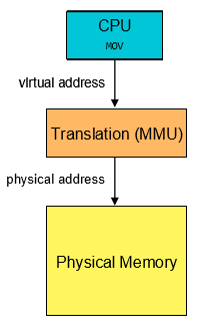
This allows the kernel to relocate processes anywhere in physical RAM or swap unused pages to disk completely transparently to the running program.