Abstract
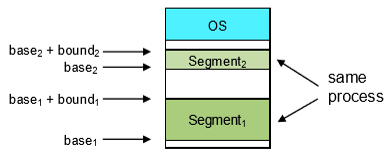
Segmentation extends Base and Bound by dividing a process’s virtual address space into multiple logical, variable-sized segments (such as Code, Static Data, Heap, and Stack). Managed via a per-process Segment Table (Segment Map), segmentation eliminates unused unallocated space between the heap and stack while enabling read-only code sharing across processes.
- Category: Variable-Sized Address Translation Systems
- Key Primitive: Segment Table / Segment Map (Base, Bound, Permissions per segment).
- Primary Deficit: External Fragmentation (variable-sized segment allocations create unusable memory holes).
Logical Memory Segments
Unlike single-segment Base and Bound systems, Segmentation splits the virtual address space into independent variable-sized segments matching standard program structures:
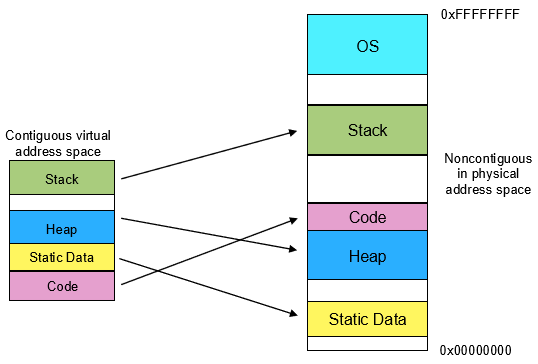
- Code Segment: Executable instructions (Read / Execute only).
- Static Data Segment: Initialized and uninitialized global variables (Read / Write).
- Heap Segment: Dynamically allocated memory growing upward (Read / Write).
- Stack Segment: Function call frames growing downward (Read / Write).
Address Translation via Segment Table
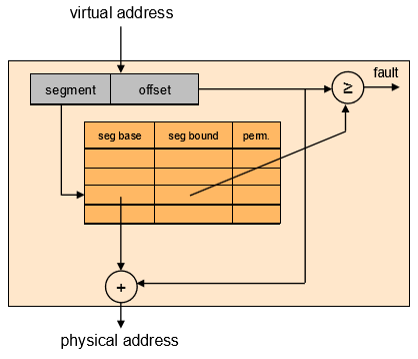
Each process maintains a Segment Table (Segment Map) in kernel memory containing Base addresses, Bound sizes, and Access Permissions for each segment:
Translation Mechanics
A virtual address encodes both a Segment Number and an Offset:
- Segment Lookup: Use the Segment Number to index into the process’s Segment Table.
- Permission & Bounds Check: Verify that the requested operation matches the segment’s permissions and that .
- Physical Address Calculation:
graph TD
    VA["Virtual Address<br/>(Segment # | Offset)"] --> Table["Segment Table Lookup"]
    Table --> Check{"Offset < Segment Bound?"}
    Check -->|"No"| Fault["Hardware Exception<br/>(Protection Violation)"]
    Check -->|"Yes"| Add["Segment Base + Offset"]
    Add --> PA["Physical RAM Address"]
External vs. Internal Fragmentation
Variable-sized memory management mechanisms introduce two distinct forms of memory fragmentation:
flowchart TD
    TITLE["<b>Memory Fragmentation</b>"]

    EXT["<b>External Fragmentation</b><br/><i>(Free space broken into small holes)</i><br/><br/>• Variable-sized segments create holes<br/>• Total free space exists, but is non-contiguous"]

    INT["<b>Internal Fragmentation</b><br/><i>(Unused space inside allocated blocks)</i><br/><br/>• Memory allocated is larger than needed<br/>• Space inside a segment/page sits idle"]

    TITLE --> EXT
    TITLE --> INT

    classDef cellStyle font-size:15px,padding:12px;
    class TITLE,EXT,INT cellStyle
| Fragmentation Type | Cause | Impact in Segmentation |
|---|---|---|
| External Fragmentation | Allocating and freeing variable-sized segments over time leaves small unusable gaps scattered across physical RAM. | High. Total free RAM may be , but if it is split into 1000 non-contiguous holes, a segment request fails. |
| Internal Fragmentation | Allocating conservative segment bounds where the application uses only a portion of the segment. | Low to Moderate. Substantially lower than single Base & Bound because heap and stack occupy separate segments. |
Trade-offs of Segmentation
Advantages
- Independent Segment Management: Segments can grow, shrink, be moved, or swapped to disk independently.
- Memory Sharing: Multiple processes can map their Code segment entries to the exact same physical RAM address, allowing shared code libraries (e.g., standard C library) to occupy physical RAM only once.
- Granular Protection: Per-segment permissions prevent illegal execution of stack data or modifications to executable code.
Disadvantages
- External Fragmentation: Requires complex memory allocation algorithms (e.g., First-Fit, Best-Fit) or expensive physical memory compaction (shifting memory contents to consolidate free holes).
- Variable-Sized Complexity: Managing variable segment tables adds kernel overhead compared to fixed-size paging systems.