Abstract
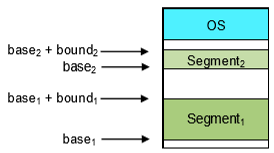
Base and Bound (also known as Base and Limit) is a single-segment contiguous hardware address translation mechanism. The hardware MMU maintains two registers per process: a Base Register (holding the physical starting address) and a Bound Register (holding the total address space size). It provides fast translation and basic protection, but suffers from severe memory fragmentation.
- Category: Hardware Address Translation Primitives
- Hardware Registers: Base Register, Bound (Limit) Register.
- Translation Formula: .
- Protection Boundary: .
Base and Bound Hardware Mechanism
First popularized in hardware architectures like the Cray-1 (1976), Base and Bound allocates a single contiguous block of physical RAM to an entire process virtual address space.
graph TD
    subgraph MMU["MMU Hardware Registers"]
        Base["<b>Base Register</b><br/>Physical starting address of the process in RAM"]
        Bound["<b>Bound Register</b><br/>Maximum size (limit) of the process address space"]
    end
Address Translation & Boundary Checking
When a running process issues a virtual address :
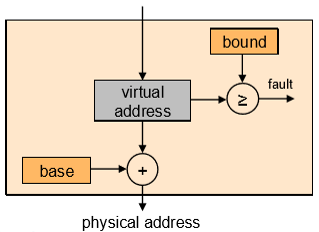
- Hardware Bounds Check: The MMU verifies that the virtual address falls within the process limit: If , the MMU hardware triggers an exception (Fault / Segmentation Violation).
- Physical Address Calculation: If the bounds check succeeds, the hardware translates the virtual address:
graph TD
    VA["Virtual Address"] --> Check{"VA < Bound Register?"}
    Check -->|"No"| Fault["Hardware Exception<br/>(Segmentation Fault)"]
    Check -->|"Yes"| Add["VA + Base Register"]
    Add --> PA["Physical RAM Address"]
Context Switching Base and Bound Registers
Because physical memory locations differ across processes, the Base and Bound registers must be swapped during every context switch:
- The kernel saves the active process’s Base and Bound register values into its Process Control Block (PCB).
- The kernel restores the next process’s saved Base and Bound values from its PCB into the CPU’s MMU registers.
- The CPU resumes execution; all subsequent virtual addresses are translated using the new process’s Base and Bound limits.
Trade-offs & Limitations
Advantages
- Simplicity & Speed: Hardware translation requires only one fast addition () and one comparison ().
- Dynamic Relocation: The kernel can move a process anywhere in physical RAM at runtime simply by copying its memory and updating its Base register.
- Hardware Protection: The Bound register prevents processes from reading or overwriting memory belonging to other processes or the kernel.
Limitations
- External Fragmentation: Allocating contiguous blocks of varying sizes creates unusable memory gaps (holes) scattered across physical RAM between processes.
- Internal Fragmentation: Unused space between the growing heap and stack inside the bound allocation sits idle and cannot be reclaimed by other processes.
- No Memory Sharing: Because the entire address space is bound in one contiguous block, two processes cannot share read-only code sections (e.g., shared libraries).