Abstract
Classical schedulers require knowing a job’s future runtime to minimize turnaround time (SJF/SRTCF) or sacrifice turnaround time for interactive responsiveness (Round Robin). The Multilevel Feedback Queue (MLFQ) solves this by dynamically learning job behavior: it penalizes CPU-bound jobs by lowering their priority while boosting interactive I/O-bound jobs, approximating SRTCF without advance runtime knowledge.
- Category: Advanced & Production Scheduling Systems
- Core Heuristic: Learn from past execution history to predict future behavior.
- Production Implementations: Linux Completely Fair Scheduler (CFS), Windows MLFQ, macOS MLFQ.
1. Multilevel Feedback Queue (MLFQ)
MLFQ maintains multiple distinct ready queues, each assigned a different priority level and time quantum:
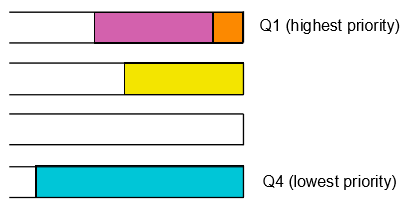
Core MLFQ Operational Rules
- Rule 1: If , runs ( does not).
- Rule 2: If , and run in Round Robin using the queue’s quantum.
- Rule 3: New jobs enter at the highest priority queue.
- Rule 4 (Priority Decay): If a job uses up its entire time quantum executing on the CPU, its priority is reduced (demoted down one queue level).
- Rule 5 (I/O Yielding): If a job yields the CPU before its quantum expires (e.g., issuing an I/O request), it stays at the same priority level (or gets boosted).
2. How MLFQ Handles I/O and CPU Bursts
MLFQ automatically differentiates between CPU-bound and I/O-bound workloads based on runtime execution patterns:
- Interactive / I/O-Bound Jobs: Perform short CPU bursts and frequently yield for I/O. They remain in high-priority queues, delivering fast response time.
- CPU-Bound Compute Jobs: Execute long computation loops, consuming their full quantum. MLFQ demotes them to lower-priority queues with larger time slices, reducing context-switch overhead.
flowchart TD
    ARRIVE["<b>Job Arrives</b><br/><i>(Highest Priority Queue)</i>"]
    DECISION{"Does it consume<br/>full quantum?"}

    YES_NODE["<b>Demote 1 Queue Level</b><br/><i>(Large Quantum, Batch)</i>"]
    NO_NODE["<b>Remain in High Priority</b><br/><i>(Fast Response Time)</i>"]

    ARRIVE --> DECISION
    DECISION -->|YES| YES_NODE
    DECISION -->|"NO (Issues I/O)"| NO_NODE

    classDef cellStyle font-size:15px,padding:12px;
    class ARRIVE,DECISION,YES_NODE,NO_NODE cellStyle
Priority Boosting & Anti-Gaming Rules
- Starvation Prevention: Periodically boost the priority of all jobs to the highest queue to ensure low-priority CPU-bound jobs make progress.
- Preventing Gaming: Track total CPU time consumed at a given level rather than resetting quantum counts on short I/O bursts (prevents processes from issuing fake I/O to hog high-priority queues).
3. Production Operating System Schedulers
Modern multi-core operating systems adapt scheduling principles to handle complex multi-threaded workloads:
1. Linux: Completely Fair Scheduler (CFS)
Instead of traditional fixed-priority queues, modern Linux uses the Completely Fair Scheduler (CFS):
- Virtual Runtime (
vruntime): Tracks the normalized amount of CPU execution time consumed by each thread. - Red-Black Tree Structure: Runnable threads are stored in a self-balancing Red-Black Tree sorted by
vruntime. The scheduler always picks the leftmost node (the thread with the smallestvruntime). - Weighting (
nicelevels): High-priority threads accumulatevruntimemore slowly, granting them larger shares of physical CPU time.
2. Windows: Multilevel Feedback Queue
Windows implements an MLFQ model with 32 priority levels:
- Levels 16–31: Real-time priorities.
- Levels 1–15: Variable dynamic priorities.
- Priority boosts are granted dynamically when threads wake up from I/O operations or window focus events.
3. macOS: Multilevel Feedback Queue
macOS employs an MLFQ architecture integrated with Mach kernel scheduling primitives, automatically balancing foreground user-interface responsiveness against background daemon tasks.