Abstract
Operating systems handle deadlocks using four main strategies: Ignorance (Ostrich algorithm), Prevention (invalidating one Coffman condition), Avoidance (dynamically tracking safe states via the Banker’s Algorithm), and Detection & Recovery (allowing deadlocks but resolving them via thread termination or resource preemption).
- Category: OS Resource Management & System Recovery
- Key Production Strategy: Resource Ordering for Deadlock Prevention.
- Theoretical Standard: Dijkstra’s Banker’s Algorithm for Deadlock Avoidance.
Overview of Deadlock Handling Strategies
| Strategy | Operational Mechanism | Pros / Cons | Primary Production Use Case |
|---|---|---|---|
| Ignorance | Ignore the problem (Ostrich Algorithm) | Zero overhead; system crashes if deadlock occurs | General-purpose OS (Linux, Windows, macOS) when deadlocks are rare |
| Prevention | Design system rules to eliminate Coffman condition | Guarantees no deadlock; can reduce resource utilization | Lock Ordering in kernel device drivers |
| Avoidance | Dynamically evaluate state transitions (Banker’s Algorithm) | Flexible resource allocation; requires knowing max needs in advance | Batch processing / Database systems with fixed resource profiles |
| Detection & Recovery | Run periodic cycle detection on RAGs; abort/preempt on cycle | High runtime overhead; requires rollbacks/thread kills | High-availability databases, transaction monitors |
Strategy 1: Deadlock Prevention
Deadlock Prevention forces the system to violate at least one of the four Coffman conditions:
1. Invalidate Mutual Exclusion
- Make resources sharable (e.g., read-only files).
- Limitation: Inherent to physical hardware (e.g., printers, write locks cannot be shared).
2. Invalidate Hold and Wait
- Require threads to request and receive all required resources simultaneously before starting execution, or release current resources before requesting new ones.
- Limitation: Low resource utilization; starvation for threads requiring many popular resources.
3. Invalidate No Preemption
- If a thread holding resources requests another resource that cannot be immediately allocated, the OS forcibly preempts and releases all resources currently held by that thread.
- Limitation: Only works for state-saveable resources (e.g., CPU registers, RAM memory pages); unworkable for locks or I/O writes.
4. Invalidate Circular Wait (Most Practical)
- Impose a strict global total ordering on all system resources.
- Rule: If a thread holds resource , it can only request resource if .
// Example: Global Lock Ordering prevents circular wait
// Always acquire lock_1 BEFORE lock_2
void worker_thread() {
    acquire(&lock_1);
    acquire(&lock_2);
    /* ... Critical Section ... */
    release(&lock_2);
    release(&lock_1);
}
Strategy 2: Deadlock Avoidance & The Banker’s Algorithm
Deadlock Avoidance permits resource requests only if allocating them leaves the system in a Safe State.
Safe State vs. Unsafe State
A state is Safe if there exists at least one execution sequence of threads that allows every thread to claim its maximum declared resources and complete without deadlocking. An Unsafe State is not a deadlock, but it can lead to a deadlock.
Dijkstra’s Banker’s Algorithm
The Banker’s Algorithm evaluates incoming resource requests against total available bank funds (resources). It rejects allocations that push the system into an unsafe state:
| Transaction State | Customer A (Max $1000) | Customer B (Max $1000) | Bank Balance Remaining | State Classification |
|---|---|---|---|---|
| Initial State | Borrowed $250 | Borrowed $500 | $250 | SAFE (Can satisfy A or B sequentially) |
| Unsafe Request | Requests $750 | Holds $500 | -$500 | REJECTED (Bank bankrupt / Unsafe) |
| Safe Execution | Retains $250 | Customer B returns $500 | $750 | SAFE (Customer A can now claim remaining) |
- Limitation of Avoidance: Requires processes to declare their maximum resource demands in advance, which is impossible for most interactive software.
Strategy 3: Deadlock Detection and Recovery
Allow deadlocks to occur, periodically execute a cycle-detection algorithm on the Resource Allocation Graph (RAG), and recover when cycles are found.
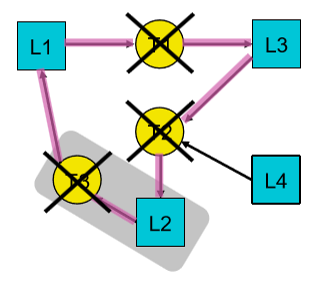
Deadlock Recovery Options
- Process / Thread Abort:
- Abort all deadlocked processes: Clean, but loses massive computation work.
- Abort one process at a time: Rerun cycle detection after killing each process until the cycle breaks.
- Resource Preemption & Rollback:
- Forcibly seize a resource from a thread in the cycle.
- Roll back the victim thread to a previously saved checkpoint state and restart it.
Checkpoint Case Study: Readers-Writers Flaw
Recall the Readers-Writers Semaphore solution:
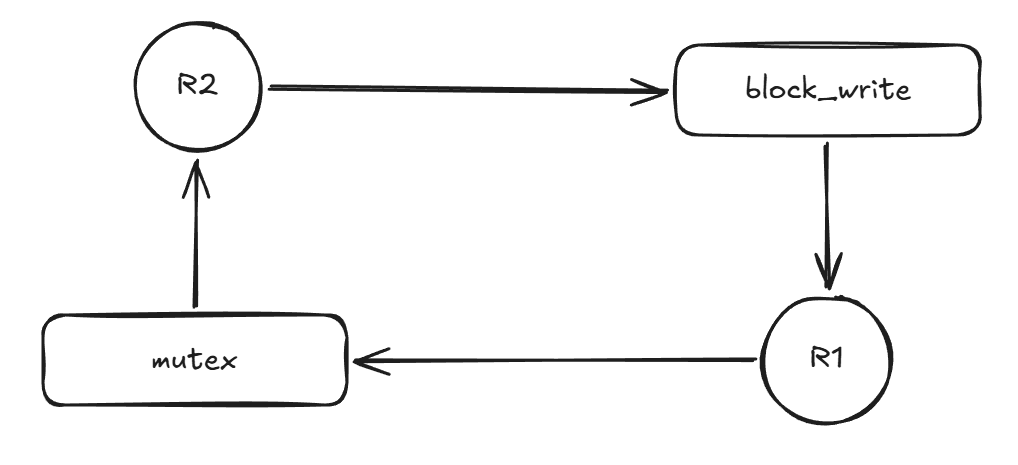
Deadlock Bug Scenario
What happens if an engineer removes
if (read_count == 1)so that every reader callswait(block_write)directly?
// BROKEN READER ROUTINE
void read() {
    wait(&mutex);
    read_count++;
    wait(&block_write); // BUG: Executed by EVERY reader!
    signal(&mutex);

    /* Read Operation */

    wait(&mutex);
    read_count--;
    signal(&block_write);
    signal(&mutex);
}
- Result: The first reader acquires
mutexandblock_write. When a second reader arrives, it acquiresmutexand blocks onblock_write. Because the second reader holdsmutex, the first reader can never re-acquiremutexduring its exit sequence to decrementread_countand callsignal(block_write)Instant Deadlock.