Abstract
To present a complete physical hardware illusion, a Virtual Machine Monitor (VMM) must virtualize execution cores (vCPUs), system events (Interrupts & Exceptions), and external I/O Devices. The hypervisor multiplexes virtual CPUs via multi-level scheduling, vectors hardware events directly to guest instances, and mediates storage and network access through emulated drivers, paravirtualized I/O, or hardware pass-through (SR-IOV).
Virtualizing the CPU & vCPU Scheduling
The hypervisor manages physical processor cores by abstracting them as Virtual CPUs (vCPUs) assigned to guest VMs.
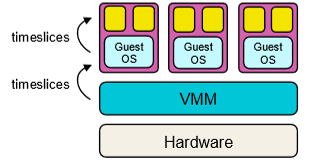
Two-Level Scheduling Model
Virtual CPU execution relies on a nested, two-tier scheduling hierarchy:
graph TD
    subgraph Level1 ["Level 1: Hypervisor Scheduler"]
        pCPU["Physical CPUs"] --> VMM_Sched["VMM Scheduler (e.g., Round Robin / Credit)"]
        VMM_Sched --> vCPU1["VM 1 (vCPU Allocations)"]
        VMM_Sched --> vCPU2["VM 2 (vCPU Allocations)"]
    end

    subgraph Level2 ["Level 2: Guest OS Scheduler"]
        vCPU1 --> Guest1_Sched["Guest OS 1 Scheduler"]
        Guest1_Sched --> P1["Process A"]
        Guest1_Sched --> P2["Process B"]
    end
- VMM Scheduling (Level 1): The hypervisor schedules vCPUs onto physical CPU cores using time-slicing algorithms (e.g., Round Robin or proportional credit schedulers).
- Guest OS Scheduling (Level 2): During its assigned vCPU time quantum, the guest OS schedules its internal user threads and processes.
Virtualizing System Events: Interrupts & Exceptions
The VMM must intercept and deliver hardware interrupts, fault exceptions, and system calls to the target virtual machine without exposing host hardware state.
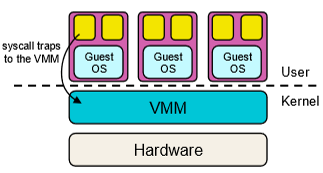
Event Delivery Paradigms
- Full Virtualization (Software Trap): Hardware events trap directly to the VMM. The VMM inspects the cause, updates virtual CPU control registers, and injects the exception into the guest OS vector table.
- Paravirtualization: The VMM places event notifications into a shared memory Event Queue, which the guest OS processes via hypercalls.
- Hardware-Assisted Virtualization: Modern CPU architectures (Intel VT-x / AMD-V) deliver virtualized interrupts directly into the guest OS execution context without requiring hypervisor intervention.
System Call Execution Workflow
When a process inside a guest VM issues a system call (e.g., read()):
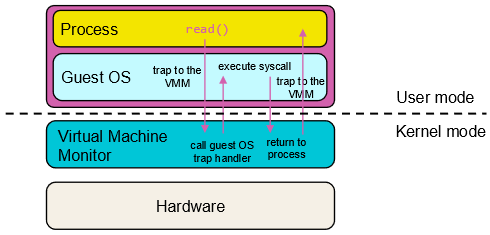
In modern hardware-assisted CPUs executing in Non-Root Mode, system calls generated within Ring 3 trap directly to the Guest OS in Ring 0 without triggering a heavy hypervisor exit (VM-Exit).
Virtualizing I/O Devices
Because the spectrum of physical expansion cards and peripheral devices is vast, hypervisors employ three distinct strategies to virtualize I/O devices:
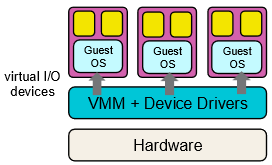
1. Emulated Virtual Devices
- The VMM exports standardized software-emulated hardware devices (e.g., an IDE disk controller or Intel e1000 NIC).
- Pros: High compatibility; default drivers included with any guest OS work out-of-the-box.
- Cons: Poor throughput; every single I/O register access triggers a hypervisor trap and emulation routine.
2. Paravirtualized I/O (e.g., virtio)
- Uses specialized virtual drivers inside the guest kernel designed to communicate directly with hypervisor ring buffers (
virtqueue). - Pros: Bypasses legacy hardware register emulation, reducing CPU overhead and maximizing throughput.
3. Hardware-Accelerated I/O (SR-IOV & IOMMU)
- Single Root I/O Virtualization (SR-IOV): Physical PCIe hardware devices export multiple Virtual Functions (VF) that can be mapped directly into guest address spaces.
- IOMMU: Translates Guest Physical Addresses (GPA) directly to Host Physical Addresses (HPA) for Direct Memory Access (DMA) transfers, achieving near-native wire speeds.
graph TD
    IO_Tech["I/O Virtualization Strategies"]

    IO_Tech --> Emulated["<b>1. Emulated Devices</b><br/>VMM runs physical drivers and presents standard generic virtual devices to guest."]
    IO_Tech --> ParaIO["<b>2. Paravirtualized I/O</b><br/>Optimized guest drivers communicate directly with VMM via shared memory buffers."]
    IO_Tech --> SRIOV["<b>3. Hardware Pass-Through (SR-IOV)</b><br/>Physical device exports Virtual Functions directly mapped to guest VMs."]