Abstract
An application’s Virtual Address Space consists of mapped and unmapped memory regions. As applications execute, their dynamic memory needs change. The operating system handles automatic Stack Growth via page fault intercepts, while Heap Growth is managed by user-space allocators (
malloc/free) interacting with the kernel viabrkandmmapsystem calls.
- Category: Virtual Memory Layout & Process Execution
- Stack Mechanism: Auto-expanding downward via guard page faults.
- Heap System Interfaces:
brk(),sbrk(), andmmap().
Process Virtual Address Space Layout
Thread execution contexts share global segments while retaining isolated execution stacks within a process’s virtual address space:
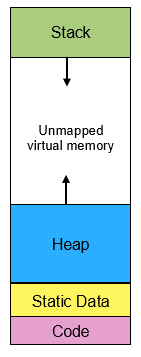
Unmapped regions between the heap and stacks trigger a Segmentation Fault (SIGSEGV) if accessed improperly.
Automatic Stack Expansion
Process stacks grow downward toward lower virtual memory addresses:
graph TD
    A["Process Accesses Unmapped Address Below Stack Pointer"] --> B["MMU Triggers Page Fault Exception"]
    B --> C["OS Page Fault Handler Inspects Fault Address"]
    C --> Check{"Is Address within Valid Stack Expansion Range?"}
    Check -->|"Yes"| Alloc["Allocate Physical Page Frame & Zero Contents"]
    Check -->|"No"| Segfault["Deliver SIGSEGV (Segmentation Fault)"]
    Alloc --> UpdatePTE["Update PTE (Valid = 1) & Resume Execution"]
Zeroing Allocated Memory
When the kernel allocates a physical frame to expand a process stack, it must overwrite the frame with zeroes (
0x00) to prevent security leaks of lingering data from former process allocations.
Heap Management & Memory Allocator Layering
The heap grows upward toward higher virtual addresses. Because system calls carry execution context switch overhead, memory allocation uses a layered architecture:
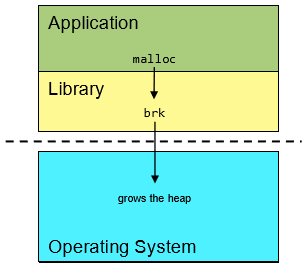
graph TD
    UserCode["Application Code (calls malloc / free)"] --> Library["User-Space Allocator (glibc malloc / jemalloc)"]
    Library -->|"Reuse Free List / Holes"| Instant["Fast Return (No System Call)"]
    Library -->|"Heap Expansion Request"| KernelCalls{"Allocation Size Threshold"}
    KernelCalls -->| Small Chunks | BrkCall["brk() / sbrk() System Call"]
    KernelCalls -->| Large Chunks >= 128 KB | MmapCall["mmap() System Call"]
    BrkCall --> OSKernel["OS Kernel Memory Manager"]
    MmapCall --> OSKernel
User-Space Allocators (malloc / free)
User-space libraries manage a pool of heap memory using free lists or arena bins. They handle small allocations directly in user space to avoid kernel traps, requesting large chunks from the kernel only when their local free list is exhausted.
Kernel System Interfaces for Heap Growth
| System Call | Interface Mechanism | Usage Characteristics |
|---|---|---|
brk(addr) / sbrk(incr) | Moves the process Program Break boundary line upward to expand contiguous heap space. | Used for small, frequent dynamic allocations; can suffer from external fragmentation if low-address allocations block break reduction. |
mmap(addr, length, ...) | Maps an unallocated chunk of virtual memory anywhere within the address space. | Used for large memory requests (e.g., ); easily returned to the OS via munmap() without heap fragmentation constraints. |