Abstract
Early file systems suffered severe mechanical seek overhead due to poor spatial layout. The BSD Fast File System (FFS) revolutionized storage performance by exploiting physical drive geometry through Cylinder Groups and intelligent placement heuristics. Modern file systems adapt these placement principles to logical block address spaces using Block Groups.
Original Unix File System Disk Layout
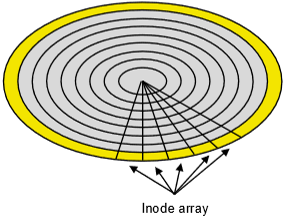
The original Unix File System used a rigid, static disk partition layout:
graph LR
    Outer["Outer Tracks: Inode Array"] --> Inner["Inner Tracks: Data Blocks"]
Drawbacks
- High Seek Latency: Inodes were concentrated on the outermost disk tracks, while data blocks were placed on inner tracks. Reading a file required long mechanical actuator seeks back and forth between the inode array and data blocks.
- Fixed Metadata Capacity: The inode table size was fixed at formatting, imposing a hard limit on the maximum number of files regardless of remaining disk space.
- Severe Allocation Fragmentation: Over time, free block lists became randomized, scattering file blocks across the disk and destroying sequential read bandwidth.
BSD Fast File System (FFS)
To address performance bottlenecks, BSD introduced the Fast File System (FFS), increasing block sizes from to , substituting free lists with fast Bitmaps, and organizing disk space around physical Cylinder Groups.
Disk Cylinders & Cylinder Groups
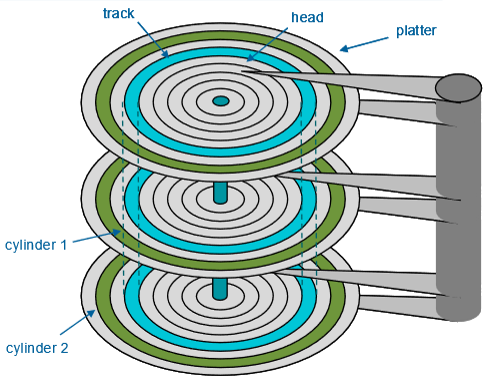
- Disk Cylinder: The set of matching tracks positioned at the same radial arm distance across all platter surfaces. Data within the same cylinder can be accessed by switching read/write heads without moving the physical actuator arm (zero seek delay).
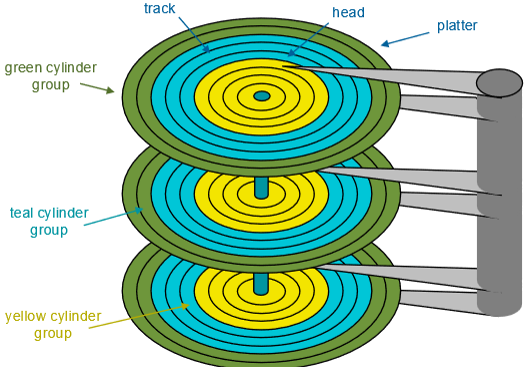
- Cylinder Group: A set of adjacent, consecutive cylinders. Files and metadata stored within the same cylinder group benefit from minimal seek latency.
Per-Group Data Structures
FFS divides the disk into multiple autonomous cylinder groups, replicating core file system data structures inside every group:
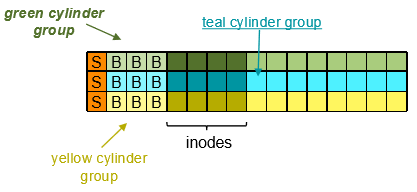
- Superblock Replica: Preserves redundant copies of global file system state to survive physical disk sector corruption.
- Per-Group Inode Table: Inodes are co-located within the same group as their associated data blocks.
- Per-Group Bitmaps: Local allocation bitmaps for inodes and data blocks.
FFS Disk Placement Policies
FFS enforces two primary placement heuristics to optimize spatial locality and prevent global fragmentation:
flowchart TD
    Request["Allocation Request"] --> Type{"Is Allocation a Directory or File?"}

    Type -->|"File"| Locality["<b>Heuristic 1: Locality Grouping</b><br/>• Place file inode in same group as parent directory.<br/>• Place file data blocks in same group as file inode."]

    Type -->|"Directory"| Balance["<b>Heuristic 2: Directory Balancing</b><br/>• Find cylinder group with below-average directory count.<br/>• Ensure group has high count of free inodes."]

    Locality --> WriteDisk["Allocate Blocks in Selected Cylinder Group"]
    Balance --> WriteDisk
- File Locality Heuristic (Co-location):
- Place a file’s inode within the same cylinder group as its parent directory.
- Place a file’s data blocks within the same cylinder group as its inode.
- Directory Balancing Heuristic (Spreading):
- Distribute new directories across different cylinder groups to avoid overcrowding a single group.
- Select target groups that have a low number of existing directories and a high count of free inodes.
Cylinder Groups vs. Modern Block Groups
Modern storage devices (HDDs and SSDs) do not expose physical cylinder/head/sector geometry to the operating system, presenting instead a flat Logical Block Address (LBA) block interface.

- Block Group: Modern file systems (e.g., Linux
ext4) adapt FFS principles to logical address spaces by dividing LBA ranges into contiguous Block Groups. - LBA Locality: Because consecutive logical block numbers map to physically adjacent disk sectors or flash pages, block group placement heuristics achieve the same spatial locality benefits as physical cylinder groups.
Summary Comparison
| Metric | Original Unix File System | BSD Fast File System (FFS) / Modern Block Groups |
|---|---|---|
| Block Size | (or larger) | |
| Free Tracking | Linked List (Free List) | Allocation Bitmaps |
| Inode Placement | Concentrated in single outer array | Distributed across localized Cylinder/Block Groups |
| Locality Optimizations | None | Directory co-location & directory balancing heuristics |
| Metadata Resilience | Single Superblock | Superblock replicas across all groups |