Abstract
Operating systems manage process life cycles from creation to termination using specialized system call interfaces. While Windows utilizes a single monolithic API (
CreateProcess), Unix-like systems separate process creation into two distinct system calls:fork()(cloning an existing process) andexec()(replacing an address space with a new program).
- Category: OS Kernel System Calls & Process Management
- Core Unix APIs:
fork(),exec(),wait(),exit()- Special Process Conditions: Zombie Processes and Orphan Processes.
The Process Creation Hierarchy
Every process is created by another existing process (its Parent Process). This forms a tree hierarchy rooted at the initial process spawned by the kernel during system boot (init or systemd with PID 1).
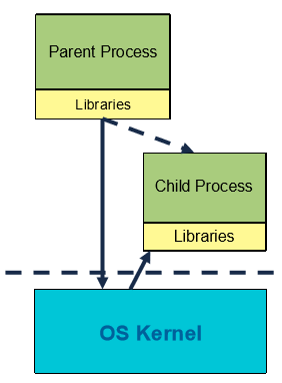
Child processes inherit properties from their parent, such as user privileges (UID/GID), working directory, and open file descriptor handles.
Process Creation Models: Windows vs. Unix
Operating systems handle process creation through two distinct architectural models:
Windows: Monolithic Creation (CreateProcess)
Windows uses a single system call that creates an entirely new process from scratch in one step:
bool CreateProcess(char* prog, char* args);
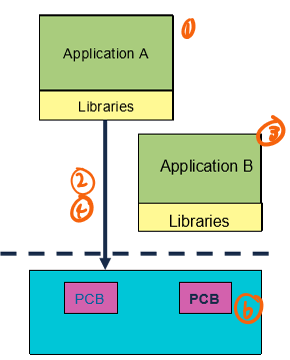
- Allocates a new PCB and address space.
- Loads the target executable (
prog) into memory. - Copies arguments (
args) into the new address space. - Initializes register context and places the new process into the Ready state.
Unix: Orthogonal Cloning & Execution (fork + exec)
Unix decouples process cloning from program loading into two distinct steps.
flowchart TD
    PARENT["<b>Parent Process</b>"]

    PARENT_RET["<b>Parent</b><br/><i>(Returns PID)</i>"]
    CHILD_RET["<b>Child</b><br/><i>(Returns 0)</i>"]
    NEW_PROG["<b>New Program Loaded</b>"]

    PARENT -->|"fork()"|PARENT_RET & CHILD_RET

    CHILD_RET -->|"exec()"| NEW_PROG

    classDef cellStyle font-size:15px,padding:12px;
    class PARENT,FORK,PARENT_RET,CHILD_RET,EXEC,NEW_PROG cellStyle
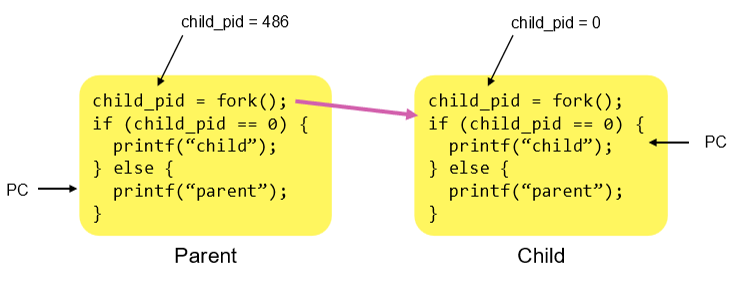
1. int fork()
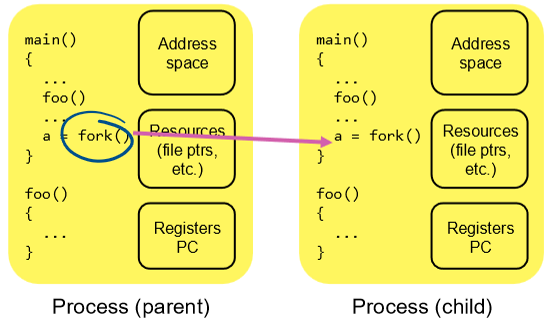
Clones the calling parent process to create an exact child process duplicate:
- Allocates a new PCB and copies the parent’s memory address space, register context, and open file descriptors.
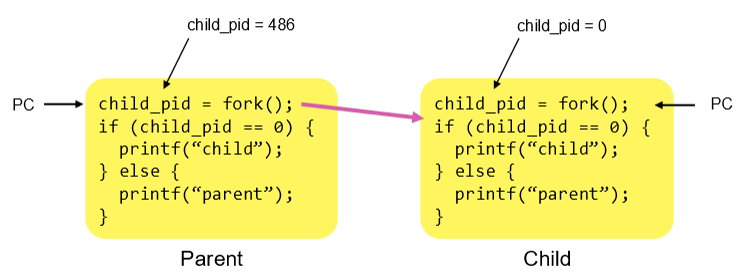
- The Duplicate Return Trick:
fork()is called once, but returns twice:- To the Parent Process: Returns the child’s new Process ID (PID ).
- To the Child Process: Returns .
2. int exec(char* prog, char* argv[])
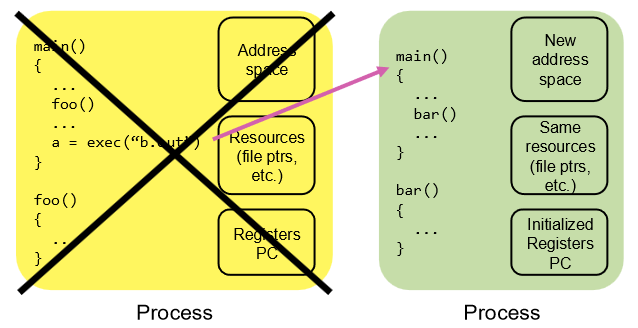
Overwrites the calling process’s active address space with a new executable:
- Stops the current program execution flow.
- Loads
proginto the existing address space (replacing code, data, heap, and stack). - Resets registers and arguments (
argv) for the new program. - Note:
exec()does not create a new process ID; open file handles and the PID remain preserved across theexec()boundary.
Why Separate
fork()andexec()?Separating cloning from loading gives the child process a window between
fork()andexec()to manipulate its environment—such as redirecting standard input/output file descriptors (stdin/stdout), setting environment variables, or changing privileges—without modifying the parent’s environment.
Process Termination & Reaping
Processes terminate explicitly by invoking exit(int status) or implicitly by returning from main().
- Resource Deallocation: The OS closes open files, releases physical memory pages, and disconnects network handles.
- PCB Preservation: The kernel retains the process’s PCB and exit status code until the parent process reads it via
wait()orwaitpid().
The wait() System Call
A parent process calls wait(&status) to suspend its own execution until one of its child processes finishes. The kernel passes the child’s exit code to the parent and frees the child’s remaining PCB.
Special Process States: Zombies & Orphans
flowchart TD
	PROCESS_EXIT["Process Exits"]
	PARENT_CALL_WAIT{"Is Parent calling wait()"}
	PCB_CLEAN["PCB Cleaned Up <br/> (Fully Reaped)"]
	ZOMBIE["Zombie Process <br/>(Retains PCB in kernel)"]
	ORPHAN["Orphan Process<br/>(Re-parented to init/PID 1)"]

	PROCESS_EXIT --> PARENT_CALL_WAIT
	PARENT_CALL_WAIT -->|Yes|PCB_CLEAN
	PARENT_CALL_WAIT -->|No|ZOMBIE
	ZOMBIE -->|Parent Exists First?|ORPHAN --> id["init calls wait() reaps"]
Zombie Process
A process that has terminated (exit()), but whose parent has not yet called wait() to collect its exit status code.
- Impact: A zombie consumes zero physical memory or CPU time, but its entry remains in the kernel’s process table (occupying a PID slot).
Orphan Process
A child process whose parent process terminates before calling wait().
- Resolution: The kernel automatically re-parents orphan processes to the root process (
initorsystemd, PID 1). Theinitdaemon continuously invokeswait()to collect exit statuses and reap orphaned processes.