Abstract
Virtual Machine Monitors (VMMs) or Hypervisors fall into two primary structural categories: Type-1 (Bare-Metal) and Type-2 (Hosted). Historically, the x86 instruction set violated classical virtualization requirements due to sensitive, non-trapping instructions (e.g.,
POPF). To achieve full virtualization before hardware extensions emerged, operating systems relied on software techniques such as Paravirtualization and dynamic Binary Translation.
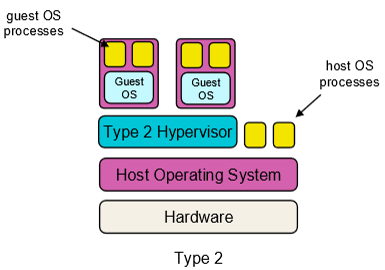
Type-1 vs. Type-2 Hypervisor Architectures
| Type-1 | Type-2 |
|---|---|
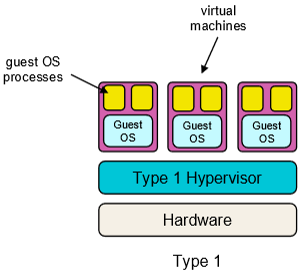 |  |
Type-1 Hypervisor (Bare-Metal)
A Type-1 Hypervisor runs directly on raw server hardware without an underlying host operating system.
- Architecture: The VMM is the operating system kernel, executing in Ring 0 with direct control over physical CPU, RAM, and I/O controllers.
- Performance & Reliability: Delivers higher performance, lower latency, and stronger security isolation due to reduced driver/stack complexity.
- Examples: VMware ESXi, Xen, KVM (when running bare-metal).
Type-2 Hypervisor (Hosted)
A Type-2 Hypervisor runs as a user-space application or kernel module on top of a conventional Host Operating System.
- Architecture: Relies on the host OS for hardware scheduling, physical memory management, and device drivers.
- Performance & Flexibility: Easier to install and manage for desktop workloads, but incurs performance overhead due to multi-layer scheduling and I/O indirection.
- Examples: VMware Workstation, VirtualBox, QEMU.
The x86 Architecture Virtualization Challenge
Classic Trap-and-Emulate virtualization relies on the Popek-Goldberg virtualization requirements: “All sensitive instructions (those that read or modify hardware configuration/privilege states) must be a subset of privileged instructions (those that trap when executed in user mode).”
Early x86 architectures violated this requirement:
- Non-Trapping Sensitive Instructions: Certain sensitive instructions executed in deprivileged User Mode (Ring 3) without raising a hardware trap.
- Example (
POPF): Modifies CPU interrupt flags. When run in Ring 3, the hardware silently ignores flag modifications rather than raising a privilege violation trap, preventing the VMM from intercepting the state change.
- Example (
- Hardware-Managed TLB: The MMU walked page tables in hardware directly, making it difficult for the VMM to interpose on address translation without software intervention.
Software Solutions for Non-Trapping Instructions
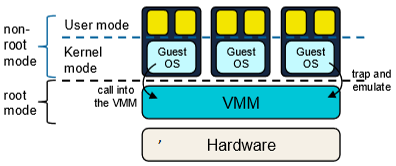
To overcome x86 hardware limitations prior to hardware-assisted virtualization (Intel VT-x / AMD-V), hypervisors utilized two primary software paradigms:
1. Paravirtualization
Paravirtualization modifies the guest operating system source code so that it actively collaborates with the hypervisor.
- Hypercalls: Sensitive operations (e.g., modifying page tables, disabling interrupts) are replaced at compile time with explicit calls into the VMM (Hypercalls), analogous to system calls.
- Trade-off: Sacrifices guest OS transparency (requires modified guest kernel code), but provides high performance without hardware extension requirements.
2. Binary Translation
Binary Translation dynamically rewrites guest OS machine code at runtime without modifying the underlying operating system binaries.
- Execution Workflow: The VMM inspects basic blocks of guest kernel code before execution. Non-privileged instructions run natively on the CPU, while sensitive instructions are dynamically replaced with equivalent code sequences or explicit VMM traps.
- Trade-off: Preserves full guest OS transparency, but introduces runtime translation overhead and caching complexity.
Summary Comparison of Virtualization Strategies
| Strategy | Guest OS Modifications Required? | Handling of Sensitive Instructions | Transparency | Performance |
|---|---|---|---|---|
| Classical Trap-and-Emulate | No | Hardware traps directly to VMM | Full | High (Requires ISA compliance) |
| Paravirtualization | Yes (Modified Guest Kernel) | Replaced with explicit Hypervisor APIs | None | High |
| Binary Translation | No | Rewritten dynamically at runtime | Full | Moderate (Translation overhead) |
| Hardware-Assisted (VT-x/AMD-V) | No | CPU switches to Non-Root Mode | Full | Near-Native |