Abstract
When physical RAM runs at capacity, servicing a page fault requires evicting an existing physical page frame to disk before loading the requested virtual page. Page Replacement Algorithms dictate which page frame to evict to maximize the system page hit rate and minimize disk I/O latency.
- Category: Memory Management Policy
- Primary Metric: Hit Rate ().
- Core Challenge: Predicting future memory access patterns without hardware overhead.
The Page Replacement Problem
Operating systems typically maintain a small free-frame pool. Once physical RAM fills up, every demand paging request forces a page replacement.
graph TD
    Fault["Page Fault Triggered"] --> Check{"Free Frames Available?"}
    Check -->|"Yes"| Load["Load Page into Free Frame"]
    Check -->|"No"| Policy["Run Page Replacement Policy"]
    Policy --> Evict["Evict Victim Page (Write if Dirty)"]
    Evict --> Load
The ideal victim page to evict is one that will never be accessed again or will be accessed farthest in the future.
Belady’s Optimal Algorithm (MIN)
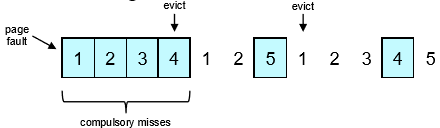
Belady’s Optimal Algorithm evicts the page that will not be accessed for the longest period in the future.
Evaluation & Properties
- Optimal Standard: Formally proven to achieve the lowest possible page fault rate for any given reference string and frame count.
- Impracticality: Requires perfect prescience of future process execution; used solely as an offline benchmark to evaluate other algorithms.
Belady’s Anomaly
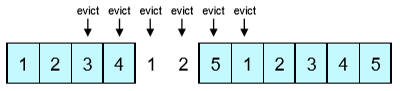
Belady’s Anomaly describes a counterintuitive scenario where increasing the number of physical page frames results in more page faults for certain replacement algorithms (such as FIFO):
Algorithms immune to Belady’s Anomaly are called Stack Algorithms (e.g., LRU, Optimal).
Common Page Replacement Algorithms
1. Random Replacement
Chooses a victim page at random.
- Pros: Simple; zero state tracking overhead.
- Cons: Non-deterministic performance; can evict heavily accessed hot pages.
2. First-In, First-Out (FIFO)
Evicts the page that has been in physical RAM the longest, using a queue structure.

- Pros: Low overhead ( queue management).
- Cons: Frequently evicts initialization pages or long-lived active memory structures; suffers from Belady’s Anomaly.
3. Least Recently Used (LRU)
Evicts the page that has not been referenced for the longest duration, exploiting temporal locality.

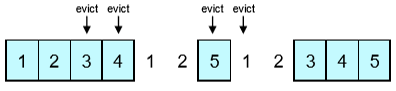
- Pros: Excellent practical approximation of Belady’s MIN algorithm; immune to Belady’s Anomaly.
- Cons: High hardware overhead; updating timestamps or reordering a doubly linked list on every single memory reference slows down execution unacceptable for production MMUs.
Approximating LRU: The Clock Algorithm
To capture LRU benefits without per-reference hardware updates, hardware MMUs set a Reference Bit () in the Page Table Entry whenever a page is accessed.
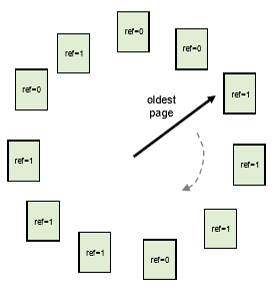
The Clock (Second-Chance) Algorithm arranges physical frames in a circular list with a moving hand pointer:
graph TD
    Hand["Clock Hand Points to Next Frame"] --> Read{"Is PTE Reference Bit R = 1?"}
    Read -->|"No"| Evict["Select Frame as Victim & Evict"]
    Read -->|"Yes"| Clear["Set R = 0 (Give Second Chance)"]
    Clear --> Advance["Advance Hand Pointer"]
    Advance --> Hand
Clock Algorithm Mechanics
- Reference Bit Inspection: The hand inspects the current frame’s bit.
- Second Chance Granted (): The OS clears and advances the hand pointer to the next frame.
- Eviction (): The page has not been referenced since the last sweep; it is selected for immediate eviction.
Clock Execution Edge Cases
- If every frame has , the clock hand sweeps through the entire circular buffer, clearing for all pages, and selects the initial page for replacement.
- On large-memory systems, a two-handed clock algorithm is used: a front hand clears reference bits while a trailing hand selects eviction victims.