Abstract
Number Systems and Boolean Algebra form the mathematical foundation of digital system design. Positional number representations (Binary, Octal, Hexadecimal) allow compact abstractions for binary physical signals. Boolean Algebra defines operations over two-valued logic () using primary operators () and derived logic gates (). Circuit analysis and simplification rely on core Boolean axioms, the Principle of Duality, algebraic theorems, and formal proof techniques.
Positional Number Encoding
In positional number systems, each digit’s position represents a specific power of the base (radix). A symbol in a given position indicates the quantity of that power:
- Base 10 (Decimal): Uses symbols . Positions represent powers of 10.
- Base 2 (Binary): Uses symbols . Positions represent powers of 2. This matches physical two-state digital hardware (high/low voltage levels).
- Base 16 (Hexadecimal): Uses symbols (where ). Functions as a compact human-readable shorthand for binary (each hex digit corresponds to exactly 4 binary bits / 1 nibble).
- Base 8 (Octal): Uses symbols . Positions represent powers of 8 (each octal digit corresponds to 3 binary bits).
Primary Logic Gates & Operations
Boolean algebra operates on a two-element set . Variables evaluate strictly to or , and operators return results in .
Primary Operators
- Logical AND (Intersection): Denoted by or concatenation ( or ). Returns if and only if all inputs are .
- Logical OR (Union): Denoted by (). Returns if at least one input is .
- Logical NOT (Complement): Denoted by or . Inverts the binary input value.
- Buffer: Returns the input value unchanged (). Used in physical circuits for signal amplification and propagation delay.
| Inputs () | AND () | OR () | NOT () | Buffer () |
|---|---|---|---|---|
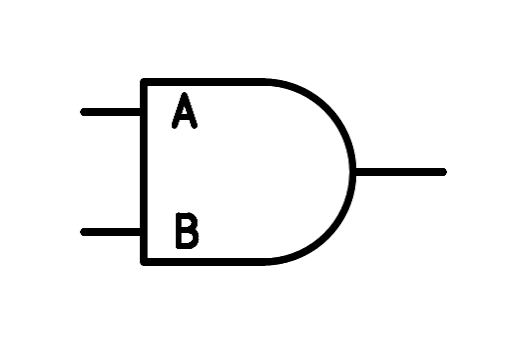
AND Gate Symbol
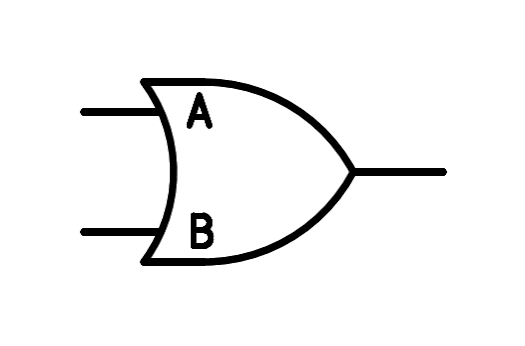
OR Gate Symbol
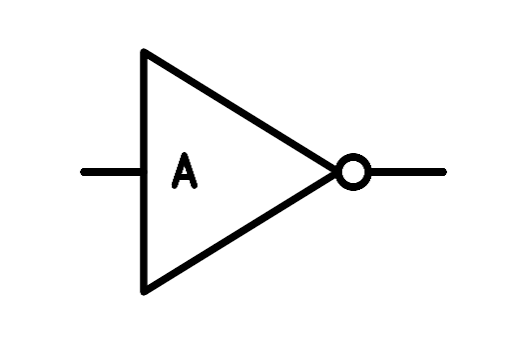
NOT Gate (Inverter) Symbol
Derived Logic Gates
Derived gates combine primary operators to perform specialized logic functions:
- NAND: Inverted AND, expressed as . Universal gate.
- NOR: Inverted OR, expressed as . Universal gate.
- XOR (Exclusive-OR): Returns when inputs differ ().
- XNOR (Equivalence): Inverted XOR, returns when inputs are identical ().
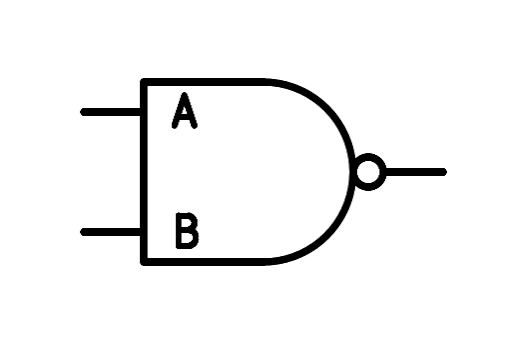
NAND Gate Symbol
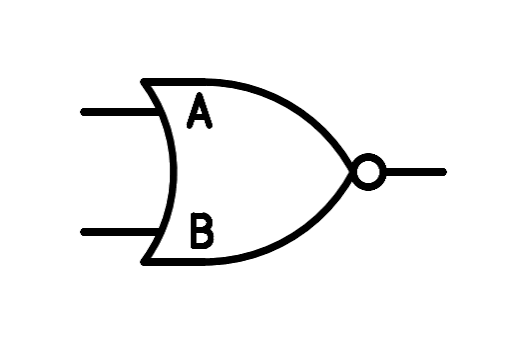
NOR Gate Symbol
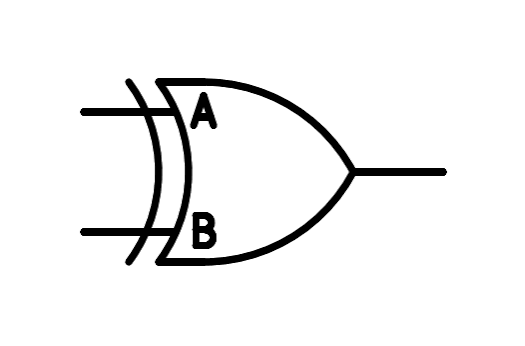
XOR Gate Symbol
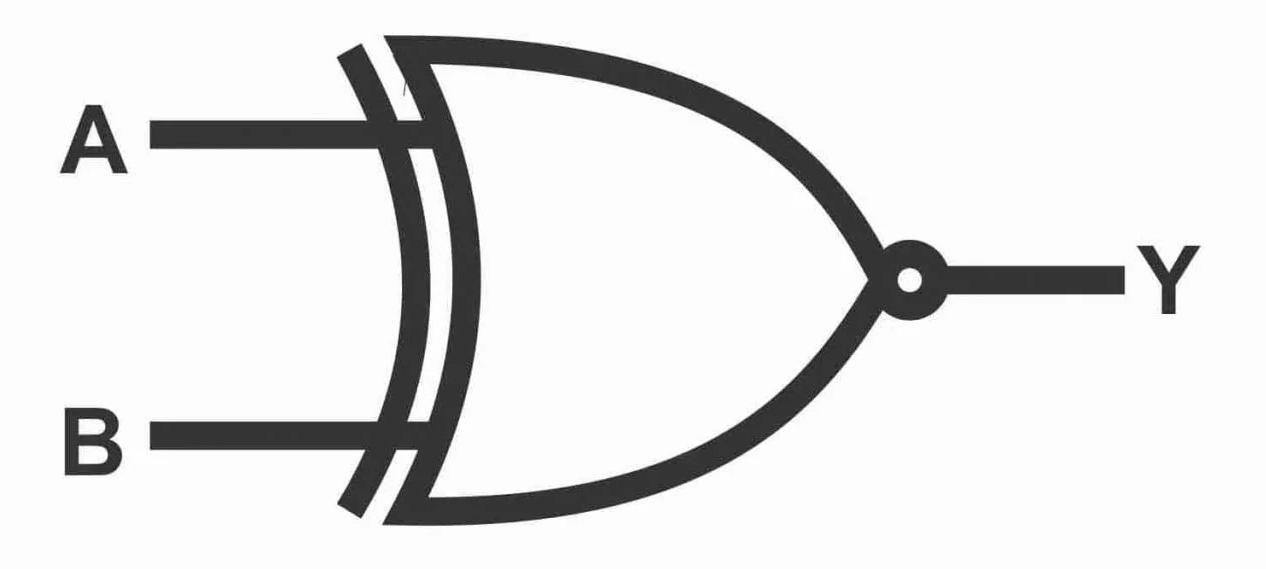
XNOR Gate Symbol
Truth Table for Derived Gates
| NAND () | NOR () | XOR () | XNOR () | ||
|---|---|---|---|---|---|
Boolean Axioms and Theorems
Fundamental Axioms
| Axiom Name | Primary Form | Dual Form |
|---|---|---|
| Binary Field | ||
| NOT Operation | ||
| Identity Axiom | ||
| Unit Axiom | ||
| Null Axiom |
Single-Variable Theorems
| Theorem Name | Theorem | Dual Form |
|---|---|---|
| Identity | ||
| Null Element | ||
| Idempotency | ||
| Involution | — | |
| Complements |
Multi-Variable Theorems
| Theorem Name | Primary Form | Dual Form |
|---|---|---|
| Commutativity | ||
| Associativity | ||
| Distributivity | ||
| Covering | ||
| Combining | ||
| Consensus | ||
| De Morgan’s Law |
Principle of Boolean Duality
The dual of a Boolean expression is obtained by swapping with , with , and vice versa, while leaving all variables unchanged.
Property of Duality
If an algebraic theorem or equality is proven true, its dual form is guaranteed to be true without requiring a separate proof. Note that Duality is distinct from De Morgan’s Theorem (Duality does not negate variables).
Proof Techniques for Boolean Expressions
1. Proof by Perfect Induction (Truth Tables)
Exhaustively verifies that both sides of a Boolean expression evaluate to identical truth values across all possible input variable combinations.
Example: Prove De Morgan’s Law
| ** ** |
Result: Columns and are identical for all inputs, proving the identity.
2. Algebraic Proof
Applies axiomatic identities step-by-step to transform one side of an equation into the target expression.
Example: Prove the Combining Theorem