Abstract
Multithreading can be implemented either inside the operating system kernel (Kernel-Level Threads) or within a user-space runtime library (User-Level Threads). While Kernel-Level Threads support multi-core parallel execution and independent I/O handling, User-Level Threads eliminate system call overhead to deliver lightweight thread operations. Modern operating systems overwhelmingly select the 1:1 Kernel-Level Threading Model.
- Category: OS Architecture & Thread Mapping Models
- Core Thread Models: 1:1 (Kernel), M:1 (User-Level), M:N (Hybrid).
- Key Trade-off: System call latency vs. multicore parallel execution and I/O blocking.
Kernel-Level Threads (1:1 Model)
In a Kernel-Level Threading system, the OS kernel is explicitly aware of all threads. The kernel manages thread creation, maintenance, state queues, and scheduling directly.
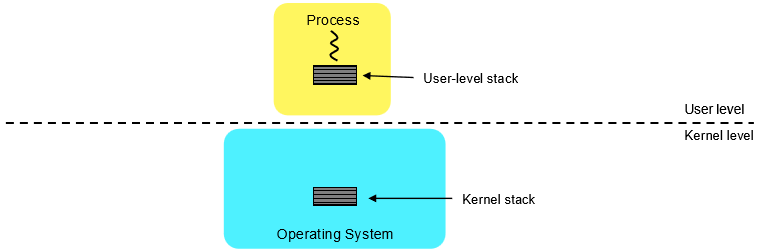
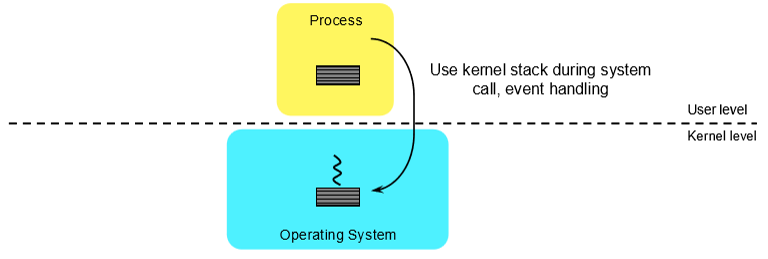
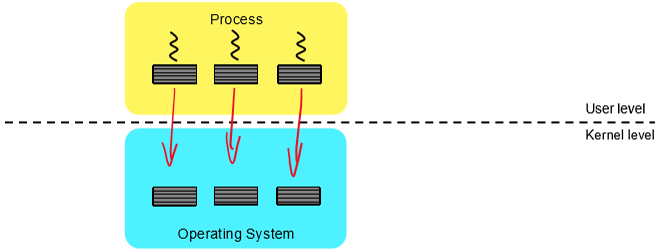
- Mapping: Each user thread maps 1:1 to an independent kernel thread (
One-to-One Model). - Implementations: Windows Threads, Linux
pthreads(viaclone()), POSIXpthread_create().
Advantages
- True Parallelism: The kernel can schedule separate threads belonging to the same process across multiple physical CPU cores simultaneously.
- Non-Blocking I/O: If one thread performs a blocking I/O system call (e.g.,
read()), the kernel blocks only that specific thread, allowing remaining threads in the process to continue running.
Disadvantages
- Operation Overhead: Creating, context-switching, or synchronizing kernel threads requires trapping into Kernel Mode via system calls, making operations slower than standard procedure calls.
User-Level Threads (M:1 Model)
In a User-Level Threading system, threads are managed entirely in user space by a runtime library or language virtual machine (e.g., Early Java Green Threads). The OS kernel is completely unaware of user-level threads; it sees only a single-threaded process.
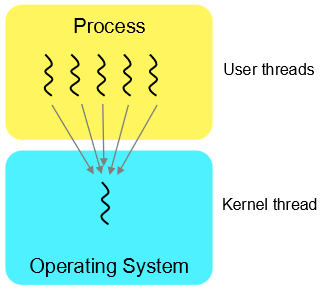
- Mapping: Multiple user threads map M:1 to a single kernel process (
Many-to-One Model).
Advantages
- Ultra-Fast Performance: Creating, context-switching, and destroying threads are performed via simple user-space C procedure calls—10x to 100x faster than kernel system calls.
- Custom Schedulers: Applications can implement language-specific lightweight cooperative scheduling policies.
Disadvantages
- Single-Core Limitation: Because the kernel sees only one process, it schedules the application onto a single CPU core. True hardware parallelism is impossible.
- Blocking System Call Hazard: If a single user-level thread executes a blocking system call (e.g.,
read()), the OS kernel puts the entire process into the Blocked state, freezing all other user-level threads inside that process. - Poor OS Integration: The kernel may make poor scheduling decisions (such as allocating CPU slices to a process whose user-level thread scheduler has no runnable threads).
Hybrid Threading Models (M:N Model)
To combine the speed of user-level threads with the multicore scaling of kernel threads, hybrid models multiplex user-level threads onto kernel-level threads (Many-to-Many Model, ).
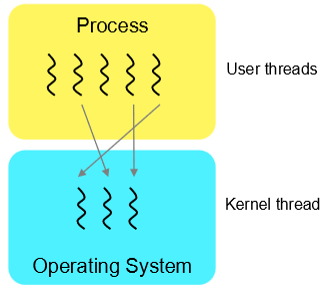
- Mechanism: A user-space scheduler manages lightweight user threads, while the OS kernel manages kernel threads (or Light-Weight Processes - LWPs) distributed across physical CPU cores.
- Trade-off: High structural complexity; requires complex communication between the kernel scheduler and user-space runtime schedulers (Scheduler Activations).
Summary Matrix of Thread Models
| Evaluation Feature | User-Level Threads (M:1) | Kernel-Level Threads (1:1) | Hybrid Model (M:N) |
|---|---|---|---|
| Thread Management Layer | User Library / Runtime | OS Kernel | Both User Library & OS Kernel |
| Context Switch Overhead | Extremely Low (Procedure Call) | Moderate (System Call Trap) | Low for user, Moderate for kernel |
| Multicore Parallel Execution | No (Single core bound) | Yes (True Parallelism) | Yes (Across kernel threads) |
| Blocking System Call Impact | Blocks the entire process | Blocks only the calling thread | Thread scheduler re-routes to other LWPs |
| Production Standard | Legacy / Specialty Green Threads | Industry Default (Linux, Win, macOS) | Go Goroutines, Erlang Schedulers |