Abstract
To protect the operating system from buggy or malicious applications—and to protect applications from each other—hardware must enforce privilege boundaries. Modern CPUs achieve this using Dual-Mode Operation, switching between User Mode and Kernel Mode via a hardware-managed mode bit.
- Category: Hardware Security & CPU Architecture
- Core Hardware Primitives: Mode Bit, Protected Control Registers, MMU.
- Primary Invariant: Unprivileged user code cannot directly execute privileged instructions or access kernel memory.
User Mode vs. Kernel Mode
The CPU core enforces privilege isolation using a hardware mode bit stored in a protected control register:
- Kernel Mode (Mode Bit = 0): The CPU can execute all machine instructions, access all physical memory addresses, and interface directly with I/O devices.
- User Mode (Mode Bit = 1): The CPU can execute only non-privileged instructions. Any attempt to execute a privileged instruction or touch restricted memory triggers an immediate hardware trap.
flowchart LR
    USER_MODE["<b>User Mode (Mode Bit = 1)</b><br/><br/>• User applications run here<br/>• Non-privileged instructions only (ADD, SUB, MOV, MOVSD, etc)<br/>• Direct hardware / arbitrary memory access BLOCKED"]

    KERNEL_MODE["<b>Kernel Mode (Mode Bit = 0)</b><br/><br/>• OS Kernel runs here<br/>• Privileged instructions ENABLED<br/>• Unrestricted access to physical hardware and memory"]

    USER_MODE -->|"Trap / Event (Hardware Switches Mode)"| KERNEL_MODE
    KERNEL_MODE -->|"Hardware Return (Restore State)"| USER_MODE

    classDef cellStyle font-size:15px,padding:12px;
    class USER_MODE,KERNEL_MODE cellStyle
Privileged Instructions
Privileged instructions are a restricted subset of CPU commands that only execute when the mode bit is set to Kernel Mode (). If executed in User Mode, the CPU halts execution and raises a hardware fault.
Key categories of privileged instructions include:
- I/O Operations: Reading or writing directly to raw disk controllers, network cards, or GPU registers.
- Memory Management State: Modifying Page Table Pointers, Segmentation registers, or clearing Translation Lookaside Buffer (TLB) entries.
- CPU Control Registers: Changing CPU operational flags, toggling interrupt enable bits, or altering the mode bit itself.
Memory Protection
The OS kernel must protect its memory from user programs, while also isolating user programs from one another.
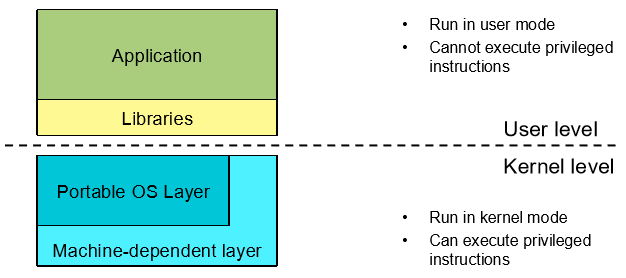
This protection is enforced at hardware speed by the Memory Management Unit (MMU):
- Page Table Pointers & Permissions: Define which virtual memory ranges are accessible, readable, writable, or executable by user-mode code.
- Segmentation & TLB: Enforce hardware memory boundaries on every memory access instruction.
Software Elevation vs. Hardware Privilege
Running an application as
rootor Administrator grants software-level API permissions inside the OS, but the CPU still executes that code in User Mode. It cannot execute privileged CPU instructions without trapping into the kernel via a system call.