Abstract
In Unix-like operating systems, the Inode (Index Node) serves as the core metadata structure for file management, using an unbalanced multi-level index to efficiently handle both small and massive files. File systems anchor root directory traversal at a fixed Superblock location, track block allocation via Free Maps, and resolve hierarchical path names (e.g.,
/one) by iteratively reading directory entries and inode block pointers.
Unix Inode Structure & Metadata
In Unix file systems, every file and directory is represented on disk by an Inode (Index Node) identified by a unique Inode Number. An inode contains all system metadata for a file except its filename (which is stored inside directory entry blocks).
Inode Metadata Fields
- File Size: Exact size in bytes and allocated block count.
- Ownership: User ID (UID) and Group ID (GID) of the file owner.
- Protection Bits: Access mode flags for user, group, and others (
rwx). - Link Count: Total number of directory entries pointing to this inode.
- Timestamps: Timestamps for creation, modification, last access, and inode state change.
Unbalanced Index Structure
To optimize access for common workloads—where most files are small but a few are extremely large—Unix inodes use an unbalanced index pointer array (typically 15 pointers total):
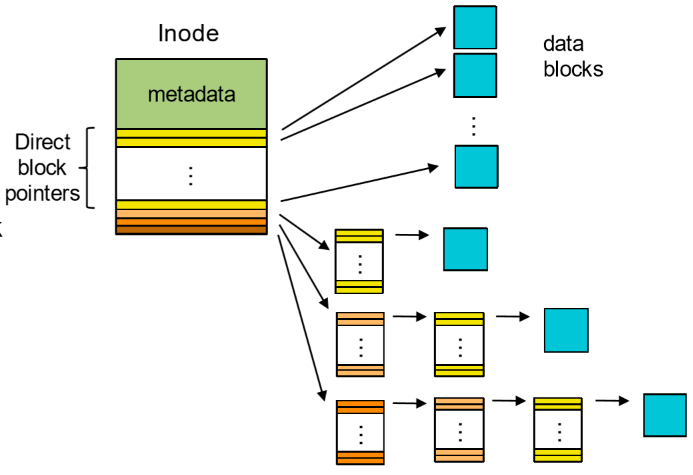
- Direct Pointers (12 pointers): Point directly to the first 12 data blocks. Small files ( for blocks) require zero indirection.
- Single Indirect Pointer (1 pointer): Points to a disk block containing pointers to data blocks.
- Double Indirect Pointer (1 pointer): Points to a block of single indirect pointers.
- Triple Indirect Pointer (1 pointer): Points to a block of double indirect pointers, enabling massive multi-gigabyte file support.
Inode Location & Disk Calculation
Inodes are compact ( each), allowing a single physical block to store multiple inodes. Given an inode number and the count of inodes that fit in a single block ():
The Superblock
The Superblock contains global file system state and configuration parameters required to mount and read the drive.
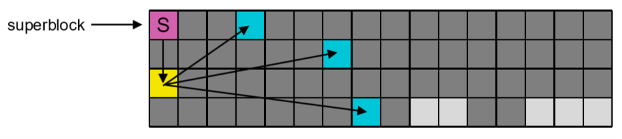
- Fixed Location: Located at a pre-determined, fixed disk offset so the OS kernel can always read it on startup.
- Root Directory Anchor: Stores a pointer to the root directory (
/) inode. - Path Translation Foundation: Serves as the starting anchor for resolving all absolute path names across the file system.
Free Block Allocation: Bitmaps vs. Linked Lists
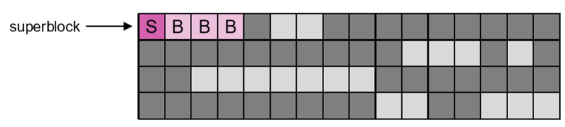
The file system maintains free state tracking to determine which physical data blocks and inode slots are available for allocation:
| Allocation Strategy | Implementation | Advantages | Disadvantages |
|---|---|---|---|
| Bitmap (Free Map) | An array of bits where each bit represents a block (). Separate bitmaps exist for data blocks and inodes. | Fast lookup for contiguous free blocks. | Requires dedicated disk space overhead to store the bitmap. |
| Linked List | Unallocated free data blocks store pointers to other free blocks in a chained list. | Zero extra storage overhead; uses unallocated blocks directly. | Slow and difficult to locate contiguous ranges of free blocks. |
Step-by-Step Path Name Translation
Opening a file via an absolute path name (e.g., /one) requires the operating system to iteratively traverse directories starting from the superblock:
sequenceDiagram
    autonumber
    participant Kernel as OS Kernel
    participant SB as Superblock
    participant RootInode as Root Inode (/)
    participant RootData as Root Data Block (/)
    participant TargetInode as File Inode (/one)
    participant TargetData as File Data Block

    Kernel->>SB: Read fixed disk location
    SB-->>Kernel: Return Inode Pointer for "/"
    Kernel->>RootInode: Read "/" Inode into memory
    RootInode-->>Kernel: Return "/" Data Block Pointers
    Kernel->>RootData: Scan entries for string "one"
    RootData-->>Kernel: Match found: Return Inode Number for "one"
    Kernel->>TargetInode: Read "one" Inode into memory
    TargetInode-->>Kernel: Return Data Block Pointers for "one"
    Kernel->>TargetData: Read first Data Block into memory
- Read Superblock: Query the fixed superblock location to get the inode pointer for the root directory (
/). - Read Root Inode: Load the
/inode into memory to locate the data blocks storing directory entries for/. - Scan Root Directory: Read the
/data block and search its entry list for the target filename"one". Retrieve"one"’s inode number. - Read File Inode: Load
"one"’s inode into memory to obtain its data block pointers. - Access Data: Read
"one"’s first data block into memory to service application read/write calls.