Abstract
System Protection encompasses the OS mechanisms that prevent accidental or malicious misuse of system resources. Protection rests on three foundational pillars: Authentication (identity verification), Authorization (permission policy), and Enforcement (access control execution). Modern operating systems combine Access Control Lists (ACLs) for static, user-friendly file policy definition with Capabilities (e.g., File Descriptors and Page Table Entries) for high-performance hardware and kernel enforcement.
Core Components of Protection
Operating system protection mechanisms resolve three distinct operational questions:
flowchart LR
    AuthN["<b>1. Authentication</b><br/><i>'Who are you?'</i><br/>Identifies the responsible party behind an action."]
    AuthZ["<b>2. Authorization</b><br/><i>'What are you allowed to do?'</i><br/>Determines permitted actions for each subject."]
    Enforce["<b>3. Enforcement</b><br/><i>'How is access controlled?'</i><br/>Executes checks to ensure unauthorized actions fail."]

    AuthN --> AuthZ --> Enforce
Key Protection Principles
System security architectures follow five canonical design guidelines:
- Permission Rather Than Exclusion (Default Deny): Default state grants zero access. Missing or misconfigured permissions fail safely by denying access.
- Complete Mediation: Every access to every object—including every instruction execution and memory reference—must be verified against authorization rules.
- Open Design (Kerckhoffs’s Principle): System security must not rely on keeping the implementation secret. Open-source systems (e.g., Linux) remain secure because safety depends on keys/credentials rather than algorithmic obscurity.
- Principle of Least Privilege: Subjects (users, processes) must execute with only the minimum set of privileges necessary to complete their task, reducing the blast radius of errors or exploits.
- Usable Security: Protection interfaces must be simple for users to manage. Overly complex security controls lead users to find dangerous workarounds.
User Identity & Privilege Escalation
All process execution in an operating system is tied to a User ID (UID), which serves as the base context for kernel permission checks.
graph TD
    User["Standard User Process"] -->|"Default Execution"| LowPriv["Restricted Permissions (Least Privilege)"]

    User -->|"sudo command"| Sudo["Authenticate via User Password<br/>Check /etc/group"] --> RootSudo["Execute Single Command as Root"]
    User -->|"su command"| Su["Authenticate via Root Password"] --> RootShell["Spawn Persistent Root Shell"]

    RootSudo --> Superuser["Root / Administrator<br/>(Bypasses All Kernel Checks)"]
    RootShell --> Superuser
- Root (Unix) / Administrator (Windows): A special administrative principal that bypasses kernel permission checks. Running routinely as root violates the Principle of Least Privilege because accidental commands (e.g.,
rm -rf /) execute unconditionally. sudovs.su:sudo: Executes a single command with root privileges. Authenticates using the user’s own password (if listed in/etc/grouporsudoers). Aligns with least privilege.su: Spawns a persistent root shell. Authenticates using the root user’s password. Higher risk due to persistent elevated context.
Authorization Models: ACLs vs. Capability Lists
Authorization evaluates actions attempted by Subjects (e.g., users, processes) on Objects (e.g., files, memory pages, sockets).
The authorization matrix can be represented in two distinct dimensional structures:
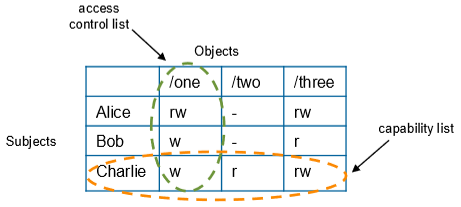
| Dimension | Representation | Primary Characteristics | OS Usage |
|---|---|---|---|
| Columns (Object-Centric) | Access Control List (ACL) | Each object maintains a list of allowed subjects and their permissions. Easy to manage, grant, and revoke. Slow to check at runtime. | File System Permissions (rwx, POSIX ACLs) |
| Rows (Subject-Centric) | Capability List | Each subject holds a collection of unforgeable tokens (“keys”) granting access to specific objects. Fast to verify, easy to transfer. | File Descriptors (FDs), Page Table Entries (PTEs) |
Operating System Hybrid Protection Paradigm
Because ACLs excel at policy management while Capabilities excel at runtime execution speed, operating systems combine both models across system layers:
sequenceDiagram
    autonumber
    participant App as User Process
    participant Kernel as OS Kernel
    participant ACL as File System ACL
    participant FDTable as Process FD Table (Capability)
    participant Data as File Data

    App->>Kernel: 1. open("/etc/config", O_RDWR)
    Kernel->>ACL: 2. Check File ACL against Process UID
    ACL-->>Kernel: Access Granted
    Kernel->>FDTable: 3. Allocate File Descriptor (FD #3)
    Kernel-->>App: 4. Return FD #3

    Note over App,Data: Subsequent I/O Ops Bypass ACL Checks:
    App->>Kernel: 5. read(FD #3, buffer, size)
    Kernel->>FDTable: 6. Fast Capability Check (Is FD #3 open for Read?)
    FDTable-->>Data: 7. Access Allowed -> Read Data
-
File System Protection (Static ACLs Capabilities):
- Policy Phase (ACL): Files store ACLs (Owner/Group/Public
rwx). When a process callsopen(), the kernel performs an expensive ACL lookup against the process UID. - Execution Phase (Capability): If allowed,
open()returns a File Descriptor (FD). The FD acts as a process-local capability token. Subsequentread()andwrite()calls validate the FD table directly ( capability check), bypassing the ACL.
- Policy Phase (ACL): Files store ACLs (Owner/Group/Public
-
Virtual Memory Protection (Dynamic Capabilities via PTEs):
- Memory protection requires checking every single instruction fetch and load/store in hardware.
- Page Table Entries (PTEs) function as hardware capabilities managed by the kernel and verified by the Memory Management Unit (MMU).

Derivation of Memory Capabilities
When creating process address spaces, the kernel sets PTE protection bits based on segment function:
| Memory Segment | Permitted Operations | PTE Protection Bits |
|---|---|---|
Code Segment (.text) | Read & Execute | Read-Only, Executable (R-X) |
Data Segment (.data / .bss) | Read & Write | Read/Write, No-Execute (RW-) |
| Stack & Heap | Read & Write | Read/Write, No-Execute (RW-) |