Abstract
A Page Table Entry (PTE) is a hardware-readable data structure that stores the physical mapping and operational status of a single virtual page. Flat, single-level linear page tables store an array of PTEs for every possible page in a process’s Virtual Address Space. While simple, linear page tables suffer from severe memory overhead in large address spaces, an issue that cannot be solved by Huge Pages alone.
- Category: Address Translation Structures
- Core Concept: Per-page metadata flags and address mapping.
- Primary Deficit: Linear page tables scale linearly with address space size, causing massive RAM waste.
Per-Process Paging Architecture
When using paging, each process maintains its own independent page table:
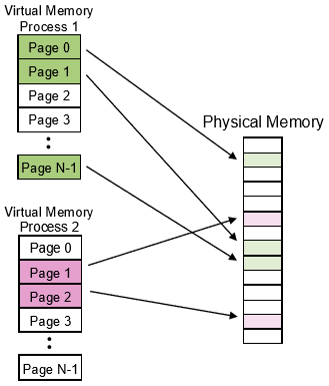
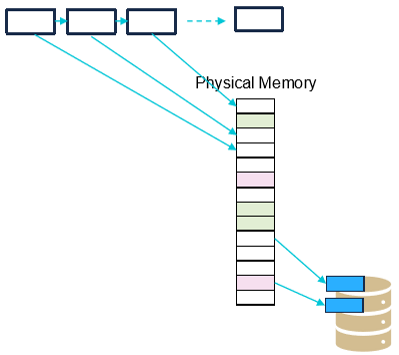
Physical memory allocations are sourced directly from an OS-managed free list of fixed-size frames. Swapping pages to disk uses the page table’s metadata flags to track valid in-memory pages versus swapped-out pages.
Page Table Entry (PTE) Bit Structure
A Page Table Entry contains the physical location mapping along with operational control bits evaluated by MMU hardware on every memory access:
| Dirty | Access | Valid | Protection | Page Frame Number |
|---|---|---|---|---|
| M | R | V | Prot | PFN / PPN |
| 1 | 1 | 1 | 3 | 20 |
| Field / Bit Name | Symbol | Description & Hardware Usage |
|---|---|---|
| Page Frame Number | PFN / PPN | Physical page frame number in RAM corresponding to the virtual page. |
| Valid Bit | V | Indicates whether the page is loaded in physical RAM. If 0, an access triggers a Page Fault exception. |
| Modify Bit | M / Dirty | Set by hardware on a write operation. Indicates the page has been modified and must be flushed to disk before eviction. |
| Reference Bit | R | Set by hardware on read or write. Used by OS page replacement algorithms to identify active pages. |
| Protection Bits | Prot | Defines allowed access modes: Read, Write, Execute (R/W/X). Protecting Virtual Page 0 with no permissions catches null pointer dereferences (causing a segmentation fault). |
Linear Page Table Memory Overhead
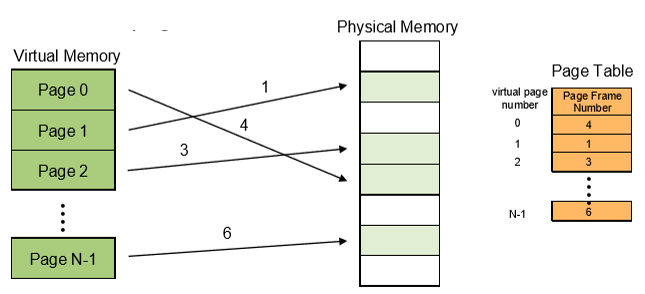
A linear page table assumes a flat array of PTEs indexed directly by the Virtual Page Number (VPN). The memory required to store a linear table scales with address space size:
32-Bit Address Space Calculation
- Address Space: .
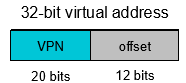
- Page Size: Offset.
- Virtual Page Number (VPN): .
- PTE Size: .
- Total Page Table Size:
If processes are running simultaneously, the system wastes of physical RAM strictly for linear page tables.
64-Bit Address Space Calculation
- Address Space: .
- Page Size: Offset.
- Virtual Page Number (VPN): .
- PTE Size: .
- Total Page Table Size:
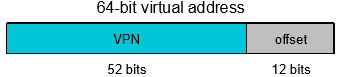
Linear page tables are completely unviable for large or 64-bit address spaces.
Huge Pages & Trade-offs
One approach to reducing the total entry count is allocating Huge Pages (e.g., or pages instead of ):
graph TD
    Root["<b>Huge Pages</b>"]

    Root --> Phys["<b>Advantages</b><br/>• Reduces TLB cache misses<br/>• Decreases total PTE count in small ranges"]
    Root --> Virt["<b>Disadvantages</b><br/>• Severe Internal Fragmentation<br/>• Fails to fix 64-bit flat table size"]
Why Huge Pages Alone Do Not Solve Single-Level Table Size
Even with huge pages, a single-level flat page table in a 64-bit space requires absurd memory:
- Pages (): Leaves for VPN .
- Pages (): Leaves for VPN .
While huge pages improve Translation Lookaside Buffer (TLB) performance for memory-intensive applications, solving the page table memory size problem requires hierarchical indirection via Multi-Level Page Tables.