Abstract
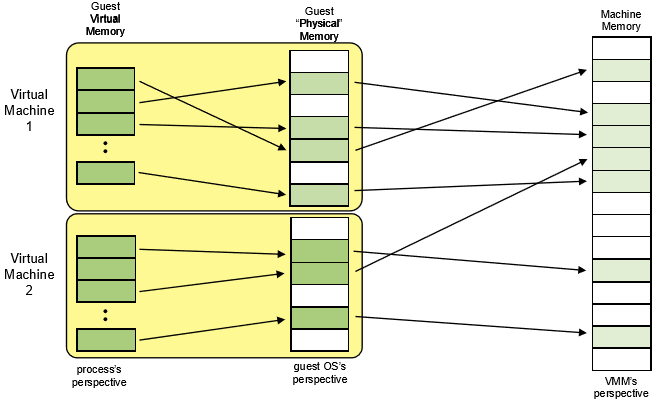
Memory virtualization introduces a three-tiered address mapping abstraction: Guest Virtual Address (GVA) Guest Physical Address (GPA) Host Physical Address (HPA). To ensure that hardware MMUs read physical DRAM locations directly, hypervisors originally maintained software Shadow Page Tables. Modern CPUs automate this translation using hardware Extended Page Tables (EPT) / Nested Page Tables (NPT), performing two-dimensional page walks in hardware.
Three-Tiered Address Abstraction
In a virtualized system, physical DRAM is controlled exclusively by the hypervisor. This requires decoupling the guest OS’s view of physical memory from real host RAM frames:
graph LR
    GVA["Guest Virtual Address<br/>(GVA)"] -->|Guest OS Page Table| GPA["Guest Physical Address<br/>(GPA)"]
    GPA -->|Hypervisor Mapping| HPA["Host Physical Address<br/>(HPA)"]
- Guest Virtual Address (GVA): The virtual address space allocated to application processes running inside the guest VM.
- Guest Physical Address (GPA): The contiguous memory space presented to the guest OS as its physical RAM.
- Host Physical Address (HPA): The actual hardware DRAM address signal generated on the host memory bus.
Software Memory Virtualization: Shadow Page Tables
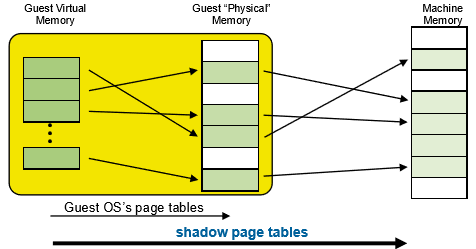
Because physical MMU hardware can only translate a single address mapping layer directly, early VMMs maintained software Shadow Page Tables that map GVA directly to HPA:
flowchart TD
    GuestPT["Guest Page Table<br/>(GVA -> GPA)<br/><i>Managed by Guest OS</i>"]
    VMMMap["Hypervisor Map<br/>(GPA -> HPA)<br/><i>Managed by VMM</i>"]

    ShadowPT["Shadow Page Table<br/>(GVA -> HPA)<br/><i>Loaded into Physical MMU (CR3)</i>"]

    GuestPT -.->|VMM Synchronization| ShadowPT
    VMMMap -.->|VMM Synchronization| ShadowPT
Synchronization & Trap Mechanics
- The hardware MMU control register (
CR3) is pointed directly to the Shadow Page Table (GVA HPA). - The VMM marks all memory pages containing Guest OS Page Tables as Read-Only.
- When the guest OS attempts to allocate memory or modify its page tables, the write operation triggers a page fault trap to the VMM.
- The VMM intercepts the fault, updates the Guest Page Table, computes the HPA mapping, updates the Shadow Page Table, and resumes guest execution.
Performance Overhead
Software Shadow Page Tables incur massive trap overhead because every single page table write or context switch inside a guest VM forces a costly hypervisor exit (
VM-Exit).
Hardware-Assisted Memory Virtualization: EPT / NPT
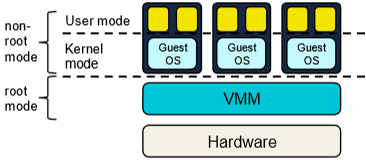
Modern processors (Intel VT-x Extended Page Tables (EPT) and AMD-V Nested Page Tables (NPT)) virtualize address translation directly inside the hardware MMU.
Hardware 2D Page Table Walk
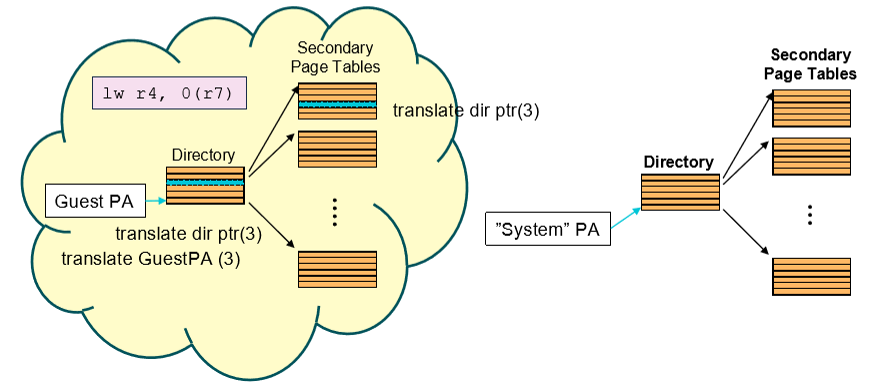
With EPT enabled, the hardware MMU performs a two-dimensional nested page table walk in hardware:
sequenceDiagram
    autonumber
    participant CPU as Hardware MMU
    participant GuestPT as Guest Page Table (GVA -> GPA)
    participant EPT as Extended Page Table (GPA -> HPA)

    CPU->>GuestPT: 1. Lookup GVA Directory Entry
    GuestPT-->>CPU: Return GPA of Page Table
    CPU->>EPT: 2. Translate GPA -> HPA via EPT
    EPT-->>CPU: Return HPA of Page Table
    CPU->>GuestPT: 3. Lookup GPA of target frame
    CPU->>EPT: 4. Translate GPA -> HPA via EPT
    EPT-->>CPU: Return Final Host Physical Address (HPA)
Benefits & Trade-offs
- Eliminates Hypervisor Traps: Guest page table updates execute natively without triggering software traps to the VMM.
- Memory Lookups: Increases hardware page table walk latency on TLB misses (up to 20+ hardware memory reads for a 2D walk), which is mitigated by large hardware TLB Caches.
Hardware Virtualization Support Overview
Modern server CPUs combine multiple hardware virtualization primitives:
| Subsystem | Hardware Technology | Functional Responsibility |
|---|---|---|
| CPU Modes | Intel VT-x / AMD-V | Adds VMX Root (Host) and Non-Root (Guest) execution modes. |
| Memory | Intel EPT / AMD NPT | Hardware 2D nested page table walks (GPA HPA). |
| I/O Translation | Intel VT-d / AMD-Vi (IOMMU) | Direct Memory Access (DMA) translation for guest VMs. |
| I/O Device | SR-IOV | Physical PCIe hardware device partitioning into Virtual Functions. |