Abstract
The Aho-Corasick Automaton is a space-efficient multi-pattern matching data structure that functions as a specialized finite state machine. By adding sequential “failure loops” and “dictionary links” onto a standard Multiway Trie backbone, it enables the simultaneous search of an entire dictionary of motif sequences during a single linear scan over a target text stream.
- Category: Automata-Based Search Structure
- Input Constraints: Preprocesses a static dictionary of multiple pattern string motifs.
- Key Advantage: Bypasses manual pointer rollbacks, processing text in strictly linear time.
- Typical use cases: Genomic restriction enzyme motif mining, intrusion detection signature matching, text spam filtering layers.
The Scaling and Restart Problem
In fields like molecular biology, discovering millions of short motif sub-sequences (of aggregate count ) inside a massive genome string (of length ) introduces major computational bottlenecks:
- The Naive Scanning Baseline: Searching for each motif sequence individually against every text offset yields a sluggish execution runtime of (where represents the average character length of a motif pattern).
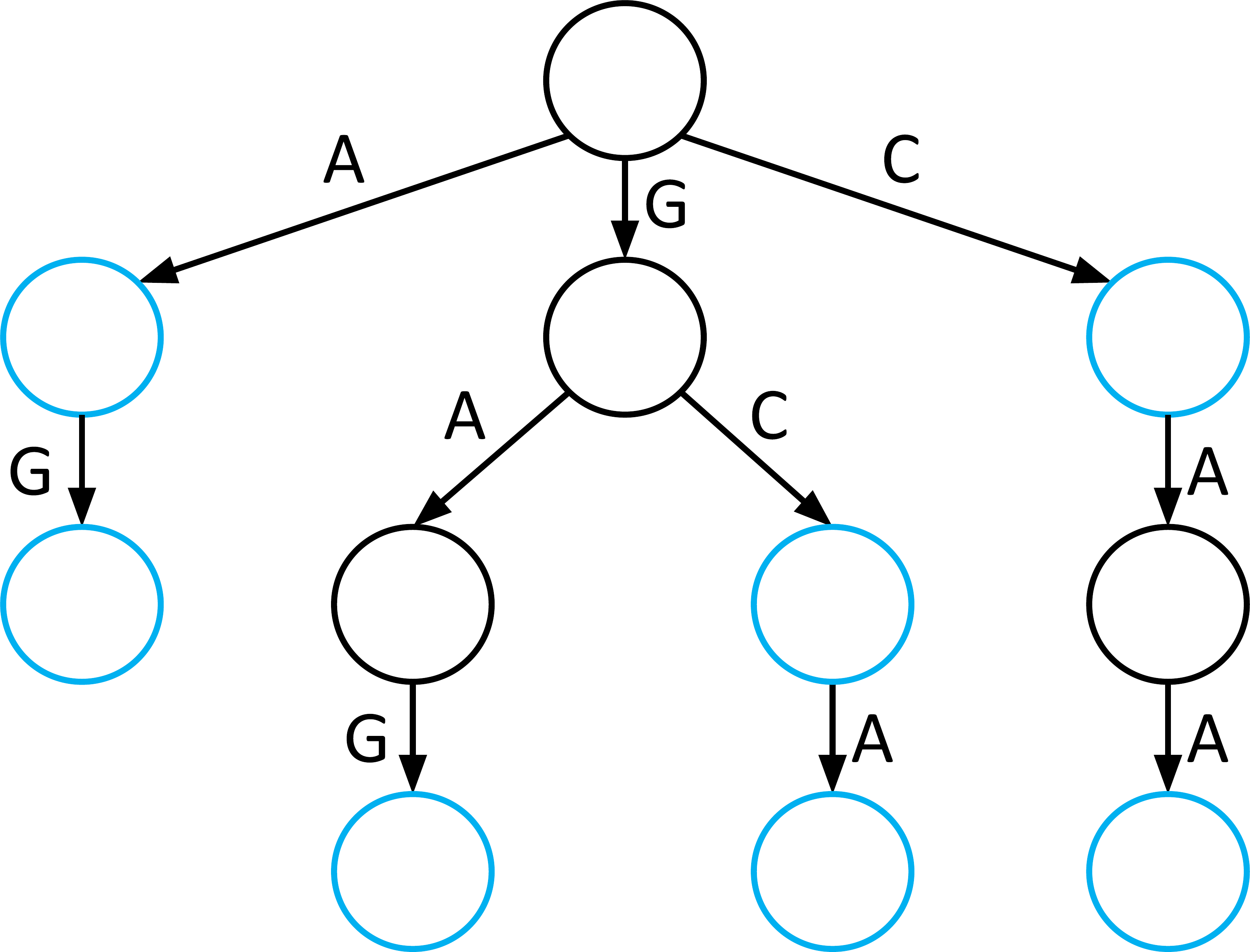
- The Multiway Trie Deficit: Combining motifs into a prefix tree enables checking multiple candidate words simultaneously. However, whenever a character mismatch manifests down a path, the text search pointer must roll back and restart the matching loop from the very next character offset in the genome, leading to a degraded runtime.
The Structural Tracking Shortcuts
The Aho-Corasick Automaton solves this tracking restart bottleneck by constructing secondary fallback shortcuts across the Trie layout. These allow the search pointer to pivot to alternative word branches without ever re-reading characters in the text stream.
1. Failure Links (Error Recovery Routing)
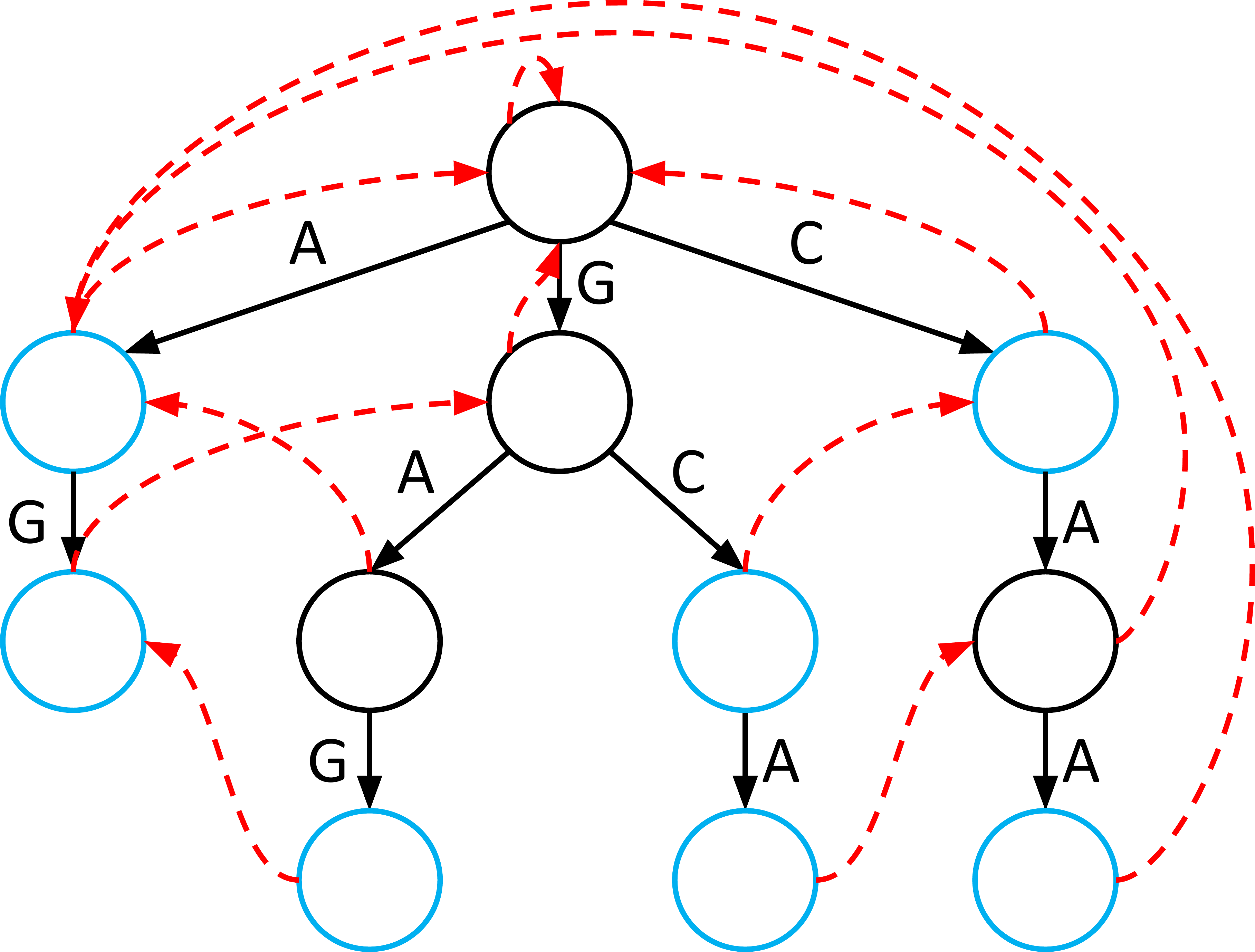
A Failure Link connects an active node to an alternative internal node if and only if the characters trace-path leading to constitutes the longest possible proper suffix of the trace-path leading to .
- Fallback Behavior: When an incoming character from the text stream fails to match any available child edge of the current node state, the automaton follows the failure link to recover.
- State Preservation: This jump preserves the lookahead progress already made by immediately landing the pointer at the prefix of another dictionary word sharing matching characters.
Algorithm 26 Aho-Corasick Failure Link Construction
procedure BuildFailureLinks(root)
for each child of root do
Enqueue(queue, curr)
while IsEmpty(queue) == do
Dequeue(queue)
for each child of curr with edge label do
while do
if x has child with edge label then
break
if then
break
Enqueue(queue, child)
2. Dictionary Links (Nested Keyword Detection)
When short patterns reside entirely inside longer words (e.g., motif "A" nested inside string "GCA"), a search engine can easily glide past the shorter pattern because its terminal match occurs early.
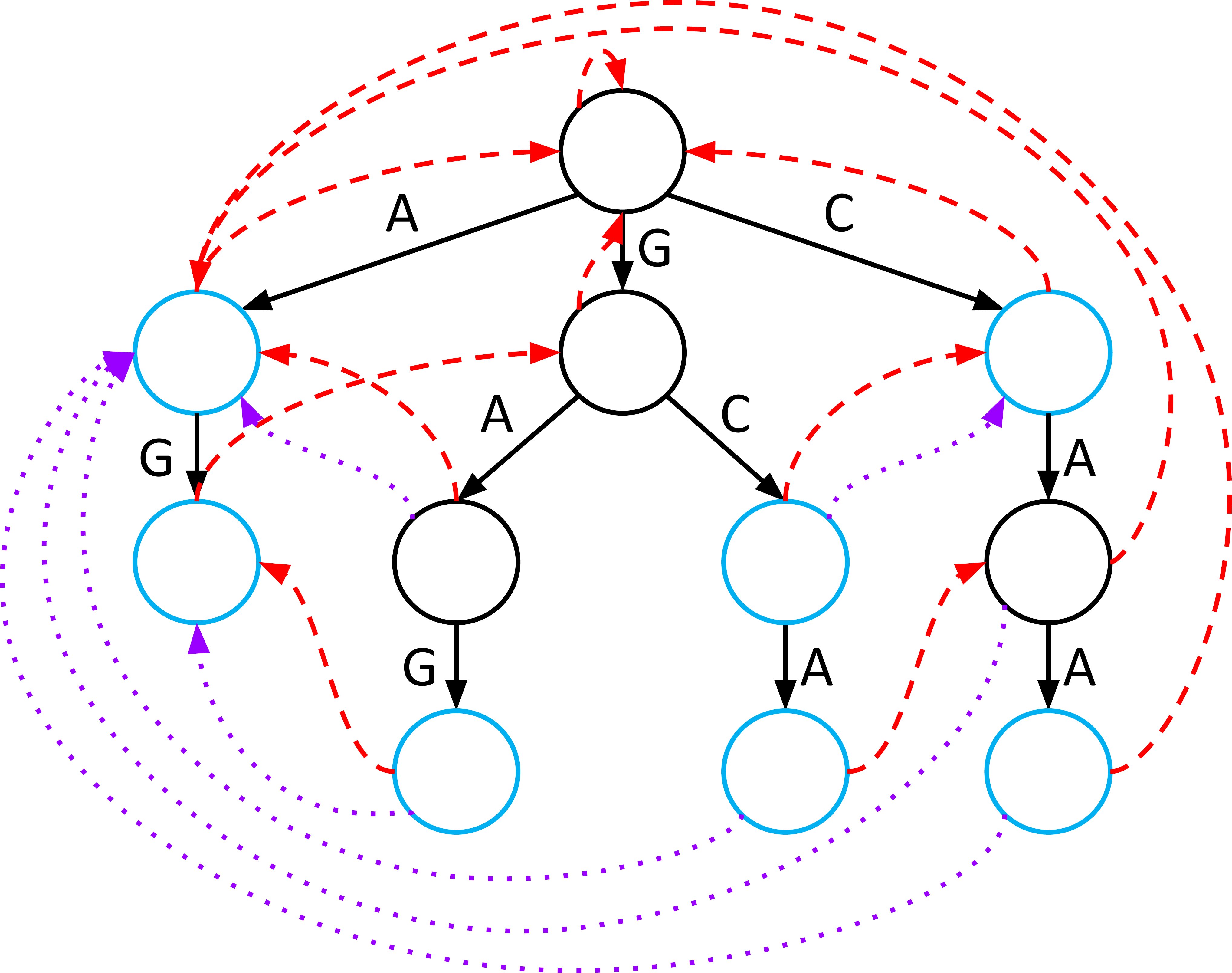
- The Blueprint: A Dictionary Link points from a node directly to the nearest reachable node that represents an explicit complete word entry by following failure tracks.
- Reporting: Whenever the tracking pointer lands on a node state, the engine follows its dictionary links to emit notifications for every nested keyword ending at that exact text offset.
Data Structure Operations
Preprocessing Automaton Setup
- Assemble a standard Multiway Trie containing all targeted search patterns.
- Run a Breadth First Search (BFS) traversal loop across the tree nodes to map failure links row by row.
- Pre-calculate dictionary link pointers to capture overlapping and nested matches.
The Linear Scanning Cycle
The search pass operates in strictly deterministic time because the stream index pointer only moves forward. If an edge mismatch triggers fallback tracking, the automaton state updates via failure jumps while the text pointer remains stationary.
- Time Complexity: runtime execution.
Algorithm 27 Aho-Corasick Text Stream Scanning
procedure ScanStream(text, root)
for each character in text do
while curr cannot move to do
if then
break
if curr has child with edge label then
ReportAllMatches(curr)
Performance Complexity Comparison
| Search Architecture Pattern | Time Complexity Profile | Operational Scan Efficiency |
|---|---|---|
| Naive Scan Pattern | Extremely Slow (Redundant rescans) | |
| Multiway Trie Structure | Moderate (Requires pattern rollbacks) | |
| Aho-Corasick Automaton | Optimal Linear Throughput |