Abstract
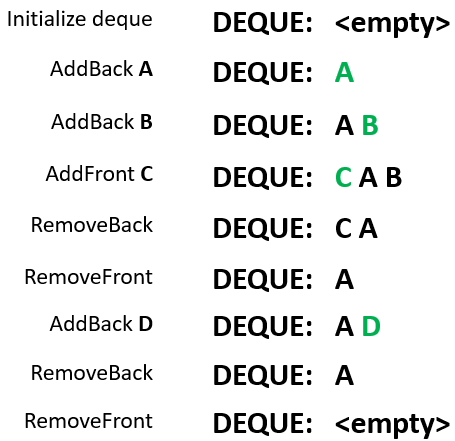
A Deque (Double-Ended Queue) is an Abstract Data Type that allows for insertion and removal of elements from both the front and the back. It serves as a generalized linear list supporting bi-directional growth, combining Stack and Queue workflows into a single interface.
- Category: Linear Boundary ADT
- Primary Interface Capability: Direct edge manipulation.
- Common Structural Implementations: Doubly-Linked Lists or Circular Arrays.
Formal Operational Contract
A compliant Deque interface exposes six core operations:
| Function | Operational Action |
|---|---|
addFront(element) | Inserts a new element at the beginning of the Deque. |
addBack(element) | Inserts a new element at the trailing end of the Deque. |
peekFront() | Returns the value of the first element without removing it. |
peekBack() | Returns the value of the last element without removing it. |
removeFront() | Removes the first element from the Deque. |
removeBack() | Removes the trailing element from the Deque. |
Implementation Frameworks
The Deque interface contract can be backed by two primary structures, each imposing unique algorithmic trade-offs:
1. Doubly-Linked List Backbone
Maintains global, explicit references to head and tail node objects.
- Boundary Performance: Guaranteed true for all six core operations via isolated pointer manipulation.
- Memory Footprint: Fully dynamic; allocates node blocks as needed without wasting capacity.
- Trade-off Risk: Accessing or reading elements situated in the middle of the collection requires an pointer-chasing traversal loop.
2. Circular Array Backbone
Utilizes a bounded flat array paired with wrapping indexing logic.
- Boundary Performance: for lookup and removal operations; addition steps are amortized but can occasionally spike to if a capacity resize event is triggered.
- Memory Footprint: May pre-allocate large continuous memory blocks, introducing memory overhead if that capacity goes unused.
- Trade-off Risk: Provides rapid random access to middle positions via simple modular index arithmetic.
Backing Structural Trade-offs
| Performance Metric | Doubly-Linked List Implementation | Circular Array Implementation |
|---|---|---|
| Boundary Operations | Strictly constant time | Amortized constant time |
| Random Access | linear traversal cost | constant time math |
| Memory Footprint Style | Node pointer overhead per item | Unused capacity buffer overhead |
| Worst-Case Add Latency | continuous performance | transient spikes during resizing |
Operational Complexity Analysis
Architectural Priority Details
Under a Doubly-Linked List backbone,
removeBackruns in constant time because each node retains an explicit pointer to its predecessor (node.prev). In a Singly-Linked List,removeBackdegrades to because the system must trace forward from theheadto locate the node preceding thetail. This makes the Doubly-Linked List the standard backing structure for Deque variants.