Abstract
The Map ADT (often called an associative array) allows us to map keys to their corresponding values. While a standard Hash Table checks for the presence or absence of a key, a Hash Map associatively pairs each key with a distinct value record, enabling fast average constant-time storage, retrieval, and removal based on key queries.
- Category: Key-Value Storage Structure
- Stores: Associative pairs of hashable key identifiers linked to variable value payloads.
- Built on top of: Arrays, Hash Tables, and Collision Resolution frameworks.
- Typical use cases: Database index records, grade books, caching systems, representing one-to-many relationship maps.
Core Structure
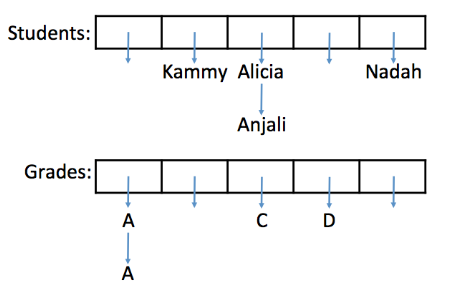
A Hash Map utilizes an underlying backing array of entries where each slot stores a key and its value together as a unified pair. Keys must be hash-able and support an equality test to handle uniqueness checks and bucket routing.
Key Idea
When we find, insert, or remove elements in a Hash Map, the operational routing algorithms mirror those of a standard Hash Table exactly, but everything is processed strictly with respect to the key. Once the target key’s slot is located, the associated value payload is exposed.
Structural Properties
- Invariant: Every stored value is structurally bound to a unique key identifier. Duplicate keys cannot point to multiple independent primary entries simultaneously within the base map structure.
- Overwriting Behavior: Attempting to insert a key that already exists will not abort the operation. Instead, the original value associated with that key is overwritten by the new input value.
- Order Guarantee: Does NOT guarantee consistent element ordering. Iterating through a Hash Map yields elements in an unstable sequence determined entirely by hash distributions and collision arrangements.
Data Structure Operations
Insert(key, value)
Hashes the key to resolve its backing array index, replacing the old value with the new value if the key already exists.
- Time Complexity: average; worst-case under severe clustering.
Algorithm 7 Hash Map Insertion (Collision-Free Paradigm)
procedure Insert()
HashFunction()
if then
return
Find(key)
Traverses the probe sequence or chain corresponding to the key’s hash index and returns the associated value if found.
- Time Complexity: average case.
Algorithm 8 Hash Map Find
procedure Find()
HashFunction()
if then
return
else
return
Remove(key)
Locates the key inside the map, isolates its associated value payload for output preservation, and deletes the element entry.
- Time Complexity: average case.
Algorithm 9 Hash Map Removal
procedure Remove()
HashFunction()
if then
Delete()
return
C++ Language Implementation Detail
In the C++ Standard Template Library (STL), the primary implementation of a Hash Map is std::unordered_map, which relies on Separate Chaining for collision management.
#include <iostream>
#include <unordered_map>
#include <string>
#include <vector>

int main() {
    // Initializing a Hash Map
    std::unordered_map<std::string, std::string> gradeBook = {
        {"Kammy", "A"},
        {"Alicia", "C"}
    };

    // Inserting a new pair
    gradeBook.insert({"Bob", "B"});

    // Querying using the bracket operator
    std::cout << gradeBook["Kammy"] << std::endl; // Outputs: A
}
Duplicate Insertion Deviation
C++ deviates slightly from the traditional Map ADT specification during duplicate handling. When inserting a duplicate element using unordered_map::insert(), the container protects the original value and ignores the overwrite. To force a replacement value update, you must use the assignment bracket operator instead (gradeBook["Key"] = newValue).
Structuring One-to-Many Relationships
Hash Maps are often deployed to manage one-to-many relationship structures by mapping discrete keys onto a collection container value, such as a vector or an inner nested Hash Table.
// Mapping drawer labels to a vector of office items
std::unordered_map<std::string, std::vector<std::string>> desk = {
    {"pens", {"favPen", "redPen"}},
    {"personal papers", {"schedule"}}
};

// Modifying the nested vector collection value dynamically
desk["personal papers"].push_back("taxDocument");
Cascading Time Complexity Risks
When wrapping collection structures inside map values, the cost of accessing a nested item requires adding the find complexity of that inner collection container. For an unsorted backing vector containing elements, locating a nested target adds an internal linear lookup cost. If absolute constant-time access is required across all nested values, use an
std::unordered_setas the value type instead of a vector.