Abstract
A Randomized Search Tree (RST) is a specialized Treap structure where priorities are randomly generated upon insertion. This application of randomness simulates a completely uniform random insertion sequence, successfully securing an average-case time complexity across all operations regardless of the actual order in which keys are provided by the user.
- Category: Probabilistic Self-Balancing Tree
- Core Composition: Dual-attribute node tracking mapping a unique search key alongside a priority score.
- Balancing Invariant: Simultaneously maintains binary search tree and max-heap properties.
The Treap (Tree + Heap) Core Architecture
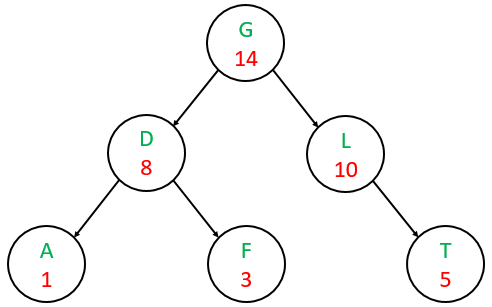
A Treap is a binary tree structure where each node explicitly encapsulates two structural attributes: a Key and a Priority. To protect the integrity of the architecture, it must satisfy two data layout properties simultaneously:
- BST Operational Invariant: The tree is sorted horizontally by keys ().
- Heap Operational Invariant: The tree is ordered vertically by node priorities (, operating under max-heap rules).
Fundamental Operations
Find(element)
Since a Randomized Search Tree functions as a valid, standard Binary Search Tree, lookups navigate down branches using key comparisons alone, bypassing priority scores entirely.
- Time Complexity: Bounded by tree height: operations.
Insert(key, priority)
Insertion updates the tree topology through a two-phase lifecycle:
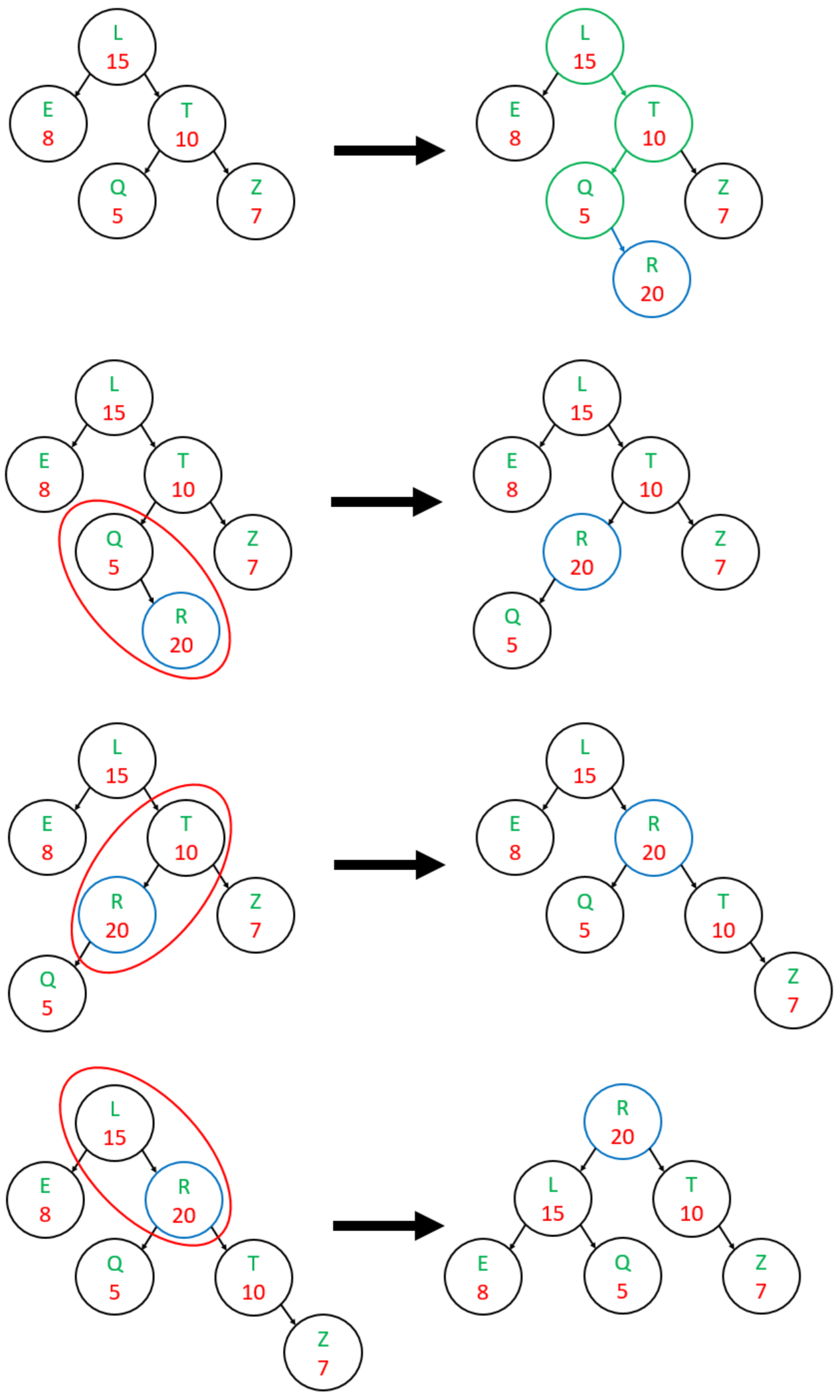
- BST Insertion Phase: Walk down the branches based solely on key comparisons, appending the new item as a terminal leaf node.
- Heap Fix Phase (Bubble Up): While the new node’s priority is greater than its parent’s priority, execute tree rotations to move the node up the structure without breaking the underlying left-to-right BST sequence.
Algorithm 48 RST Node Insertion
procedure Insert(key, priority, root)
PerformBSTInsertion(key, priority, root)
while and do
if then
AVLRight()
else
AVLLeft()
Remove(key)
- BST Removal Phase: Trace down the branches to isolate the target node matching the input key.
- Heap Fix Phase (Trickle Down): If the substitute successor node brought into the position violates the priority hierarchy, run tree rotations to shift it down until max-heap ordering properties are restored.
The Structural Tool: Tree Rotations
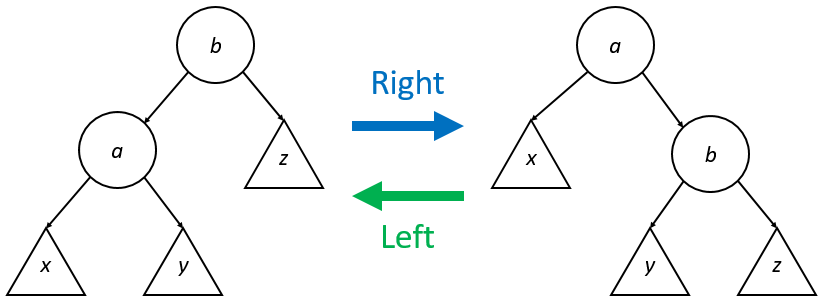
Rotations are constant-time pointer-swapping operations that modify the physical layout of tree branches while preserving the relative left-to-right sorted sequence of the keys.
| Rotation Style | Operational Description | Trigger Condition |
|---|---|---|
| Right Rotation | Promotes a left child into its parent’s structural position. | Triggered when a left child node registers a higher priority score than its parent. |
| Left Rotation | Promotes a right child into its parent’s structural position. | Triggered when a right child node registers a higher priority score than its parent. |
RST Balance Rotations
Algorithm 49 RST Right Rotation
procedure AVLRight(b)
if and then
else if and then
if then
Algorithm 50 RST Left Rotation
procedure AVLLeft(a)
if and then
else if and then
if then
Why Use Randomness?
In a native, non-balancing BST, introducing sorted data in sorted sequences (such as [1, 2, 3, 4, 5]) causes the nodes to stack into a single linear branch line. This degrades lookups to an expensive search cost. An RST resolves this sorting risk through a distinct pipeline:
- Accepts the incoming key value from the input stream.
- Generates an independent, random priority score from a uniform distribution.
- Inserts the key-priority pair into the Treap container.
Because the assigned priority weights are randomly distributed, the nodes bubble up into a balanced layout that mimics a standard tree built from a random insertion sequence. This keeps the branch height balanced on average, even if the input keys themselves are sorted or patterned.
Performance Complexity Summary
| Execution Case | Time Complexity | Structural Behavior Profile |
|---|---|---|
| Average-Case | Maintained via randomized priority distributions. | |
| Worst-Case | Occurs if random priority assignments happen to generate a sorted list layout (statistically rare). |
Worst-Case Mitigation
While an RST fixes average-case degradation, its absolute worst-case boundary remains . In real-time production systems where worst-case delays are unacceptable, developers instead select strict, deterministic height-balanced models like the AVL Tree or Red-Black Tree.