Abstract
Named after inventors Adelson-Velsky and Landis, the AVL Tree is a self-balancing Binary Search Tree (BST) that guarantees a worst-case time complexity of for search, insertion, and deletion operations. It achieves this performance by enforcing a strict structural balance property maintained through deterministic node rotations.
- Category: Balanced Hierarchical Tree
- Core Invariant: Balance factors across all nodes must strictly reside within the set .
- Balancing Strategy: Localized single or double pointer rotations executed during stack rollbacks.
Core Structural Properties
To prevent height degradation into a linear chain, an AVL tree enforces the Balance Condition at every internal node coordinate:
The Balance Invariant
For every individual node inside the tree, the structural heights of its left and right subtrees can differ by at most 1.
The mathematical representation of this tracking metric is the Balance Factor (BF):
A node state is considered structurally valid if and only if:
| Valid AVL Tree | Invalid AVL Tree |
|---|---|
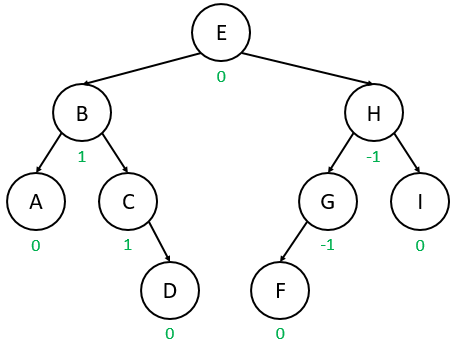 | 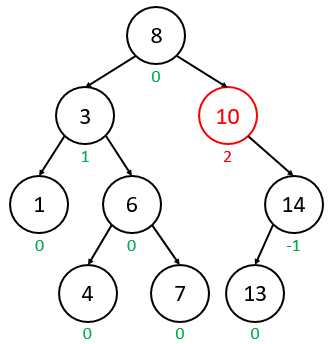 |
If an insertion or erasure causes to drift to , the node is flagged as imbalanced, immediately triggering structural rebalancing.
Mathematical Proof of Bounded Height
We can prove that the maximum height of an AVL tree containing nodes is bounded at by determining the minimum number of nodes required to form a valid AVL tree of height .
To construct the most sparse AVL tree possible of height , we provide one child with the minimum valid height and the opposing child with the minimum valid height , plus the root node itself:
Using a 1-based height index framework where base cases resolve to and , this recurrence relation matches the growth trajectory of the Fibonacci sequence. Because Fibonacci terms scale exponentially relative to the golden ratio (), we establish that:
This mathematical relationship confirms that the height of an AVL tree is strictly bounded at , ensuring guaranteed performance.
Rebalancing: Structural AVL Rotations
When mutations push an asset’s balance factor to , pointer adjustments are executed to restore the structural balance of the tree.
1. Single Rotations (The Straight-Line Cases)
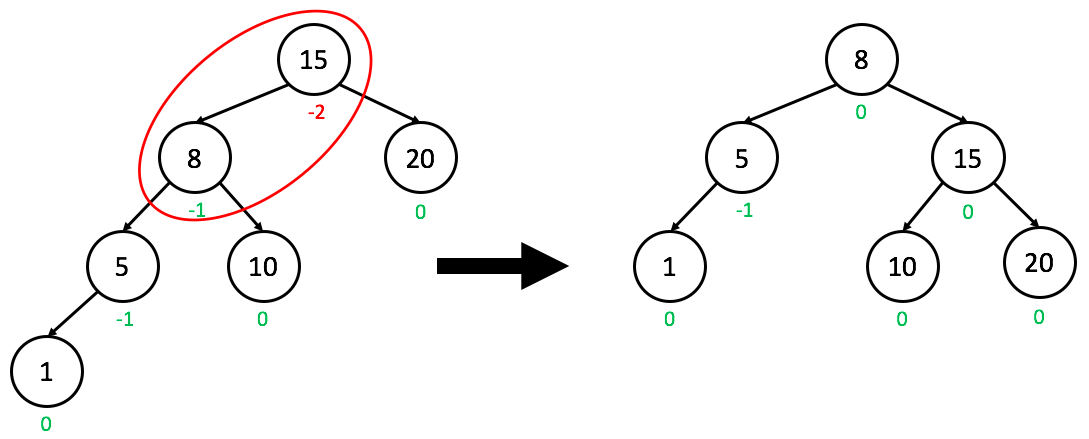
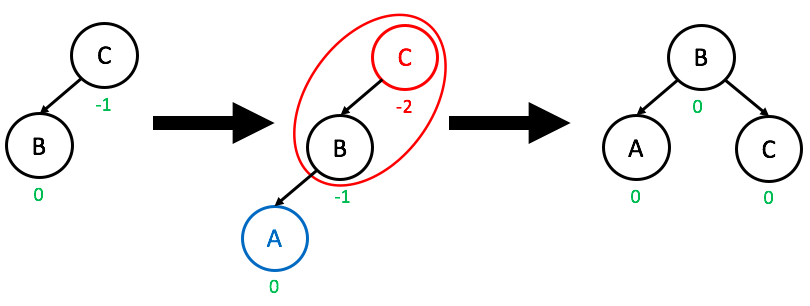
Single rotations resolve imbalances caused by insertions or removals occurring on the outer margins of a node’s extended subtree lineage (Left-Left or Right-Right configurations).
- Right Rotation: Corrects a Left-Left () linear imbalance.
- Left Rotation: Corrects a Right-Right () linear imbalance.
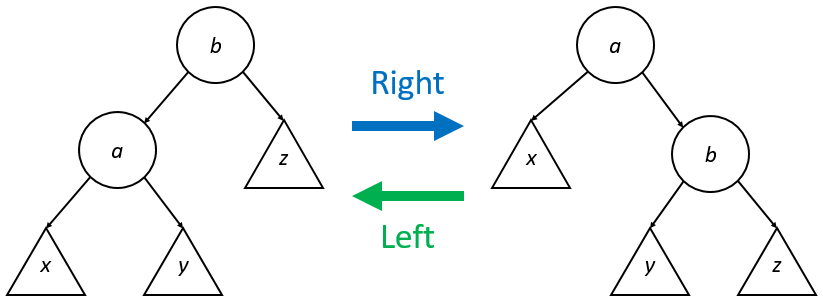
Algorithm 29 AVL Single Right Rotation
procedure AVLRight(b)
if and then
else if and then
if then
Algorithm 30 AVL Single Left Rotation
procedure AVLLeft(a)
if and then
else if and then
if then
2. Double Rotations (The Kink Cases)
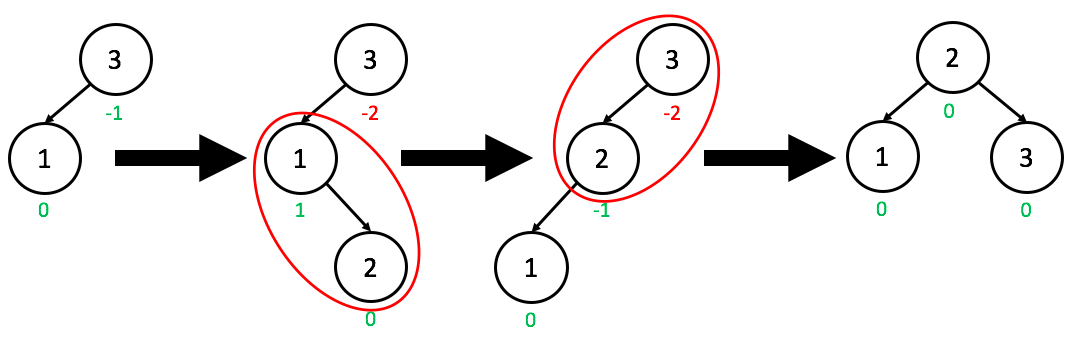
Double rotations correct zig-zag imbalances caused by mutations nested deep inside inner child coordinates (Left-Right or Right-Left configurations). A single rotation cannot resolve a zig-zag imbalance.
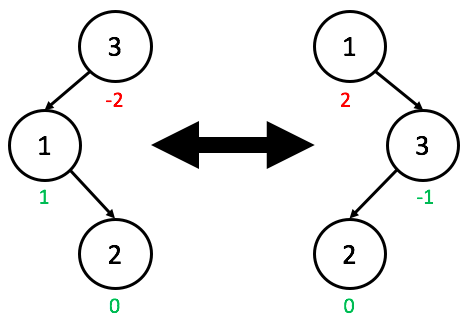
- Left-Right Double Rotation: Executes a primary left rotation on the child node, transforming the zig-zag into a straight line, followed by a right rotation on the parent node.
- Right-Left Double Rotation: Executes a primary right rotation on the child node, transforming the zig-zag into a straight line, followed by a left rotation on the parent node.
Algorithm 31 AVL Double Right Rotation
procedure DoubleAVLRightKink(a)
AVLRight()
AVLLeft(a)
Algorithm 32 AVL Double Left Rotation
procedure DoubleAVLLeftKink(a)
AVLLeft()
AVLRight(a)
Insertion Example Requiring Double Rotation
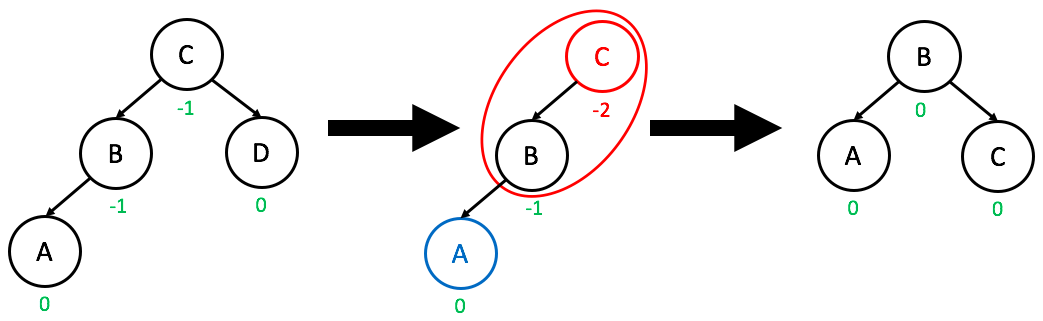
If we append a value of into our active tree array:
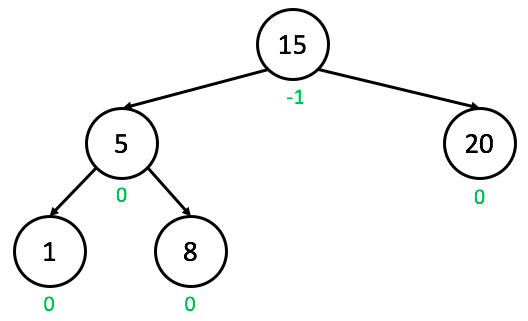
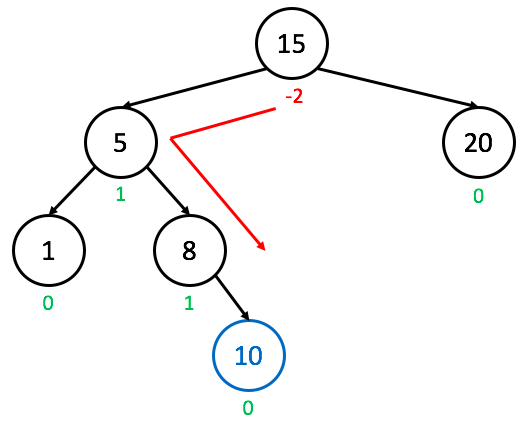
Following a traditional BST insertion path yields an imbalanced parent node structured in a zig-zag “kink” configuration:
To resolve this imbalance, a double rotation sequence is triggered. First, we execute a left rotation on child node to unroll the kink structure into a clean straight line:
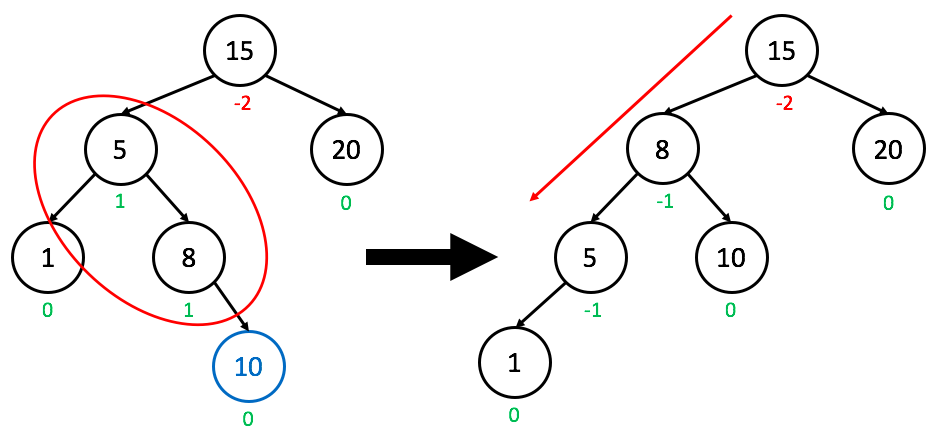
With the straight line achieved, we complete a right rotation on the root ancestor node to restore absolute tree height balance parameters:
Data Structure Operations
Every mutations pipeline couples traditional binary search tree logic with an integrated upward rebalancing sweep to maintain tree balance.
Find(element)
Operates identically to a standard BST lookup. The engine traverses down tree branches by comparing target values against active node keys.
Time Complexity:
Guaranteed since tree height is strictly controlled.
Insert(element)
- BST Phase: Trace downward to find the target leaf slot and insert the element.
- Update Phase: Walk back up toward the root starting from the new leaf node.
- Balance Phase: Recalculate balance factors at each ancestor node. If any ancestor registers , execute the appropriate single or double rotation.
Time Complexity:
to search downward plus for the upward rebalancing path.
Complex Insertion Walkthrough
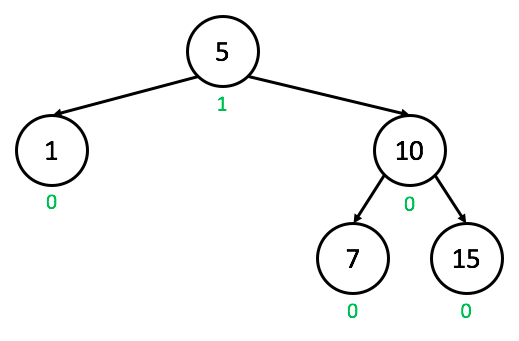
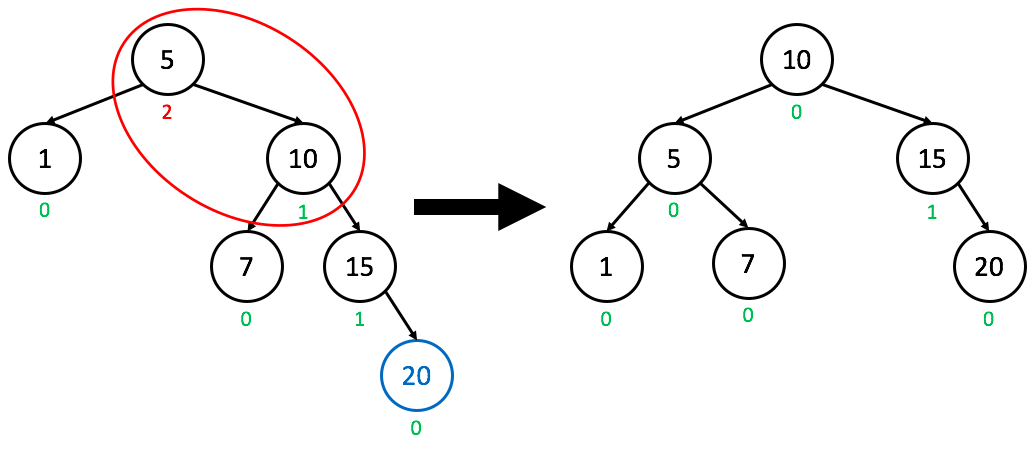
Consider inserting item into the following initial state:
A basic insertion drops the new leaf to the right margin, breaking balance codes up the chain:
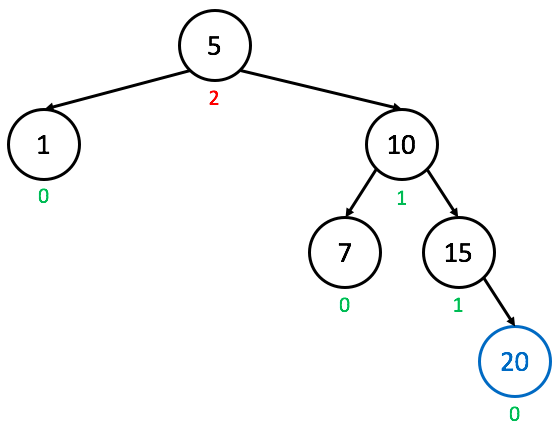
The engine immediately runs a left rotation centered at the root. Node assumes the root position, node is re-assigned to the right child slot of node , and node shifts into the left child coordinate of node :
Remove(element)
- BST Phase: Execute standard BST node removal rules (managing the 0, 1, or 2-child structural configurations).
- Update Phase: Start at the parent coordinate of the physically removed item and trace upward to the root.
- Balance Phase: Check balance factors at every level. Unlike insertion (where a single rotation fix is guaranteed to restore balance across the entire tree), removal mutations can alter heights globally, occasionally requiring multiple independent rotations along the path to the root.
Time Complexity:
search cost plus an multi-step balancing sweep.
Balanced Structural Performance Matrix
| Evaluation Metric | Standard Binary Search Tree | AVL Self-Balancing Tree |
|---|---|---|
| Average Search Time | ||
| Worst-Case Search Time | (Degrades into a linear list) | (Strictly enforced) |
| Balancing Strategy | None | Height-based balance factors () |
| Operational Passes | 1 Pass (Downward trajectory only) | 2 Passes (Downward mutation + Upward repair) |
Architectural Design Trade-off
While AVL trees offer excellent lookup speeds due to their strict balance property, they require a two-pass update cycle (down to mutate, then back up to balance). In heavy write-dominated production libraries, developers often select Red-Black Tree, which compromise on strict height balancing to complete structural repairs in a single pass.