Abstract
A Multiway Trie (or Prefix Tree) is a specialized tree structure designed specifically for storing and matching string sets. It achieves a worst-case time complexity of for lookups (where matches the length of the string) while preserving alphabetical tracking order—a dual capability that standard Hash Tables cannot match.
- Category: Character Path Prefix Tree
- Core Traversal Invariant: Paths represent character sequences; keys match edge transitions.
- Key Capabilities: High-speed prefix queries and auto-complete indexing.
Mechanics: The Edge-Path Mapping
In a Lexicon backed by a Multiway Trie, words are not stored as standalone properties inside single nodes. Instead, they are represented by the explicit sequence of labeled edges traversed starting from the root node:
- Edge Tracking: To locate a word, the search engine walks down edge transitions labeled with successive characters of the input string.
- Validation Flags: A word is confirmed to exist in the lexicon only if the character traversal loop terminates on a node explicitly marked with a
word-nodeboundary flag.
flowchart TD
    Root["<b>Root Node</b>"] -->|'c'| N1["<b>Node</b>"]
    N1 -->|'a'| N2["<b>Node</b>"]
    N2 -->|'t'| N3["<b>Word Node: 'cat'</b>"]
Edges vs. Nodes Notation
Inside a Multiway Trie, character letters label the connecting edges, not the nodes themselves. An empty Trie is a single root node with no outgoing transitions. Inserting a single-letter word like “a” requires creating a child node so the character “a” can label the newly formed edge.
Algorithmic Operations
Find(word)
Starts at the root node and sequentially follows the edge labeled with each consecutive letter of the word.
- Time Complexity: worst-case boundary.
flowchart TD
    Start(["<b>Start Search</b>"]) --> CheckEdge{"Does edge for<br/>character exist?"}

    CheckEdge -- No --> Missing(["<b>Return False</b><br><i>(Word is missing)</i>"])
    CheckEdge -- Yes --> Advance["Advance to child node"]

    Advance --> Exhausted{"Exhausted all<br/>characters?"}

    Exhausted -- No --> CheckEdge
    Exhausted -- Yes --> CheckWordNode{"Is final node flagged<br/>as a word-node?"}

    CheckWordNode -- Yes --> Found(["<b>Return True</b><br><i>(Word Found)</i>"])
    CheckWordNode -- No --> PrefixOnly(["<b>Return False</b><br><i>(Prefix Only)</i>"])
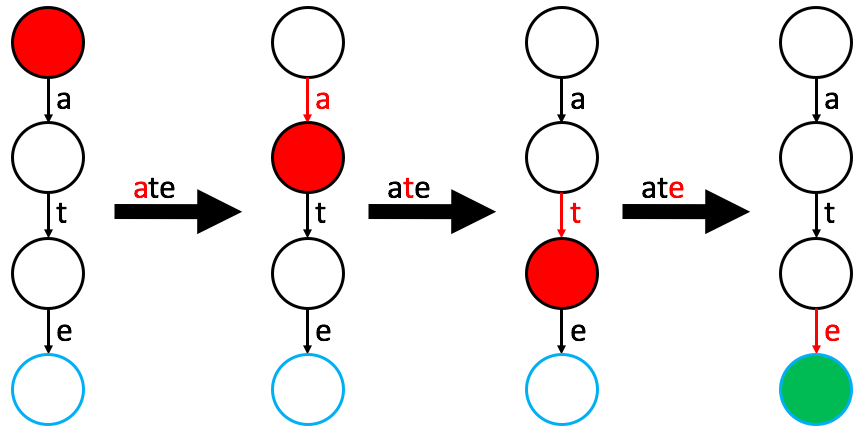
Algorithm 23 Multiway Trie Find Algorithm
procedure Find(word, root)
for each character in word do
if curr does not have an outgoing edge labeled by then
return
return curr.isWordNode
Insert(word)
Traces the character edge path from the root, creating new child nodes and labeled edges whenever a character transition is missing, and flags the final terminal node as a valid word-node.
- Time Complexity: operational steps.
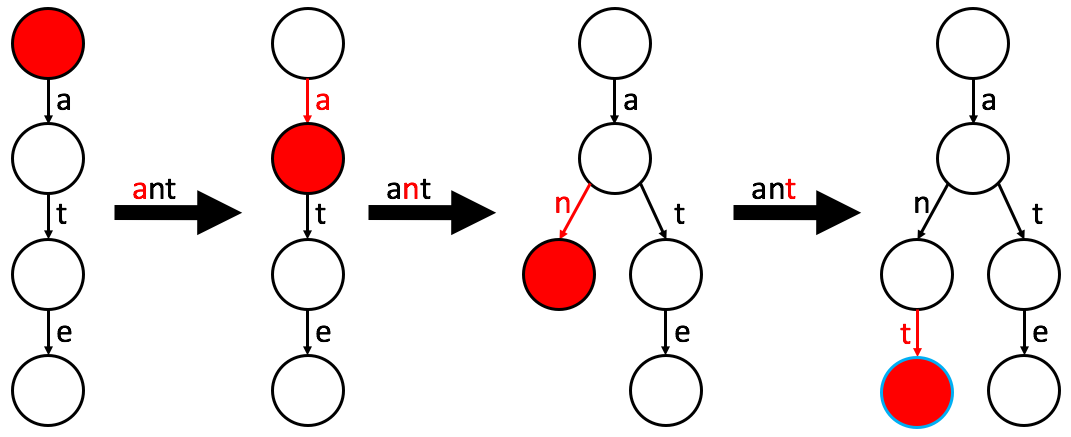
Algorithm 24 Multiway Trie Insertion
procedure Insert(word, root)
for each character in word do
if curr does not have an outgoing edge labeled by then
CreateChildNode(curr, c)
if curr.isWordNode true then
curr.isWordNode
Remove(word)
Follows the character path to the terminal node and unmarks the word-node flag. The parent nodes and character edges are preserved to protect other words that share those prefixes.
- Time Complexity: operational steps.
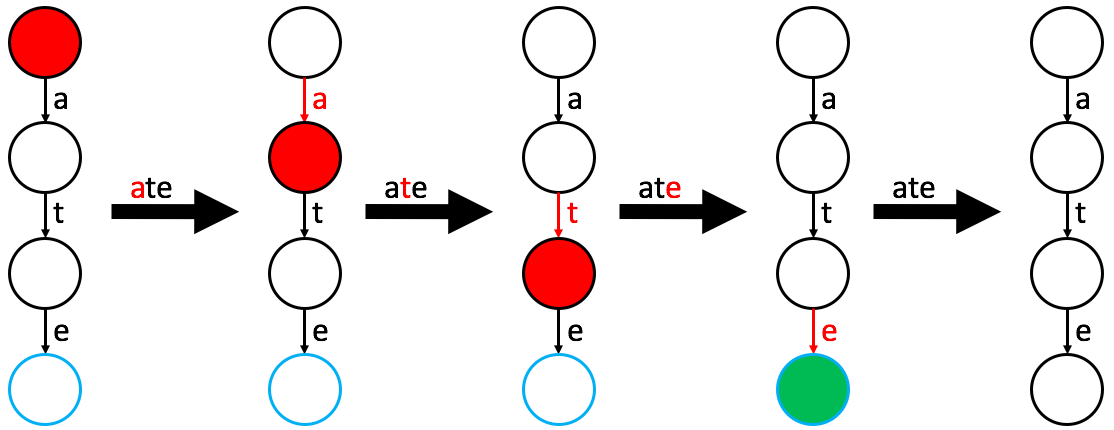
Algorithm 25 Multiway Trie Removal
procedure Remove(word, root)
for each character in word do
if curr does not have an outgoing edge labeled by then
return
if curr.isWordNode == true then
curr.isWordNode
Advanced Lexicon Features
The hierarchical prefix structure of the Trie enables operations that are difficult to implement using standard arrays or hash structures:
- Alphabetical Iteration: By performing a Pre-Order Traversal (visiting child branches in alphabetical order), the entire Lexicon can be printed in sorted order.
- Auto-complete Prefix Extraction: By traversing down a chosen prefix path (e.g., “cat”) and then executing a traversal across that isolated subtree, the engine instantly returns all stored words starting with that specific prefix (e.g., “cats”, “catnip”, “cathedral”).
Space Complexity and Memory Allocation Trade-offs
- Space Complexity: where represents alphabet size.
- The Memory Bottleneck: To maintain quick direct access to children during transitions, each node typically encapsulates an array of size (e.g., 26 pointers for English text). If the Trie is sparse, the vast majority of these pointer slots sit empty as
NULL, introducing significant memory overhead.
Structural Comparison: Hash Table vs. Multiway Trie
| Technical Feature | Hash Table Implementation (Average) | Multiway Trie Implementation (Worst-Case) |
|---|---|---|
| Search Speed | character hashing evaluation | character path edge steps |
| Alphabetical Ordering | No | Yes (Supported natively via pre-order walks) |
| Auto-complete Queries | Unsupported | Supported natively via subtree sweeps |
| Space Efficiency | Moderate ( flat bound allocations) | Low (Wasted array pointer slots per node) |
| Determinism Profile | Non-deterministic average-case performance | Strictly deterministic paths |