Abstract
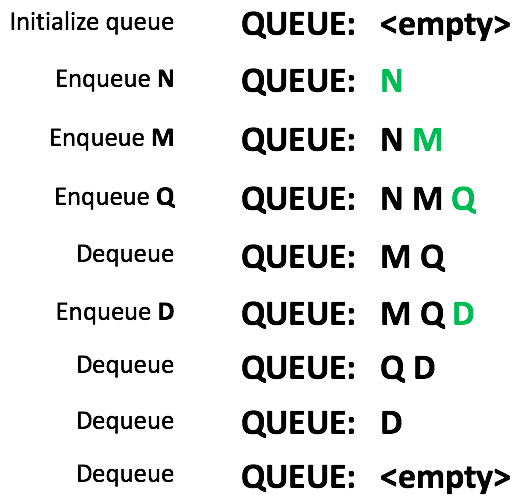
A Queue is an Abstract Data Type that strictly enforces the First In, First Out () operational protocol. It mimics real-world waiting lines: the first element introduced into the data container is guaranteed to be the first element extracted from the structure.
- Category: Bounded Monitored ADT
- Core Workflow: Elements enter at the trailing end and exit at the leading end.
- Common Structural Backbones: Deques, Doubly-Linked Lists, or Circular Arrays.
Core Functional Interface
The Queue ADT contract provides three primary operations:
| Operation | Detailed Functional Execution |
|---|---|
enqueue(element) | Appends a new element to the back of the Queue. |
peek() | Evaluates and returns the item sitting at the front boundary without removing it. |
dequeue() | Removes the item positioned at the front boundary of the Queue. |
Structural Composition via Deques
Because a Deque interface natively supports data adjustments at both boundary margins, it serves as an excellent structural backbone for a Queue. Wrapping a Deque within a restricted interface implements Queue behavior with minimal code duplication.
C++ Language Composition Map
class Queue {
private:
    Deque deque; // Backed internally by a Doubly-Linked List or Circular Array
public:
    bool enqueue(Data element) { return deque.addBack(element); }
    Data peek() { return deque.peekFront(); }
    void dequeue() { deque.removeFront(); }
    int size() { return deque.size(); }
};
Python Language Composition Map
class Queue:
    def __init__(self):
        self.deque = Deque()
    def enqueue(self, element):
        return self.deque.addBack(element)
    def peek(self):
        return self.deque.peekFront()
    def dequeue(self):
        self.deque.removeFront()
    def __len__(self):
        return len(self.deque)
Interface Return Variances
In this implementation pattern,
dequeue()behaves as a void operation that modifies state without returning a value. While languages like Java combine removal and value-return into a single function call (such aspoll()), architectures like C++ separate lookup (front()) and removal (pop()) into distinct steps for conceptual clarity.
Sequential Processing Pipeline
Interface Symmetry Challenge
Could a valid Queue be implemented by reversing boundary roles—using addFront() for insertion alongside peekBack() and removeBack() for removal?
- Answer: Yes. As long as entry and exit points are kept on opposite margins of the underlying data structure, the structural sequence is preserved.
Core Architectural Applications
- Buffer Management: Directs shared system pipelines, such as network packet routing queues, print spools, or customer support lines.
- OS Task Scheduling: Sequences incoming CPU threads in their exact chronological order of arrival.
- Graph Exploration Traversals: Serves as the foundational container that powers Breadth-First Search (BFS) algorithms to discover shortest paths across unweighted graphs.