Abstract
Mastering the division between Abstract Data Types (ADT) and explicit Data Structures is a core milestone in software design. This boundary isolates logical operations from low-level memory mechanics, shielding system applications from breaking when underlying data frameworks are optimized.
Strategic Structural Comparison
We distinguish between specification details and concrete physical layouts through a functional split:
Data Structures (The Physical Backbone)
A concrete implementation containing:
- The raw data values.
- The explicit physical relationships among data items.
- The literal algorithms applied to manipulate those values in memory.
- Role: Defines exactly how data is organized, allocated, and moved across machine memory addresses.
Abstract Data Types (The Logical Specification)
A behavioral contract from the user’s perspective:
- Specifies available operations.
- Describes only what needs to be achieved, not how it is executed.
- Provides an interface model entirely decoupled from memory management code.
The Structural Architecture Mapping
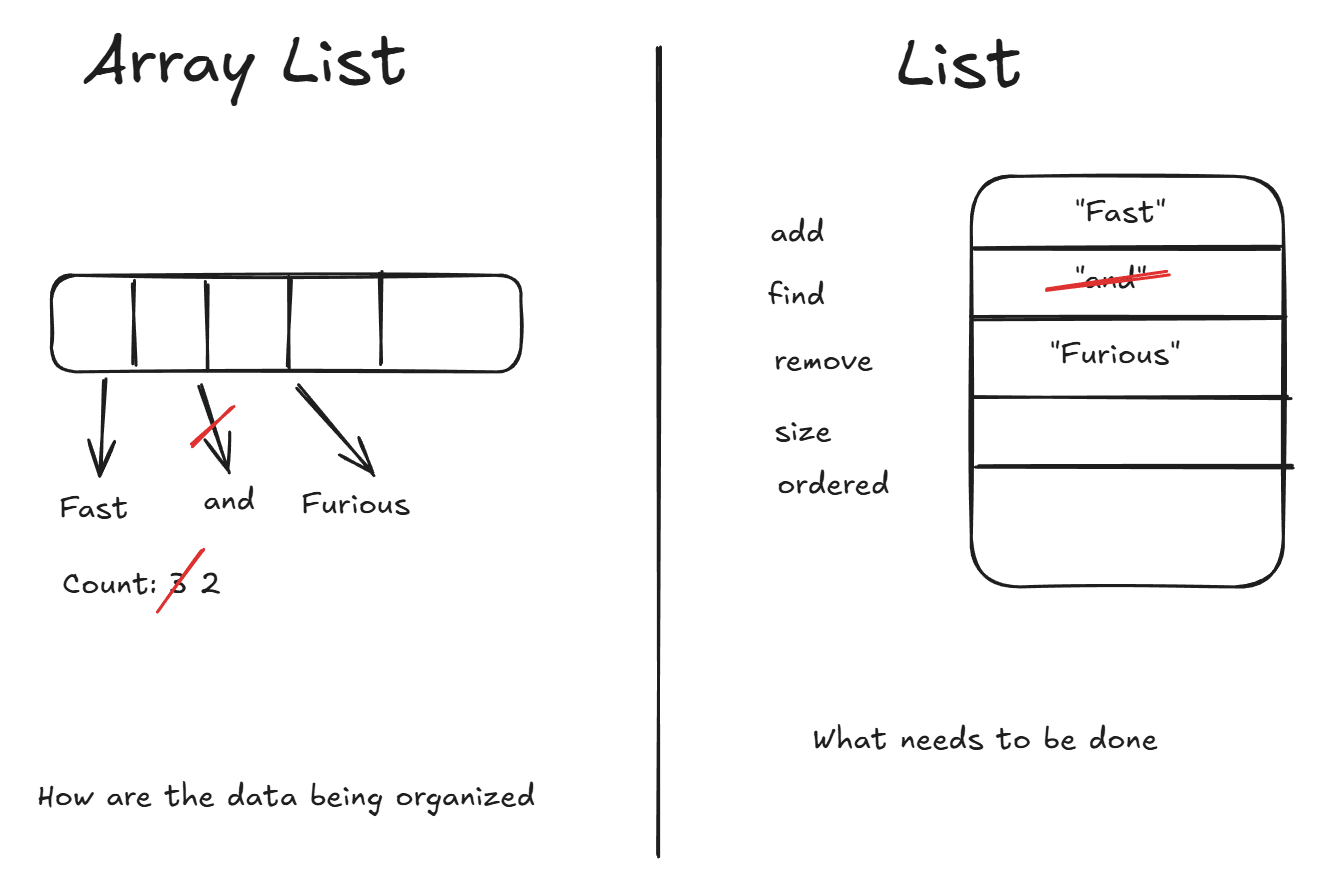
The Big Performance Rule
We cannot calculate or assume the time complexity profile of an Abstract Data Type function from its interface definition alone. The runtime behavior depends entirely on the concrete data structure selected by the engineer to back that interface.
Architectural Trade-off Evaluation
To see this architectural interaction in practice, observe how a single List ADT interface behaves under different backing implementations:
| Target Operational Environment | Selected Implementation Backbone | Resulting Big-O Performance Shift |
|---|---|---|
| High Frequency Index Reading | Array List | Random Access: via simple index offsets. Front Insertion: due to sequential cell shifting. |
| High Frequency Edge Modifications | Doubly Linked List | Random Access: due to pointer-chasing traversals. Front Insertion: via simple pointer swaps. |