Overview
Foundational definitions and the generic search procedure underlying every graph traversal algorithm in this vault. Depth First Search (DFS), Breadth First Search (BFS), and Explore are each a specific choice of data structure for the frontier in the Graph Search algorithm below.
Foundational Concepts
Graphs
A graph is specified by nodes and edges:
Directed edge: — an edge from to .
Graph Representations
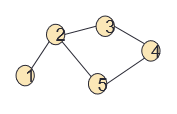
| Adjacency Matrix | Adjacency List |
|---|---|
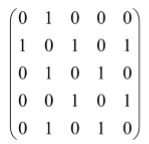 | 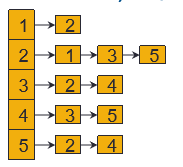 |
Adjacency Matrix
A matrix :
Symmetric if is undirected.
- PRO: check for an edge in time
- CON: uses up space
Adjacency List
For each node, there is a list of outgoing edges.
- PRO: just space
- PRO: easily iterate through a node’s neighbors
- CON: check for an edge in time
Graph Search
Graph Search is a core foundational outline of most graph algorithms, serving as a template for algorithms such as DFS, BFS, Dijkstra’s, etc.
- Instance: a graph and a starting vertex
- Output: a list of all vertices reachable from by a directed path in
At each point in a graph search algorithm, the vertices are partitioned into:
- : explored
- : frontier
- : unreached
Pseudocode
Algorithm 41 Graph Search
procedure GraphSearch()
= empty, = ,
while is not empty do
Pick in
for all do
if or then
move from to
move from to
return X
Implementing , , is a set: Array of Booleans indexed by vertex
- Test Membership:
- Insert:
is a set: Stack or Queue + Array of Booleans
- Find and Delete (Pop, Dequeue, Flip Boolean):
- Test Membership:
- Insert (Push, Enqueue, Flip Boolean):
is a set: Array of Booleans
- Test Membership:
- Delete:
Choosing = stack gives Depth First Search (DFS) / Explore; choosing = queue gives Breadth First Search (BFS).
Runtime Analysis
Since each is added to at most once, each is also deleted from at most once:
Correctness
If , then there is a path from to :
- Loop Invariant: after the iteration of the while loop, every element of or is reachable from in .
- Base Case: before the loop, is empty and .
- Inductive Hypothesis: suppose the loop invariant is true after iterations.
- Inductive Step:
- Pick a vertex in .
- Move all neighbors of into if they’re in — if there’s a path from to and an edge , then there’s a path from to .
- Move from to — by the IH, there is a path from to .
- Thus, it remains true that all elements of and are reachable from .
If by the end of the algorithm, then there is not a path from to :
- Suppose by contradiction that there is a vertex reachable from that is not in . Then there is a path from to .
- Let be the last vertex in the path that is in , and be the next vertex after in the path.
- Then must have been in at some point. When was picked from , must have been moved from to . And down the line, must have been moved from to — contradicting that .
Conclusion: since both directions hold — there is a path from to — the algorithm correctly computes exactly the set of vertices reachable from .
Notes in This Section
| Note | Description |
|---|---|
| Graph Algorithms Summary | A quick, notesheet-style overview of Graph Algorithms |
| Depth First Search (DFS) | Graph Search with = stack (via recursion), run over all vertices to cover disconnected components |
| Explore | The low-level, single-component recursive implementation of Graph Search with = stack |
| Breadth First Search (BFS) | Graph Search with = queue; guarantees shortest paths on unweighted graphs |
| Dijkstra’s Algorithm | Graph Search with = priority queue keyed by cumulative distance; handles weighted graphs (non-negative weights) |
| Prim’s Algorithm | Same loop shape as Dijkstra’s, but is keyed by single-edge cost to build a minimum spanning tree instead |
| Kruskal’s Algorithm | A different greedy MST approach — sorts all edges globally and uses Disjoint Sets & Up-Trees instead of a frontier-based search |
| Strongly Connected Components (SCC) | Two-pass DFS (with a reversed graph) that decomposes a directed graph into its strongly connected components |
| A-Star Search | Graph Search with = priority queue keyed by cumulative distance distance away from goal; handles weighted graphs (non-negative) and more efficient compared to Dijkstra’s |