ABSTRACT
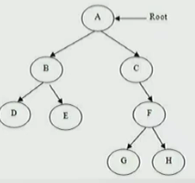
A rooted tree is a specific type of Directed Acyclic Graph (DAG) where one vertex is designated as the root. It serves as the fundamental structure for hierarchical data representation.
Structure and Properties
In a rooted tree:
- Root: The source vertex. It has an in-degree of 0 (no incoming edges).
- Internal Vertices & Leaves: Every vertex other than the root has exactly one incoming edge from its parent.
- Directionality: Edges are directed away from the root toward the leaves.
- Parent Function: For any vertex (except the root), denotes its unique parent.
Height
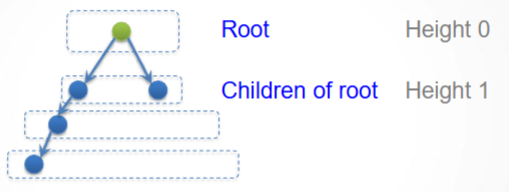
The height of a vertex is the length of the unique path from the root to :
- The height of the tree is defined as for all in the tree.
Binary Tree
A binary tree is a rooted tree where each vertex has at most two children, typically identified as the left child and the right child.
Capacity and Limits
- Maximum Vertices: A tree of height can contain at most vertices.
- Maximum Height: For vertices, the height is (a degenerate tree or “line”).
- Minimum Height: To keep operations efficient, we aim for a height of:
Binary Search Tree (BST)
A BST is a binary tree that maintains a specific ordering property to allow for fast lookups, insertions, and deletions.
The BST Property
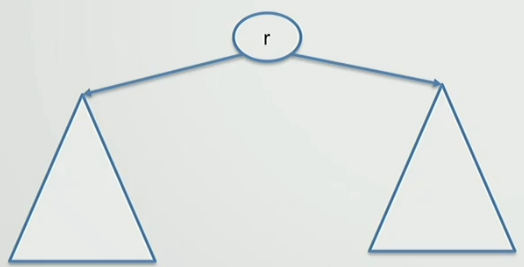
For any node :
- All values in the left subtree of are .
- All values in the right subtree of are .
Operations
- Search: Compare the target with the current node; move left if smaller, right if larger. Repeat until found or a
NILpointer is reached. - Insertion: Follow the search logic until a
NILposition is found, then attach the new node as a leaf. - Deletion:
- Leaf: Remove the node and set the parent’s pointer to
NIL. - Internal Node: Find a successor (usually the smallest value in the right subtree) to replace the deleted node, then re-link the subtrees.
- Leaf: Remove the node and set the parent’s pointer to
Performance Analysis
The efficiency of a BST depends entirely on its height. If the tree is balanced, operations are logarithmic. If it is unbalanced (skewed), performance degrades to linear.
| Operation | Array (Unsorted) | BST (Balanced) | BST (Worst Case/Skewed) |
|---|---|---|---|
| Search | |||
| Insert | |||
| Delete |
Self-Balancing Trees
To prevent the “line” scenario and ensure performance, various self-balancing algorithms adjust the tree structure during insertion and deletion:
- AVL Tree: Maintains height balance strictly.
- Red-Black Tree: Uses color properties to ensure the path to the furthest leaf is no more than twice the path to the nearest.
- Splay Tree: Moves frequently accessed nodes closer to the root.
- 2-3 Tree: A non-binary approach where nodes can have multiple keys and children.
Related Notes
- Graphs: Rooted trees are a specialized subset of directed graphs.
- Graph Reachability: Trees are a type of Directed Acyclic Graph (DAG) where every node is reachable from the root.
- Binary Search: BSTs are the dynamic data structure implementation of the binary search principle.
- Recursive Algorithms: Most tree operations, including height calculation and BST traversal, are defined and analyzed using recursion.
- Huffman Code: Uses the rooted tree structure to create optimal prefix-free variable-length codes.