ABSTRACT
Graph reachability focuses on the ability to travel between vertices using edges. This note covers the vocabulary of connectivity, the fundamental graph search algorithm, and the specialized properties of Directed Acyclic Graphs (DAGs).
Degrees and Handshaking
Understanding reachability starts with the density of connections (degrees).
Undirected Degrees
The degree () of a vertex is the number of edges incident to it. A self-loop contributes twice to the degree.
- Handshake Theorem: In any undirected graph, the sum of all degrees is exactly twice the number of edges:
NOTE
Every graph has an even number of odd-degree vertices.
Directed Degrees
- Indegree(v): Number of edges entering .
- Outdegree(v): Number of edges leaving .
- Summation: .
Connectivity Vocabulary
- Walk
- A sequence of edges that begins at a vertex of a graph and travels from vertex to vertex along edges of the graph
- Describes a route from one vertex to another
- Allowed to repeat vertices and edges
- Trail (non-simple path)
- A walk that doesn’t repeat edges
- Path (simple path)
- A walk that doesn’t repeat edges or vertices
- Trivial Path
- Every vertex has a trivial path to itself
- A walk that stays at the vertex itself
- Length of walk/path/trail
- Number of edges the connection have
- trivial path has length
- Closed Walk
- A walk that starts and ends at the same vertex
- Circuit (closed trail)
- A trail that starts and ends at the same vertex
- length greater than
- Cycle (closed path)
- A path that starts and ends at the same vertex
- length greater than
- Loop (self-loop)
- An edge from a vertex to itself
Summary Comparison
| Type | Repeats Edges? | Repeats Vertices? | Closed? |
|---|---|---|---|
| Walk | Yes | Yes | Optional |
| Trail | No | Yes | Optional |
| Path | No | No | No |
| Closed Walk | Yes | Yes | Yes |
| Circuit | No | Yes | Yes |
| Cycle | No | No | Yes |
Graph Search Algorithm
To find all vertices reachable from a starting vertex , we partition the graph into three sets:
- Explored (X): Vertices we have finished processing.
- Frontier (F): Vertices discovered but not yet processed.
- Unreached (U): Vertices not yet seen.
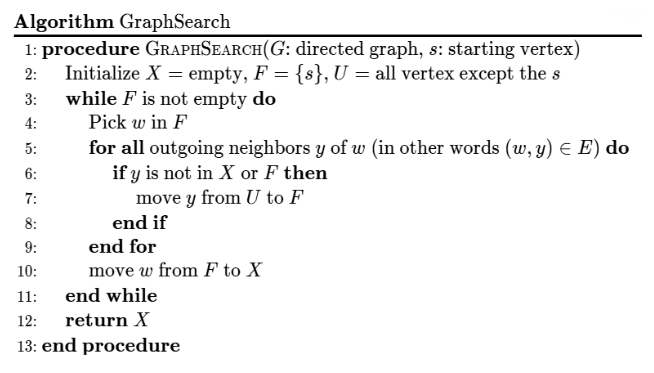
The data structure used for the Frontier (F) determines the search strategy:
- Stack: Depth First Search (DFS)
- Queue: Breadth First Search (BFS)
- Priority Queue: Dijkstra’s Algorithm
Connectedness
Undirected Graphs
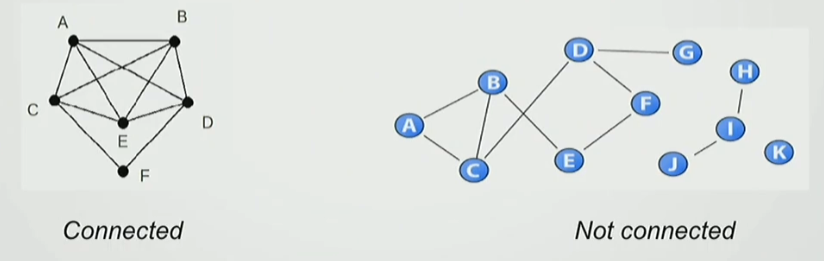
A graph is connected if a path exists between every pair of vertices.
- Connected Component: A maximal subgraph where all vertices are connected to each other.
Directed Graphs
Reachability is more nuanced in directed systems:
- Strongly Connected: A path exists from to AND from to for all pairs.
- Weakly Connected: The graph is connected if all edge directions are ignored.
WARNING
We cannot say that a directed graph is connected or disconnected → needs to be more specific

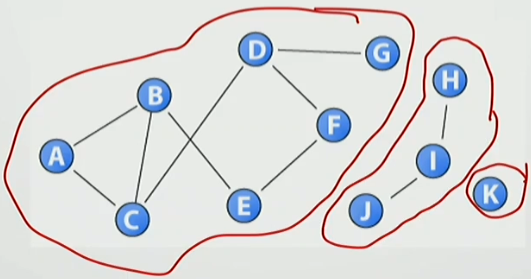
Connected Components
Disconnected graphs can be broken up into pieces where each is connected Each (maximal) connected piece of the graph is a connected component
NOTE
maximal means that if you can make it any larger, it will lose the given (in this case “connected”) property
Hamiltonian Path
Visits every vertex exactly once. (NP-Hard to find).
Eulerian Trails and Circuits
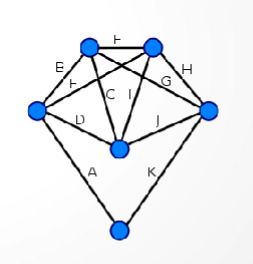
An Eulerian trail is a trail that visits every edge in the graph exactly once.
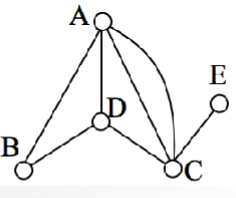
If the trail starts and ends at the same vertex, it is called an Eulerian circuit.
The Eulerian Theorem
An undirected graph (without isolated vertices) has an Eulerian trail if and only if is connected and has at most 2 odd-degree vertices.
IMPORTANT
From the Handshake Lemma (Sum of Degrees), every graph must contain an even number of odd-degree vertices. Therefore, a graph with an Eulerian trail will have exactly 0 or 2 odd-degree vertices.
Summary of Conditions:
- Eulerian Circuit: All vertices must have an even degree.
- Eulerian Trail (not a circuit): Exactly two vertices have an odd degree (these serve as the start and end points).
Fleury’s Algorithm (Proof by Construction)
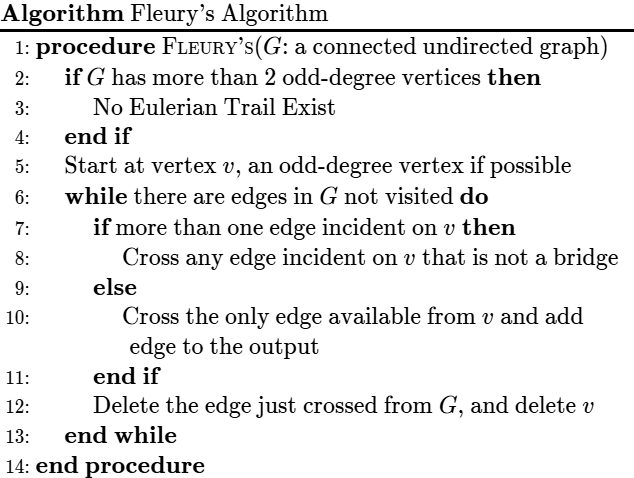
Fleury’s Algorithm provides a way to construct an Eulerian trail by following a simple rule: Do not cross a bridge unless you have no other choice.
Definitions
- Bridge: An edge which, if removed, would cause the graph to become disconnected.
- Logic: In an Eulerian trail, you must visit every edge on one side of a bridge before crossing it, because once you cross, there is no way to return to the previous component.
Step-by-Step Example
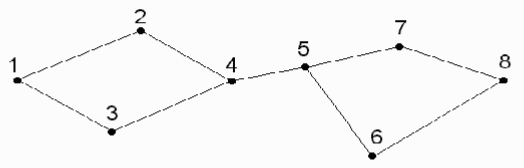
Suppose we have a graph where vertex 4 has an odd degree:
- Start: Begin at a vertex with an odd degree (e.g., vertex 4).
- Select Edge: Choose an edge to travel. If you have multiple options, prioritize edges that are not bridges.
- Example: From vertex 4, moving to 2 or 3 is better than moving to 5 if the edge (4,5) is a bridge that isolates a section of the graph you haven’t visited yet.
- Traverse and Remove: Move across the chosen edge and “remove” it from the graph (or mark it as used).
- Repeat: Continue until all edges are traversed.
Comparison: Eulerian vs. Hamiltonian
| Property | Eulerian Trail | Hamiltonian Path |
|---|---|---|
| Focus | Every edge exactly once | Every vertex exactly once |
| Requirement | Degree parity (Even/Odd count) | No simple degree-based rule |
| Complexity | Easy to find () | Hard to find (NP-Complete) |
Directed Acyclic Graphs (DAG)
A directed graph with no cycles. DAGs are essential for representing dependencies.
Topological Ordering (Linearization)
An ordered list of vertices where for every edge , appears before in the list.
- Only possible if the graph is a DAG.
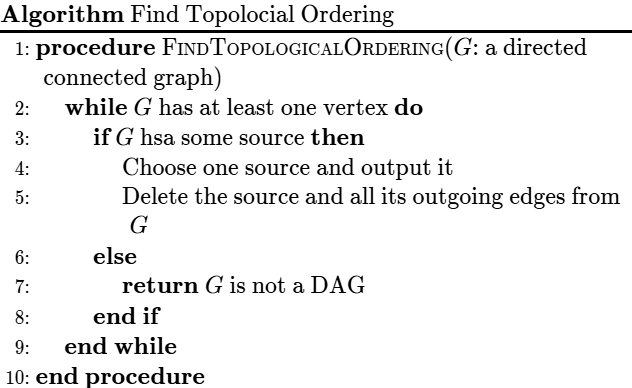
- Algorithm: Repeatedly remove a source (vertex with Indegree 0) and add it to the list.
Sources of a DAG
- Vertices with no incoming edges are called sources → and
- Vertices with no outgoing edges are called sinks → and
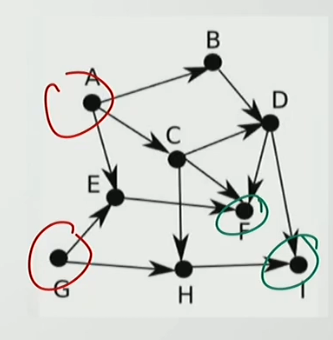
IMPORTANT
Every finite DAG must have at least one source and at least one sink.
Related Notes
- Graphs: The fundamental definition of vertices and edges.
- Directed Tree (Rooted Tree): A rooted tree is a special case of a DAG with exactly one source.
- Asymptotic Notation: Used to analyze the complexity of BFS and DFS.
- Recursive Algorithms: DFS is typically implemented as a recursive function.