ABSTRACT
An undirected tree is a connected graph that contains no cycles. This structural simplicity leads to unique properties regarding edges, vertices, and paths, making them foundational in both graph theory and algorithm design.
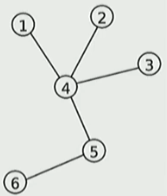
Facts and Definitions
- Leaves: Vertices of degree 1. If the tree consists of only a single vertex, that vertex is considered to have a degree of 0.
- Forest: A set or collection of disjoint trees. A forest is acyclic but not necessarily connected.
- Unique Path Property: Between any pair of distinct vertices in a tree, there is exactly one simple path.
The Existence of Leaves
A tree with vertices will always have at least one vertex of degree 1 (a leaf).
Proof by Contradiction: Suppose there exists a tree with vertices where every vertex has a degree of at least 2.
- Start at an arbitrary vertex and move to a neighbor .
- Since has a degree , there must be an edge to a vertex other than .
- Continue this process to form a walk: .
- By the Pigeonhole Principle, in a walk of vertices where there are only unique vertices available, at least one vertex must be repeated.
- The repetition of a vertex in this walk implies the existence of a cycle, which contradicts the definition of a tree.
NOTE
Pigeonhole Principle
If you have more items (“pigeons”) than containers (“pigeonholes”), at least one container must contain more than one item.
The Tree Edge Theorem
Every tree with vertices has exactly edges. Proof by Induction:
- Base Case: If a tree has vertex, it has edges. This is true by definition.
- Induction Hypothesis: Suppose that all trees with vertices have edges for some .
- Induction Step: Consider an arbitrary tree with vertices.
- From our previous proof, we know must have at least one leaf vertex .
- Remove the leaf vertex and its single incident edge.
- The remaining graph is still connected and acyclic, meaning it is a tree with vertices.
- By the Induction Hypothesis, has edges.
- Re-attaching the leaf and its edge to returns us to the original graph .
- Total edges in edges.
Summary of Properties
| Property | Tree (n vertices) | Forest (k trees, n vertices) |
|---|---|---|
| Connectivity | Connected | Disjoint Components |
| Acyclic | Yes | Yes |
| Edge Count | ||
| Simple Paths | 1 between any two nodes | Max 1 (0 if in different trees) |
Related Notes
- Graphs: Trees are a specific subclass of undirected graphs.
- Directed Tree (Rooted Tree): Adding direction and a root to an undirected tree creates a hierarchy.
- Graph Reachability: The unique path property ensures that reachability in a tree is simple and unambiguous.
- Recursive Proofs: Induction is the primary tool used to prove the structural properties of trees.