IMPORTANT
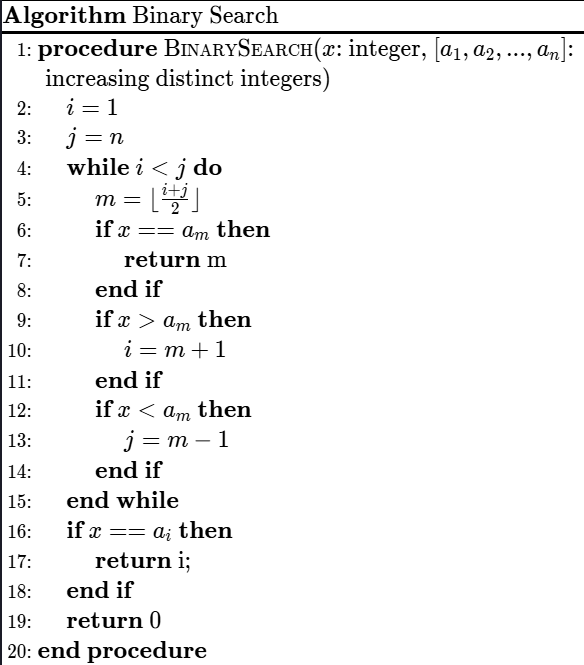
Binary Search is only applicable if the list is sorted. It uses the “Decrease and Conquer” strategy to eliminate half of the search space with every comparison.
The Procedure
- Divide: Identify the mid-point of the current list. Divide the search space into two conceptual halves:
- — The left half.
- — The right half.
- Compare: Check the target element against the value at the mid-point:
- Smaller: Search the left half.
- Greater: Search the right half.
- Equal: Return the current position (Target found).
- Recurse: Continue splitting and searching until only one element remains.
- Terminate: If the search space is exhausted without a match, report that the item is not found.
Time Analysis
The efficiency of Binary Search comes from how quickly it shrinks the input. Each “split” reduces the remaining work by half.
1. Comparison Scaling
As shown in the table below, as the input size roughly doubles, the number of required comparisons only increases by 1.
| n | # of splits | # of comparisons (k) |
|---|---|---|
| 1 | 0 | 1 |
| 3 | 1 | 2 |
| 7 | 2 | 3 |
| 15 | 3 | 4 |
| 31 | 4 | 5 |
2. Deriving the Complexity
In general, if the list size is , you need comparisons. To find the runtime in terms of , we solve for :
\begin{align*} n &\leq 2^k - 1 \\ n+1 &\leq 2^k \\ \log_{2}(n+1) &\leq k \\ k &= \boxed{\lceil\log_{2}(n+1)\rceil} \end{align*}$$ > [!CHECK] > > > This confirms that Binary Search grows at a Logarithmic rate, $O(\log n)$, making it incredibly efficient for large datasets. ![[Pasted image 20251106180059.png]] --- ## Formal Proof (Strong Induction) **Claim:** Binary Search correctly finds the target in a sorted list of size $n$. - **Base Case ($n=1$):** The mid-point is the only element. The algorithm checks it and correctly returns the index or "not found." - **Inductive Hypothesis:** Assume Binary Search is correct for all sorted lists of size $m < n$. - **Inductive Step:** For a list of size $n$, the algorithm compares the mid-point. - If equal, it returns correctly. - If not equal, it calls itself on a sub-list of size roughly $n/2$. - Since $n/2 < n$, the **Inductive Hypothesis** applies, and the sub-search is guaranteed to be correct. --- ## Related Notes - [[Linear Search vs Binary Search]] — Visualizing why $O(\log n)$ is asymptotically faster. - [[Merge Sort]] — The most common way to ensure a list is sorted before searching. - [[Asymptotic Notation]] — More on the $O$ notation used here.