ABSTRACT
The choice between Linear and Binary search is a trade-off between data preparation and execution speed. While Linear Search is flexible, Binary Search is asymptotically faster, meaning its efficiency advantage grows exponentially as the dataset scales.
Comparative Analysis
1. Linear Search
- Mechanism: Compares the target value with every element in the list, one by one.
- Requirement: Works on any data (sorted or unsorted).
- Efficiency: . The time taken grows in a 1:1 ratio with the input size.
2. Binary Search
- Mechanism: Leverages the sorting property to eliminate half of the remaining list with every single comparison.
- Requirement: Data must be sorted.
- Efficiency: . The time taken grows extremely slowly as the input size increases.
Visualizing the Gap
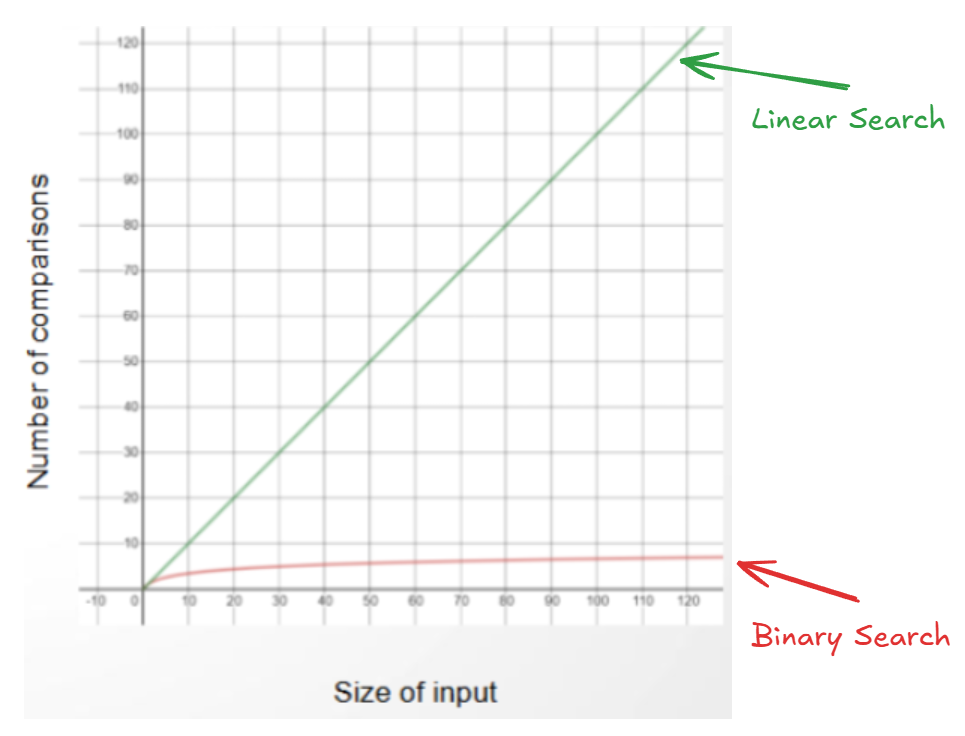
As shown in the graph, Binary Search is not just faster; its runtime becomes a smaller and smaller fraction of the Linear Search runtime as grows.
INFO
Mathematically, we say Binary Search is asymptotically faster than Linear Search. Even if Linear Search was running on a supercomputer and Binary Search on a calculator, for a large enough , Binary Search will always win.
Summary Table
| Feature | Linear Search | Binary Search |
|---|---|---|
| Recurrence | ||
| Complexity | ||
| Best Case | (First element) | (Middle element) |
| Data Order | Unsorted | Must be Sorted |
Related Notes
- Asymptotic Notation – Understanding the math behind the “Gap.”
- Merge Sort – Often used as a prerequisite to enable Binary Search.
- Lower Bounds for Searching – Why we can’t do better than for comparisons.