ABSTRACT
Merge Sort is a comparison-based sorting algorithm that uses the Divide and Conquer strategy to achieve a guaranteed time complexity. It relies on the fact that merging two sorted lists is significantly more efficient () than sorting an unsorted one from scratch.
The Strategy
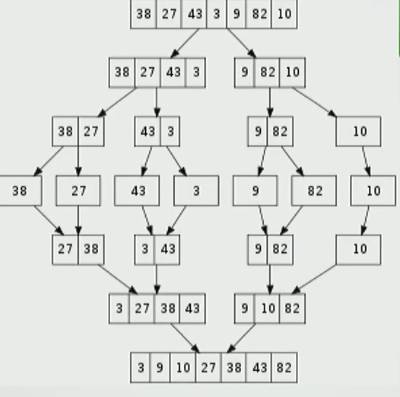
- Divide: Split the unsorted list into two sub-lists of roughly size.
- Recursively Sort: Call
MergeSorton both sub-lists until base cases are reached. - Conquer (Merge): Combine the two sorted sub-lists into one sorted result using the
RMergehelper.
Formal Proof of Correctness
Part 1: The Merge Helper (RMerge)
We prove the helper function using Regular Induction because the total number of elements () decreases by exactly 1 in each recursive call.
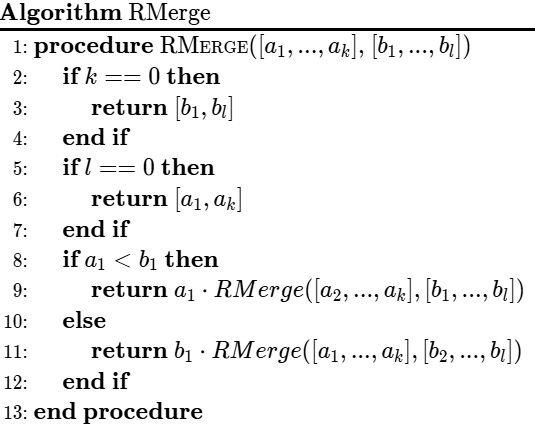
- Base Case: If both lists are empty (), it returns an empty list, which is sorted.
- Inductive Hypothesis: Assume
RMergecorrectly merges any two sorted lists with combined size . - Inductive Step: For a combined size , we compare the heads (). The smaller element is prepended to the result of
RMergecalled on the remaining elements. By the hypothesis, the sub-call is correct; thus, the final list is sorted.
Part 2: The Main Algorithm
We prove MergeSort using Strong Induction because each subsequent call halves the input size ().
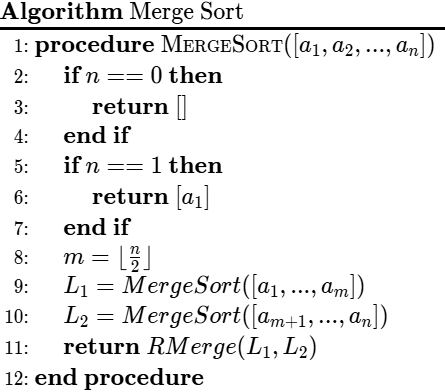
- Base Case:
- : Returns an empty list (trivially true).
- : Returns , a trivially sorted list containing all elements.
- Inductive Hypothesis: Assume
MergeSortcorrectly sorts all lists with elements for any , where . - Inductive Step:
- Divide the list of size into two halves of size and .
- By the Strong Inductive Hypothesis, since both halves have size , the recursive calls and return correctly sorted lists.
- By the correctness of
RMerge, results in a sorted list of all elements.
Time Analysis
1. Recurrence Extraction
Let be the runtime of MergeSort on a list of size .
Since , the expression is:
2. Method A: Master Theorem
Comparing to :
- (number of recursive calls)
- (factor by which size is reduced)
- (exponent of non-recursive work )
Comparison: and .
Since , we use Case 2:
3. Method B: Unraveling (Iteration)
We substitute the recurrence into itself to find the pattern:
To reach the base case , we set :
Related Notes
- Fast Multiplication – Another application of D&C.
- Master Theorem – Deep dive into the cases used here.
- Recursive Proofs – General framework for Strong vs. Regular Induction.