ABSTRACT
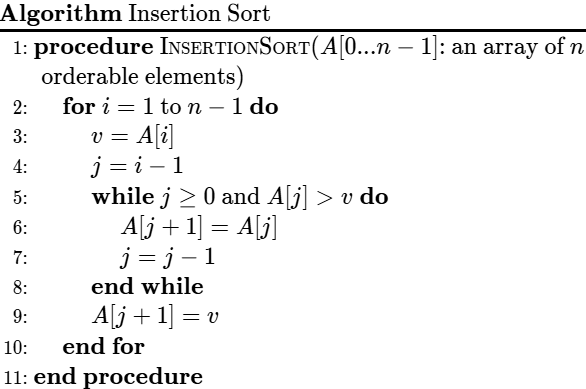
Insertion Sort is an intuitive, comparison-based sorting algorithm that builds the final sorted list one element at a time. It is analogous to the way most people sort a hand of playing cards: you take one card at a time and “insert” it into its correct relative position among the cards already in your hand.
The Strategy
For a list :
- Divide: Imagine the list is split into a “sorted” side (left) and an “unsorted” side (right). Initially, the first element is considered sorted.
- Pick: Take the first element from the unsorted side (the “key”).
- Shift: Compare the key with elements in the sorted side from right to left. Shift elements that are larger than the key one position to the right.
- Insert: Once you find the correct spot (or reach the beginning), drop the key into the empty slot.
- Repeat: Continue until the unsorted side is empty.
Proof of Correctness (Loop Invariant)
- Invariant: At the start of each iteration , the sub-list consists of the original elements but in sorted order.
- Base Case: When , the sub-list has only one element, which is trivially sorted.
- Maintenance: If is sorted, the algorithm finds the correct position for by shifting larger elements. After inserting , the sub-list is sorted.
- Termination: When reaches , the entire list is sorted.
Time Analysis
On a list of length :
1. Best Case ()
- Scenario: The list is already sorted.
- Logic: The algorithm only performs one comparison for each element and zero shifts. It realizes immediately that each element is already in the correct place.
2. Worst Case ()
- Scenario: The list is in reverse order.
- Logic: For every new element, the algorithm must compare and shift against every element already in the sorted portion.
- Formula: .
3. Average Case ()
- Logic: On average, each element will be compared/shifted with half of the sorted sub-list.
Pros and Cons
| Strengths | Weaknesses |
|---|---|
| Adaptive: Very fast for lists that are already “nearly sorted.” | Inefficient () for large, randomly ordered datasets. |
| Stable: Does not change the relative order of equal elements. | Performs many “shifts” (writes), though fewer than Bubble Sort. |
| Online: Can sort a list as it receives it (streaming data). |
Related Notes
- Bubble Sort – Another sort, but usually less efficient than Insertion Sort.
- Selection Sort (Min Sort) – but performs fewer swaps (at most ).
- Merge Sort – The alternative for larger datasets.