ABSTRACT
A Random Variable is a formal way to quantify outcomes. It is a function that maps every possible outcome in a sample space to a real number, allowing us to perform mathematical operations like averaging and summation on probabilistic events.
Definition
A random variable is a function from the sample space to the set of real numbers :
The Distribution
The distribution of a random variable (specifically the Probability Mass Function for discrete variables) is the function that assigns a probability to each possible value :
TIP
Think of the distribution as the probability that an outcome results in a specific random variable value.
Expectation
The expectation (), also known as the average or expected value, is the center of mass of the distribution. It can be calculated in two ways:
-
Summing over outcomes:
-
Summing over values (The Distribution Method):
Example: Sum of Two Dice
Let be the random variable representing the sum of the pips of 2 fair dice.
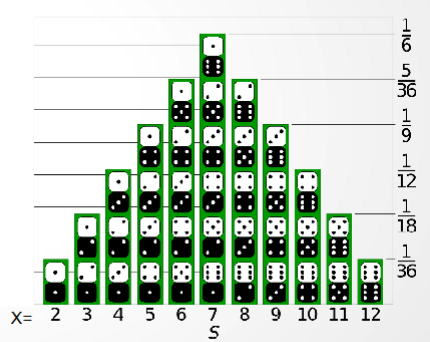
- Mapping:
- Distribution: The likelihood of each sum varies based on the number of ways to achieve it.
Types of Random Variables
| Type | Description | Example |
|---|---|---|
| Discrete | Values are countable (integers). | Number of heads in 10 flips. |
| Continuous | Values exist on a continuum (intervals). | The exact height of a person. |
| Indicator | Takes only values 0 or 1. | if a die is even, otherwise. |
Related Notes
- Distributions: High-level overview of how probability mass is spread.
- Expected Value: Deeper dive into the properties of .
- Linearity of Expectation: A method to find the expectation of a sum of random variables without knowing their joint distribution.
- Binomial Distribution: A specific, famous discrete random variable distribution.