1. Sets
A set is a group of objects represented as a unit.
- Elements: The objects within a set. The symbols and denote membership and non-membership.
- Subsets: means every member of is also in .
- Proper Subset: means but .
- Infinite Sets: Sets with infinitely many elements, often denoted with ""
- Natural numbers →
- Integers →
- Special Sets:
- Empty Set (): A set with zero members.
- Multiset: A set where the number of occurrences of an element matters.
- Set Operations:
- Union (): Combines all elements from both sets.
- Intersection (): Elements common to both sets.
- Complement (): All elements under consideration that are not in A.
| Union | Intersection |
|---|---|
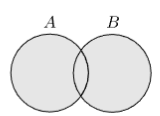 | 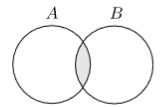 |
2. Sequences and Tuples
A sequence is a list of objects in a specific order, designated by parentheses.
- Order and Repetition: Unlike sets, both order and repetition matter in sequences
- Tuples: Finite sequences. A -tuple has elements; a 2-tuple is an ordered pair.
- Power Set: The set of all subsets of a given set.
3. Functions and Relations
- Functions: A rule that maps an input (from a domain ) to exactly one output (from a range or codomain).
- Relations: A set of ordered pairs representing a property between elements (e.g., “less than” on integers).
- Equivalence Relation: A special type of relation that is reflexive, symmetric, and transitive.
4. Graphs
A graph consists of a set of nodes (vertices) and edges connecting them.
- Directed vs. Undirected: Directed edges have an orientation ; undirected edges do not.
- Paths and Cycles: A path is a sequence of nodes connected by edges; a cycle is a path that starts and ends at the same node.
- Connectedness: An undirected graph is connected if every pair of nodes has a path between them.
5. Strings and Languages
- Alphabet (): Any finite, non-empty set of symbols.
- String: A finite sequence of symbols from an alphabet.
- Length: The number of symbols in a string.
- Empty String (): A string of length 0.
- Language: A set of strings.
6. Boolean Logic
A system for manipulating the values TRUE and FALSE (often represented as 1 and 0).
- Operations:
- Negation (): NOT.
- Conjunction (): AND.
- Disjunction (): OR.
- Implication (): IF-THEN.