Abstract
In a graph, there consists of many types of edges that connects from node to node
Tree Edge (Forward Edge)
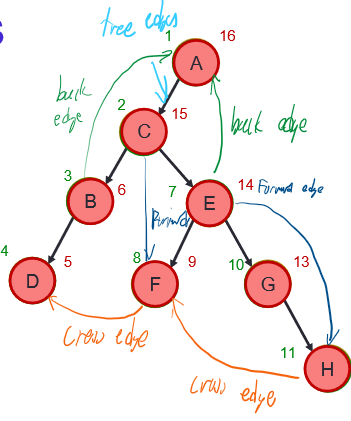
A solid edge included in the DFS Output Tree, in other words, edges that have been visited by Depth First Search (DFS) or Explore. This edge leads to a descendent
Note
Although Tree Edge and Forward Edge are similar in both directing an edge forward down the graph, the Forward Edge specifies any edge that connects to a node that may require 2 or more edges in the tree to reach said node
Pre/Post Number Determination
is a tree/forward edge when
Back Edge
An edge that is not included in the DFS Output Tree that leads to an ancestor
Note
Back Edge is slightly different in directed and undirected graphs
Back edges in an undirected graph that has been explored are edges in that are not in the DFS tree of but connects vertices in the DFS output tree.
Removing a back edge will not disconnect the graph
Removing an edge that is in a cycle will not disconnect an undirected graph and removing an edge that is not in a cycle will disconnect an undirected graph
Graph Cycles Theorem
An undirected connected graph has a cycle if and only if it’s DFS output tree has a back edge.
Proof:
- If has a cycle → DFS output has a back edge
- If DFS has a back edge → has a cycle
Pre/Post Number Determination
is a back edge when
Cross Edge
An edge that is not included in the DFS Output Tree that leads to neither and ancestor nor descendent
Pre/Post Number Determination
is a cross edge when
Example
Given this graph:
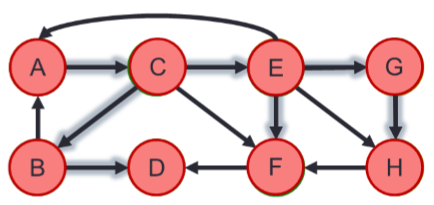
Run Depth First Search (DFS) starting from vertex , we get the following output:
| cc | post | prev | pre | |
|---|---|---|---|---|
| A | 1 | 16 | 1 | |
| B | 1 | 6 | 3 | C |
| C | 1 | 15 | 2 | A |
| D | 1 | 5 | 4 | B |
| E | 1 | 14 | 7 | C |
| F | 1 | 9 | 8 | E |
| G | 1 | 13 | 10 | E |
| H | 1 | 12 | 11 | G |
From this table, we find the following DFS Output Forest