ABSTRACT
The expected value () is the long-run average value of a random variable over many repetitions of an experiment. It is the probability-weighted average of all possible outcomes.
Formal Definition
The expectation of a random variable on a sample space can be calculated in two equivalent ways:
-
By Outcome: Summing over every individual outcome in the sample space .
-
By Value: Summing over every possible value that the random variable can take.
Examples
1. Rolling a Single Die
Let be the number showing on a fair six-sided die after one roll. Each outcome has a probability of .
2. Sum of Two Dice
Let be the random variable representing the sum of pips after rolling two fair dice. The possible values for range from to .
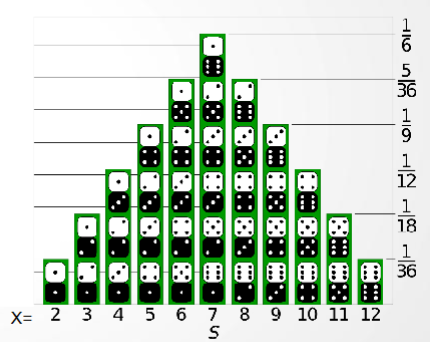
To find the expectation, we multiply each possible sum by its corresponding probability:
Properties and Applications
| Concept | Application |
|---|---|
| Linearity of Expectation | A shortcut for the two-dice problem: . |
| Conditional Expectation | Used when calculating the average outcome given that a certain event has already occurred. |
| Distributions | Every standard distribution (Binomial, Geometric, etc.) has a predefined formula for its expected value. |
Related Notes
- Random Variables Definition: Expected value is only defined for numerical random variables.
- Law of Total Expectation: A method for calculating by partitioning the sample space into cases.
- Case Analysis: Useful for finding the expected value of complex, multi-stage experiments.