ABSTRACT
An RST is a Treap where priorities are randomly generated upon insertion. This clever use of randomness simulates a random insertion order, successfully achieving an average-case time complexity of regardless of the actual order in which keys are provided.
1. The Treap (Tree + Heap)
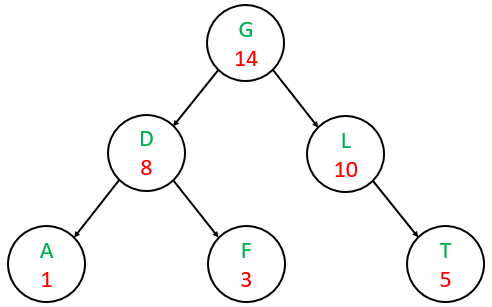
A Treap is a binary tree where each node has two attributes: a key and a priority. It must satisfy two simultaneous properties:
- BST Properties: The tree is ordered by keys (Left < Node < Right).
- Heap Properties: The tree is ordered by priorities (Parent priority > Child priority for a Max-Heap).
2. Fundamental Operations
Find
Since a RST is a valid BST, the find algorithm is identical to a standard BST.
- Complexity: , where is the tree height.
findalgorithm found here
Insertion
Insertion occurs in two distinct phases:
- BST Insertion: Insert the node based solely on its key as a leaf.
- Heap Fix (Bubble Up): While the node’s priority is greater than its parent’s, perform AVL Rotations to move the node up without violating the BST property.
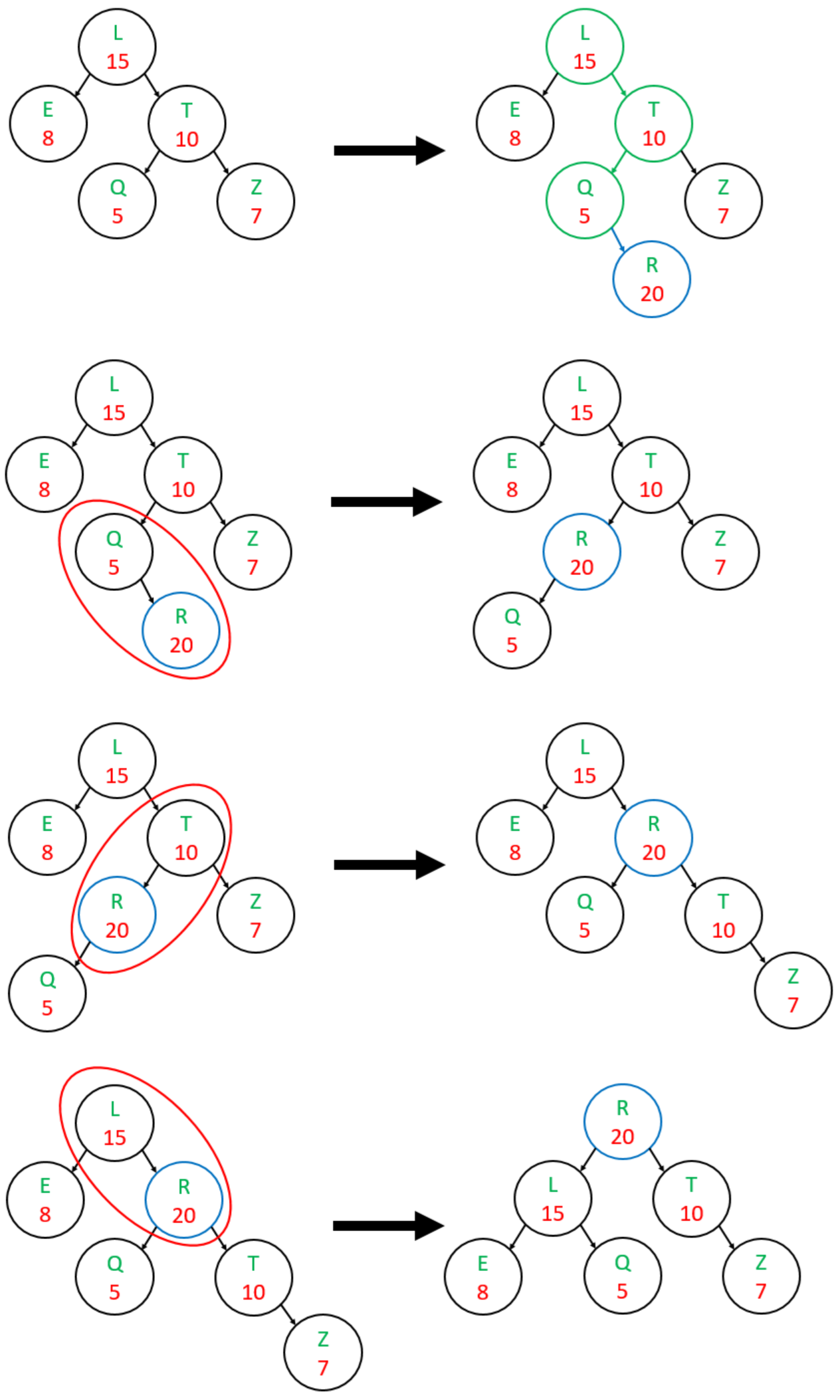
insert(key, priority):
    // Phase 1: Standard BST Insertion
    node = perform_BST_insertion(key, priority)

    // Phase 2: Bubble Up using Rotations
    while node != root and node.priority > node.parent.priority:
        if node == node.parent.leftChild:
            AVLRight(node.parent)
        else:
            AVLLeft(node.parent)
Removal
- BST Removal: Remove the node based on its key.
- Heap Fix (Trickle Down): If the successor moved into the position violates the Heap Property, use rotations to move it down until the property is restored.
3. The Tool: AVL Rotations
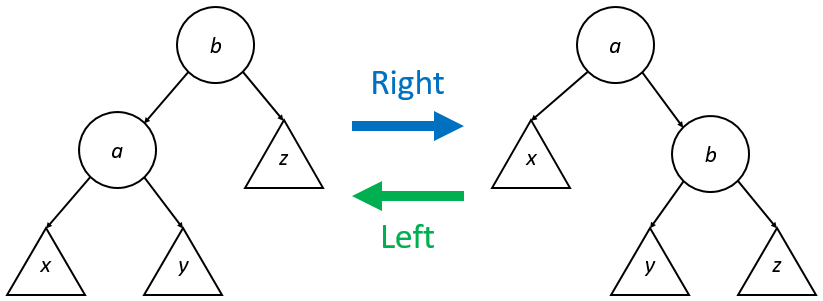
Rotations are constant-time operations that change the structure of the tree while preserving the relative sorted order of the keys.
| Rotation | Description |
|---|---|
| Right Rotation | Moves a left child into the parent’s position. Used when the left child has higher priority. |
| Left Rotation | Moves a right child into the parent’s position. Used when the right child has higher priority. |
AVLRight(b): // Perform a right AVL rotation on node b
    a = left child of b
    y = right child of a (or NULL if a does not have a right child)
    p = parent of b (or NULL if b does not have a parent)
    if p is not NULL and b is the right child of p:
        make a the right child of p
    otherwise, if p is not NULL and b is the left child of p:
        make a the left child of p
    make y the left child of b
    make b the right child of a

AVLLeft(a): // Perform a left AVL rotation on node a
    b = right child of a
    y = left child of b (or NULL if b does not have a left child)
    p = parent of a (or NULL if a does not have a parent)
    if p is not NULL and a is the right child of p:
        make b the right child of p
    otherwise, if p is not NULL and a is the left child of p:
        make b the left child of p
    make y the right child of a
    make a the left child of b
4. Why Use Randomness?
In a standard BST, if data is inserted in sorted order (1, 2, 3…), the tree becomes a linked list (). In an RST, we:
- Take the user’s key.
- Generate a random priority.
- Insert the pair into the Treap.
Because the priorities are random, the nodes “bubble up” into a topology that mimics a tree built from a random insertion order. This guarantees that the tree stays balanced on average, even if the keys themselves are sorted or patterned.
5. Performance Summary
| Case | Time Complexity |
|---|---|
| Average Case | |
| Worst Case |
NOTE
While the RST effectively fixes the average case, the worst-case remains (though it is statistically extremely unlikely). To guarantee in the worst case, we must look toward structures like the AVL Tree.