ABSTRACT
Conditional probability measures the likelihood of an event occurring given that another event has already occurred. This effectively restricts the sample space to only those outcomes where the second event is true, rescaling the probabilities accordingly.
The Formula
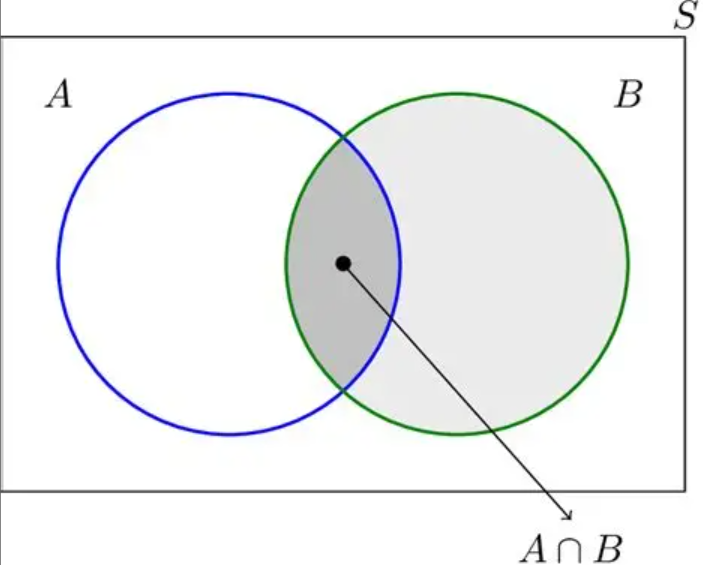
Suppose and are events, and . The probability of given is defined as:
- : The probability of given .
- : The probability of the intersection (both and occurring).
- : The probability of , which serves to rescale the scope of the probability to the new restricted sample space.
From this, we can also derive the Multiplication Rule:
Example: Two Dice
Consider rolling a fair blue die and a fair yellow die. What is the probability that the sum is 8 () given that both dice are even ()?
1. Identify the Events
-
Event (Condition): Both dice are even.
-
Possible outcomes:

-
.
-
-
Event (Intersection): The sum is 8 and both dice are even.
- Possible outcomes: .

- .
2. Calculate the Conditional Probability
Applying the formula:
Key Intuition
The probability of an event may change if you have additional information about the outcomes. In the example above, the unconditional probability of the sum being 8 is . However, knowing both dice are even increases that probability to (or ) because we have eliminated all “odd-sum” and “mixed-parity” possibilities that could not result in our specific even-sum condition.
Related Notes
- Independent Events: Events where , meaning the additional information does not change the likelihood.
- Bayes’ Theorem: A method for “reversing” conditional probabilities to find if you know .
- Law of Total Probability: Used to calculate the total probability of an event by summing its conditional probabilities across a partition.